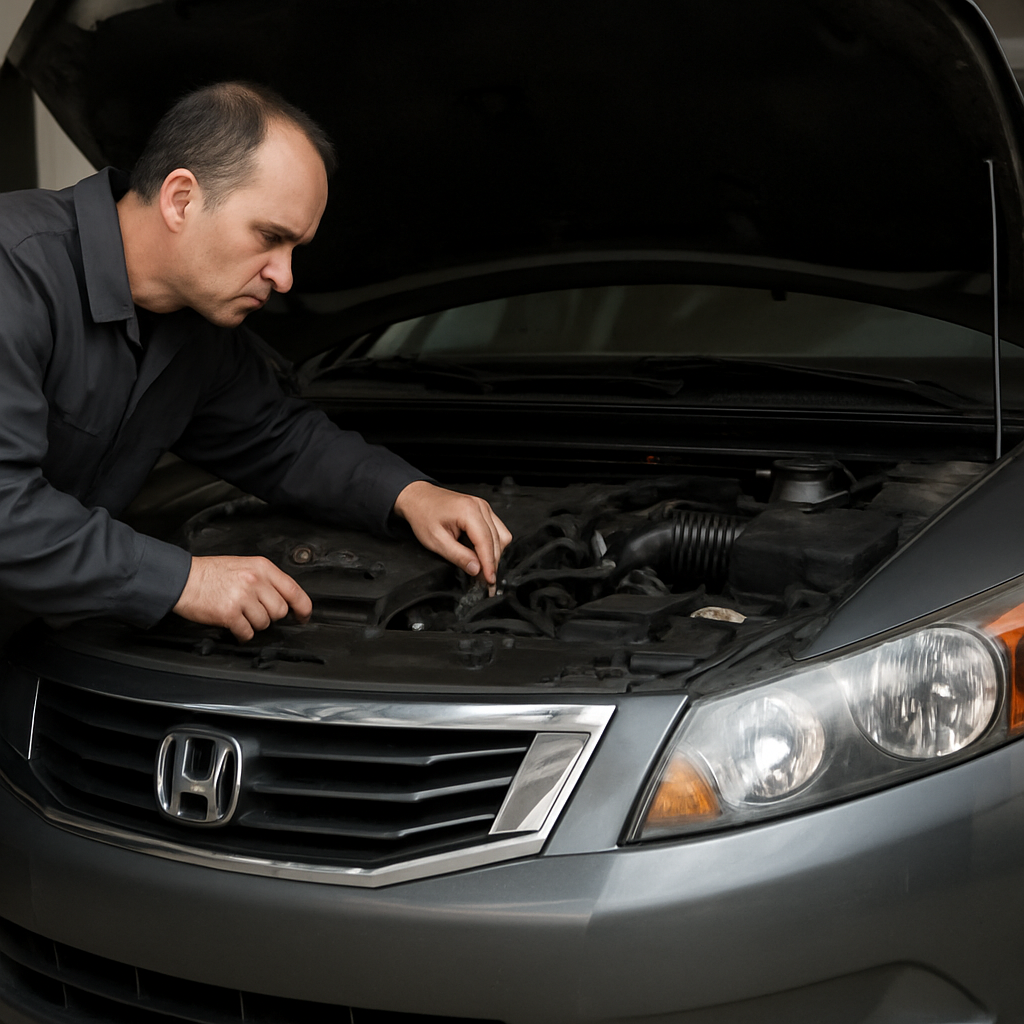
A rattling noise while driving a Honda Accord can come from several areas, including the engine, exhaust or heat-shield area, or an accessory belt or pulley. The sound alone cannot confirm which part, if any, has failed. When it occurs, where it seems to come from and how it changes with driving conditions can help a technician narrow down the cause.
Why might a Honda Accord rattle while driving?
Possible engine-related sources listed in a specialist article about Honda Accord cold-start rattles include VTC actuator wear, timing-chain or tensioner noise, low or dirty engine oil, incorrect oil viscosity, delayed oil pressure, worn engine components, and accessory-belt or pulley noise. Exhaust or heat-shield vibration is another possibility. These are areas to investigate, not a ranked list of likely faults or proof that any particular component is defective.
The cited material is secondary information. It does not establish how often these causes occur, whether a specific model year is affected, or whether the same possibilities apply to every Accord engine. A rattle also does not necessarily originate inside the engine: it may be produced elsewhere on the vehicle, and vibration can travel through components, making the apparent location misleading.
Make a note of whether the sound occurs with the engine cold or warm, at idle or only while moving, during acceleration, or at a particular road speed. Also note whether it seems loudest from the top of the engine, the belt area, beneath the car or elsewhere. These observations help describe the symptom, but they do not identify a failed component by themselves.
A general engine noise is not automatically a rattle, nor does it prove an internal-engine fault. Ticking, knocking, humming and other noises can have different sources. If the rattle repeats, worsens or remains unexplained, arrange a professional inspection rather than replacing a part based on the sound alone.
As a low-risk owner check, inspect the oil level and confirm the required oil specification only in accordance with the Accord owner’s manual. Do not reach near hot or moving engine components. An oil-level or oil-specification observation may be useful to a technician, but it does not establish that oil is the cause or that an oil service will resolve the noise.
What if the Accord rattles while idling?
A continuing rattle at idle is different from a brief noise immediately after a cold start. The available information does not establish a specific idle-only fault for the Honda Accord. Depending on the vehicle and circumstances, the possible areas already noted include engine timing components, oil condition or pressure, exhaust or heat-shield vibration, and an accessory belt or pulley. None can be diagnosed from an idle rattle alone.
Note whether the sound changes as the engine warms up or varies with engine speed. These are useful details to report, rather than tests that confirm a component has failed. If an idle rattle persists, worsens or is accompanied by other concerning symptoms, have the car assessed. The supplied evidence does not support a model-year-specific diagnosis or a safe-to-drive conclusion.
Could a cold-start rattle be the VTC actuator?
It is one possibility, particularly where there is a brief metallic rattle at startup that quickly disappears. The VTC actuator is part of the variable valve timing system. The specialist source describes a possible pattern in which an actuator that does not hold its position after the vehicle has been sitting may rattle briefly when the engine starts.
That pattern is not proof that every startup rattle is caused by the VTC actuator, or that a particular Accord has an actuator fault. The same source lists other considerations, including oil condition, oil viscosity, delayed oil pressure, and timing-chain or tensioner noise. It does not establish that an oil service will fix an actuator or that oil condition is the cause in an individual car.
Searches relating to a 2013 Honda Accord rattling when starting and a 2008 Honda Accord VTC actuator do not, by themselves, establish that either model year has this fault. The available evidence does not verify applicability, prevalence, a model-year-specific defect or a repair requirement for those years. If a startup rattle keeps returning, have the vehicle assessed rather than replacing an actuator based on the sound description alone. For further background, see what a brief engine rattle on startup can mean.
A VTC actuator and a VVT solenoid both relate to variable valve timing, but they are not interchangeable component names. A rattle does not establish a solenoid fault either. Read more about how VVT solenoid symptoms differ from an actuator rattle.
What does it mean if the rattle happens while accelerating?
A rattle during acceleration is a distinct pattern from a brief cold-start rattle or an ongoing idle noise. The available sources do not identify a confirmed cause for a 2013 Accord rattling during acceleration, and they do not establish a model-year-specific diagnosis for that symptom. Exhaust or heat-shield vibration, engine-related possibilities, and belt or pulley noise are among the general areas that may be considered, but an inspection is needed to identify the source.
Note whether the sound seems to follow engine speed, road speed or the act of accelerating, and report those conditions to the technician. Such clues can guide diagnosis, but they do not prove that the engine, exhaust, transmission or another part is responsible. For broader guidance on the symptom pattern, see more on rattling noises during acceleration; this is not evidence of a Honda-specific fault. Arrange an inspection if the noise is persistent, worsening or accompanied by other concerning symptoms.
What a rattle does not establish
A sound alone does not confirm a fuel-pump problem, and the available research does not establish fuel-pump symptoms or a connection between a fuel pump and this Accord rattle. It also does not establish the most common problem with a 2008 Accord. A noise when selecting Drive is another distinct symptom: the supplied information does not identify its cause, so do not assume that the transmission is at fault. If the noise occurs during gear selection and persists or comes with abnormal operation, seek professional diagnosis.
Reports of suspension or wheel-related noises, or exterior trim moving in the airflow, are not enough to establish those parts as the cause of a particular Accord rattle. One owner’s report described loose sealant near the windscreen and A-pillar causing flapping at speed, but this is anecdotal rather than evidence of a common fault. A technician can inspect the vehicle and trace the sound instead of relying on an assumed source.
What should you do next?
- Record when the rattle occurs: cold or warm, at idle, during acceleration, at a particular speed, or in more than one condition.
- Describe where it seems loudest, while remembering that vibration can travel and make the source difficult to locate.
- Check oil level and oil specification only as directed by the owner’s manual; do not reach near hot or moving components.
- Arrange a professional inspection for repeated, worsening or unexplained rattling, especially if other concerning symptoms occur.
No supplied evidence establishes a repair procedure, repair cost, recall status, failure frequency or universal Accord model-year defect for this symptom. An inspection is needed to distinguish among the possible sources; the sound alone cannot confirm a diagnosis or determine whether continued driving is appropriate.