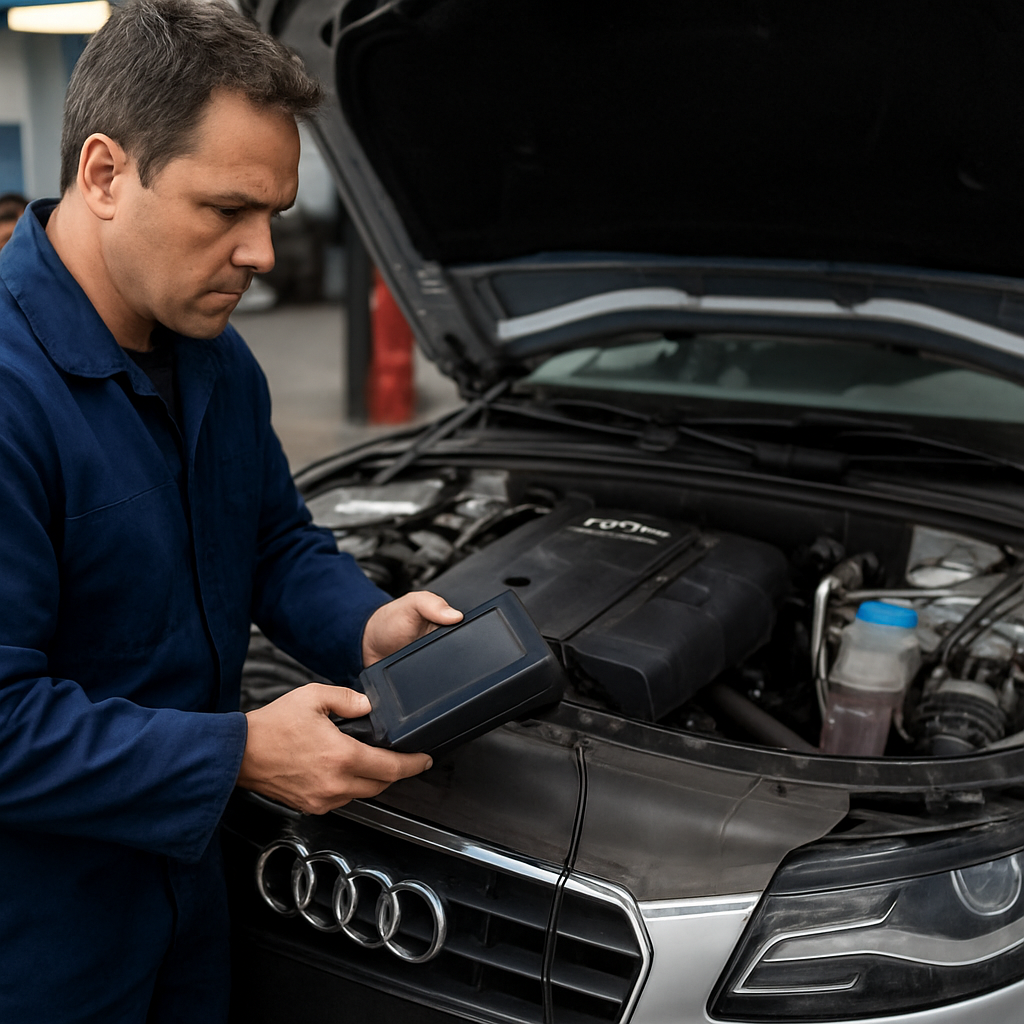
Possible signs that an Audi A4 turbo is failing include sluggish acceleration, an unusual whine or whistle, other abnormal noises, exhaust smoke, rising oil use, and a check-engine or EPC warning. However, none of these signs alone confirms turbocharger failure. A qualified diagnosis, which may include a diagnostic scan and appropriate boost-system testing, is needed to identify the cause.
Audi A4 turbo failure symptoms: what to look and listen for
Reduced power or sluggish acceleration
A turbocharger helps the engine receive more air under load. If the boost system is not operating as expected, you may notice slower acceleration, hesitation under load, or a flat feeling when accelerating or overtaking. Reduced power is a reason to investigate, but it does not prove that the turbo itself is faulty; other engine and boost-system faults can produce similar symptoms.
A new whine, whistle, hiss or grinding noise
A new sound from the engine area that changes with engine speed or load is worth investigating. A whine, whistle, hiss or grinding noise can be associated with the turbocharger or surrounding components, but sound alone cannot identify the failed part. Note when the noise occurs and whether it is becoming louder or changing. For wider context, see our guide to other causes of a whine when accelerating.
Exhaust smoke
Smoke colour can provide a clue, but it is not a diagnosis. Blue smoke can indicate that the engine is burning oil and may be associated with oil passing through failed turbo seals. Grey smoke can also have other causes, including a PCV fault. Black smoke is more commonly associated with a fuelling issue than turbo failure, although a boost-related problem may exist at the same time.
For more information, read our guides to what blue smoke or oil from the exhaust can mean and the causes of black smoke when accelerating.
Severe smoke, visible oil leakage, a sudden major loss of power, or rapidly worsening symptoms require prompt professional assessment. Do not assume the car is safe to continue driving in these circumstances.
Increasing oil use
A sudden increase in oil consumption can be a warning sign, including where worn turbo seals allow oil into the intake or exhaust system. It can also have other causes. Check the oil only in the manner specified in the owner’s manual, keep a record of any change in use, and tell the repairer what you have observed. There is no single consumption figure in this guidance that can reliably determine whether the engine or turbocharger is healthy.
Check-engine or EPC warning
A check-engine or EPC warning is not specific to the turbocharger. These warnings can accompany many different faults, so the warning light alone cannot confirm turbo failure. A diagnostic scan can identify stored fault information for a technician to assess, while appropriate boost-system testing can help establish whether the turbocharger or another part of the system is responsible.
If a scan reports P0299, it indicates an underboost-related fault finding; it does not, by itself, prove that the turbocharger has failed. Read more about what a P0299 underboost code means.
How to confirm whether the turbocharger is the problem
Consider the pattern of symptoms rather than relying on one sign. Sluggish acceleration together with a new noise, smoke or rising oil use is a stronger reason to investigate than any one symptom alone, but it is still not confirmation of a failed turbocharger. An Audi-focused turbo symptom guide recommends considering symptoms together and using a diagnostic scan and boost test to help establish the cause. A general technical guide to failing turbochargers also identifies warning lights, power loss, smoke, oil use and abnormal noises as possible warning signs. These are symptom references rather than an Audi factory diagnostic procedure.
- Record what happens, including whether power loss, noise or smoke occurs during acceleration, under load, or at another particular time.
- Note any warning lights and ask for stored diagnostic information to be recorded. A fault code is a clue to investigate, not automatic proof of a failed turbocharger.
- Monitor oil use and smoke, checking the oil as specified in the owner’s manual.
- Arrange an assessment by a qualified repairer familiar with the exact vehicle. Ask whether the scan results and appropriate boost-system checks support a turbocharger diagnosis before authorising replacement.
If an oil-pressure warning also appears, treat it as a separate warning rather than proof of turbo failure. Follow the vehicle manual’s instructions and seek qualified advice. Our guide explains what to do if the oil-pressure warning appears.
Do the signs differ on 2010, 2012, 2013 and 2016 Audi A4 models?
The general warning signs in this guide can help owners of these model years decide when to arrange an inspection. However, the supplied evidence does not establish that 2010, 2012, 2013 and 2016 Audi A4 models share the same engine, turbocharger, failure pattern or diagnostic procedure. Do not assume a known defect or a year-specific diagnosis from symptoms alone. A repairer should use technical information that applies to your vehicle’s exact year and engine.
Are the warning signs similar on an Audi A3?
In general, possible turbocharger warning signs include reduced power, unusual turbo-related noise, smoke, increased oil use and possible warning lights. These are general symptoms rather than an A3-specific diagnosis. The available evidence does not establish A3-specific engine differences, model-year diagnostic procedures or failure rates. Audi A3 owners should have the vehicle assessed using information for its exact year and engine, including a professional scan and appropriate boost-system testing.
Can these symptoms establish repair cost or engine reliability?
No. Symptom information cannot establish how much an Audi A4 turbocharger repair will cost. The final price depends on the exact vehicle, the confirmed fault, parts required and local labour charges. Obtain a diagnosis and an itemised quote from a qualified local repairer rather than relying on a single figure for every A4.
This symptom guide also cannot determine whether an Audi 2.0 turbo engine is reliable overall or identify the most common Audi A4 problem. Those questions require evidence specific to the engine variant, model year, maintenance history and problem frequency. Turbocharger symptoms alone do not support either conclusion.