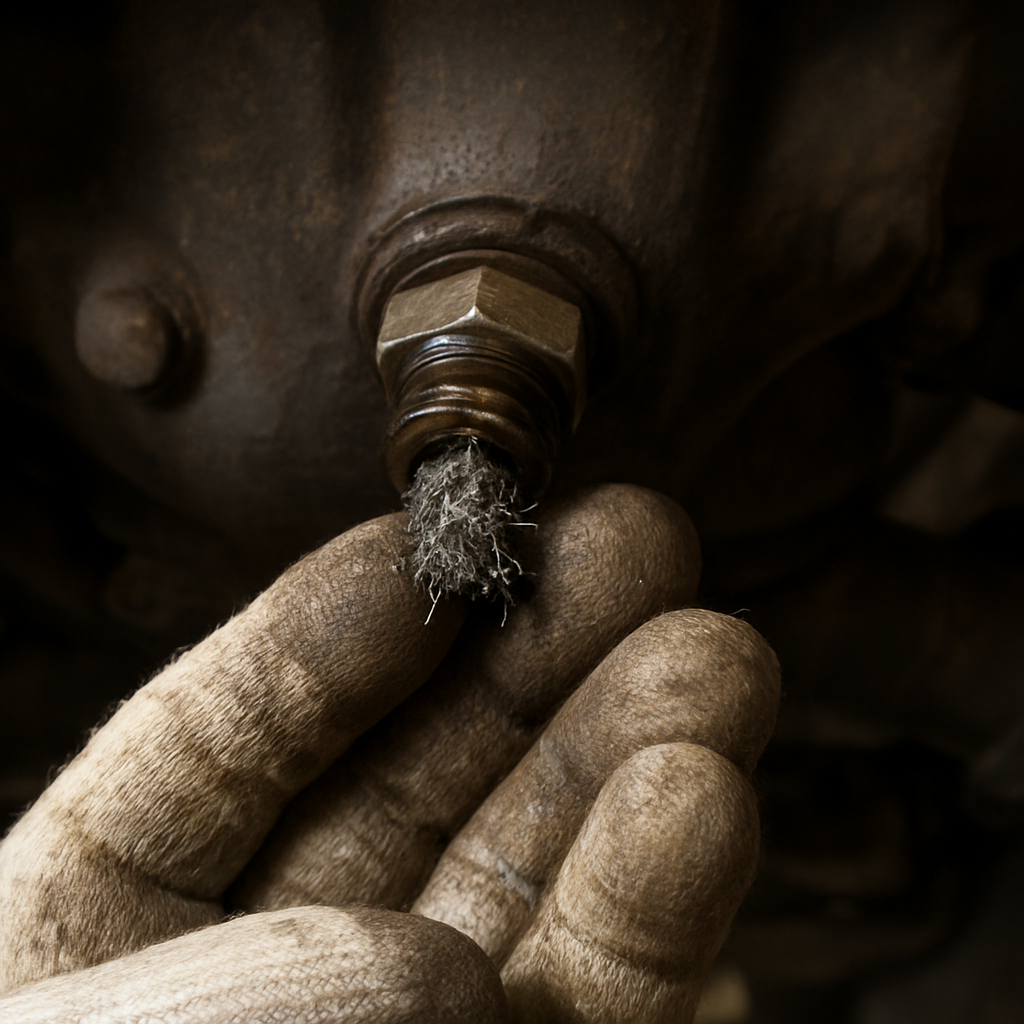
A small amount of fine metallic residue or soft, fuzzy paste on a rear differential’s magnetic plug can occur. However, visible flakes, sharp slivers or larger pieces should not simply be treated as normal. There is no validated universal quantity that separates ordinary wear from a fault, and debris alone cannot identify a failed part or establish whether the vehicle is safe to drive.
Is a small amount of metal in rear differential fluid normal?
Fine particles collected as a thin coating or soft fuzz on a magnetic plug are different from separate flakes, sharp slivers or larger pieces. Owner discussions describe some fine residue on a magnetic plug as something that can occur in a differential, including a Tundra owners’ discussion of differential shavings and a forum discussion of metal flakes in differential oil. These are owner-forum reports, however, rather than manufacturer service guidance or a validated diagnostic standard.
A magnetic plug is designed to collect some ferrous material, but it will not necessarily capture every type of wear debris. Residue on the plug does not, by itself, prove that the differential is healthy. Equally, a few fine particles do not confirm that a component has failed.
Conspicuous flakes, slivers, chunks, a substantial amount of debris, or debris that returns after service merit professional assessment. These are practical warning signs rather than a manufacturer-approved measurement threshold. The available sources do not establish a universal acceptable amount or a fixed interval for checking the fluid again.
What affects how the debris should be interpreted?
Vehicle age and mileage, service history, and whether the differential or axle has recently been replaced or repaired can all provide useful context. Record those details for the technician, but do not assume that recent work makes any amount of debris harmless. The supplied evidence does not establish a safe break-in allowance or a standard recheck interval.
Debris appearance cannot confirm whether a gear, bearing or another component is damaged. A forum discussion mentions groaning or changes in noise with speed, acceleration or deceleration as reasons to pay attention, but noise is not a diagnosis. The absence of noise does not prove that the differential is sound.
What should you do if you find metal in the differential fluid?
- Photograph the residue or debris before it is cleaned away, if possible. Note whether it resembles a fine coating, separate flakes, slivers or pieces.
- Record the vehicle’s mileage, the last known differential-fluid service, and any recent axle or differential work.
- Use the vehicle’s owner’s manual or other vehicle-specific service information for the correct fluid specification and service procedure. Do not assume that a specification or procedure applies across all vehicles.
- Arrange an inspection if you find chunks, substantial or recurring debris, or related driveline symptoms. Seek prompt assessment if there is severe or changing noise, or if you suspect the fluid level is low.
The supplied evidence cannot determine whether a vehicle with metal debris is safe to drive. Do not use appearance alone to make that decision; ask a qualified technician to assess the vehicle, particularly if the debris is substantial or symptoms are present.
If you also notice a whine while accelerating, it may help to read about why a car may whine when accelerating. That general noise guide does not diagnose differential damage.
What can cause metal flakes in transmission fluid?
Transmission fluid and rear differential fluid belong to different systems, so finding debris in one does not explain debris in the other. The limited evidence supplied for transmission fluid is a forum discussion noting that wear within components may produce particles and that transmissions can contain aluminium parts and wear surfaces. As a result, debris may not all be magnetic. The discussion is not an authoritative diagnostic source, and particle appearance alone cannot confirm the source or severity of a transmission problem.
If transmission fluid contains conspicuous flakes or chunks, or there are related symptoms, arrange vehicle-specific professional diagnosis rather than applying rear-differential service advice to the transmission.
What does a differential fluid leak look like?
The available research does not establish what a differential-fluid leak looks like, where it would appear on a particular vehicle, or how to distinguish it from other fluids. If you suspect a leak, have a technician identify its source rather than relying on an unsupported description or appearance alone.
How much does it cost to fix a rear differential leak?
The supplied evidence contains no repair prices, labour estimates or diagnosis-specific cost information, so it cannot support a reliable price range. The repair estimate depends on identifying the leak source and the vehicle involved; a seal replacement should not be assumed to be the necessary fix. Ask a repairer to diagnose the leak and provide an estimate for the confirmed repair.
Is it worth fixing the rear differential?
Metal debris alone cannot show whether a differential is worth repairing. That decision requires a diagnosis and repair estimate, considered alongside the vehicle’s overall condition and value. The available sources do not provide enough information to recommend repair or replacement in a particular case.