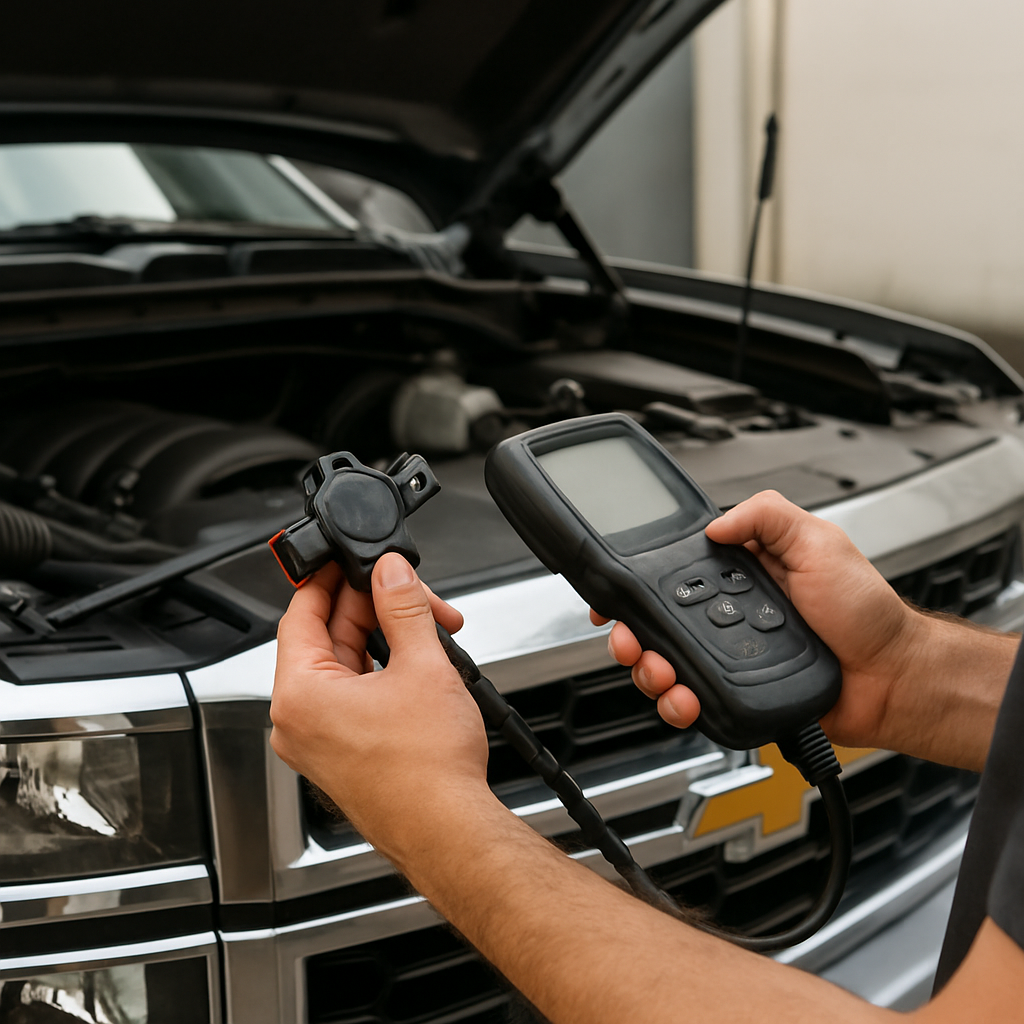
On a Chevy Silverado, diagnostic trouble code P2138 indicates an Accelerator Pedal Position (APP) Sensor 1–2 correlation fault. The engine computer has detected that the two APP signal readings do not agree within the limits calibrated for the vehicle. The code identifies a signal problem; it does not, by itself, confirm that the accelerator pedal sensor or throttle body has failed.
Depending on the fault, a Silverado may show an intermittent malfunction indicator lamp (MIL) and a “Reduced Engine Power” message or indicator. GM’s technical bulletin describes these as possible customer complaints, not symptoms that every truck with P2138 will have. Because the code can be associated with reduced or unpredictable throttle response, don’t assume the truck is safe to drive based on the code alone.
What P2138 means on a Chevy Silverado
The accelerator pedal assembly uses position signals that the engine control module (ECM) monitors. P2138 is set when the APP Sensor 1 and APP Sensor 2 signals fail to correlate as expected for the required period. In plain terms, the computer sees a mismatch between related readings and may limit engine power as a protective response.
This is a circuit and signal-correlation code rather than a verdict on which part is faulty. A problem with a sensor, wiring, connector, or another part of the circuit may need investigation. The GM technical bulletin hosted by NHTSA describes P2138 as an APP Sensor 1–2 correlation fault and outlines diagnostic considerations for applicable vehicles. A general explanation of the code is also available from AutoZone’s P2138 guide.
Does the diagnosis differ on 2006–2010 Silverados?
The general meaning of P2138 is an APP sensor correlation problem for a 2006, 2007, 2008, 2009, or 2010 Silverado. The available evidence does not establish year-by-year differences in the correct diagnostic steps or repairs for those trucks.
Nor does the supplied bulletin extract establish that its guidance applies to every Silverado in those model years. It notes a revision adding 2016–2018 model years, but that does not confirm coverage for a particular 2006–2010 truck. Bulletin applicability and the correct procedure should be checked using the truck’s exact year, configuration, and VIN in GM service information or with a qualified technician.
What can cause P2138 on a Silverado?
One Silverado-relevant possibility identified in the GM bulletin is water intrusion at the instrument-panel-to-body harness connector. That connector carries APP signals toward the ECM. Water intrusion can create a voltage difference between APP Sensor 1 and APP Sensor 2, which may set P2138.
The bulletin also cautions that aftermarket equipment electrically connected to APP signal or reference circuits can generate P2138 and/or other diagnostic trouble codes. Other items a technician may investigate include an open or short in the relevant circuit, damaged wiring, corrosion, a loose connector, or a poor electrical connection. These are diagnostic possibilities, not proof that any one fault is present on your truck.
Can a dirty throttle body cause P2138? The supplied evidence does not establish dirt on the throttle body as a cause of this code. A throttle-body fault could be considered as part of a wider diagnosis, but P2138 alone does not prove that the throttle body is faulty. Don’t clean or replace it solely because this code appears, and don’t confuse the accelerator-pedal APP sensors with throttle-body position sensors.
How P2138 should be diagnosed and repaired
A sound diagnosis confirms what is happening before replacing parts. GM’s bulletin directs technicians to check whether aftermarket equipment is electrically connected to APP signal or reference circuits, then follow the vehicle’s diagnostic process. The bulletin extract also directs technicians to consider whether 5-volt-reference codes are present; those codes affect which diagnostic path to follow.
A practical assessment should establish whether P2138 is current or stored in history, check for related codes, including 5-volt-reference DTCs, and assess the APP wiring and connectors. The technician may also look for evidence of water intrusion and review aftermarket electrical connections. If you have recently installed accessories or electrical equipment, mention that when booking the truck in.
The repair depends on the test results. It could involve addressing a connection or wiring issue, investigating water intrusion or aftermarket interference, or repairing a component confirmed to be faulty. The supplied bulletin extract is not a complete, year-specific repair procedure, so it does not justify replacing the pedal sensor, throttle body, harness, or connector without further testing. Use VIN-appropriate GM service information or a qualified technician for circuit testing and any required repair.
If “Reduced Engine Power” appears, or acceleration becomes poor or unpredictable, pull over somewhere safe if vehicle control or acceleration is compromised and arrange a professional assessment. Don’t continue driving simply because the warning goes away after restarting or clearing a code.
How much might a P2138 repair cost?
There is no defensible Silverado-specific price in the supplied evidence, and the code alone cannot predict the bill. The work might involve diagnosis of wiring and connectors, investigation of possible water intrusion or aftermarket electrical interference, or repair of a component identified by testing.
Ask for an estimate before authorising parts replacement. It should make clear whether the price includes diagnostic time, any connector or wiring repairs, parts, labour, and follow-up verification. A quote to replace the accelerator pedal sensor or throttle body should be supported by test results rather than the code alone.
Can you reset the throttle-body sensor to clear P2138?
The available evidence does not establish one universal Silverado throttle-body or APP sensor reset or relearn procedure, so a generic key cycle, pedal-pumping sequence, or scan-tool instruction cannot be recommended for every model year. If a relearn or calibration is required after a repair, follow service information for the truck’s year and VIN or ask a qualified technician.
Clearing a stored code is not a repair. If the underlying signal, wiring, connector, water-intrusion, or aftermarket-equipment issue remains, P2138 may return. The useful next step is to identify and correct the cause, then verify the repair rather than relying on a reset alone.