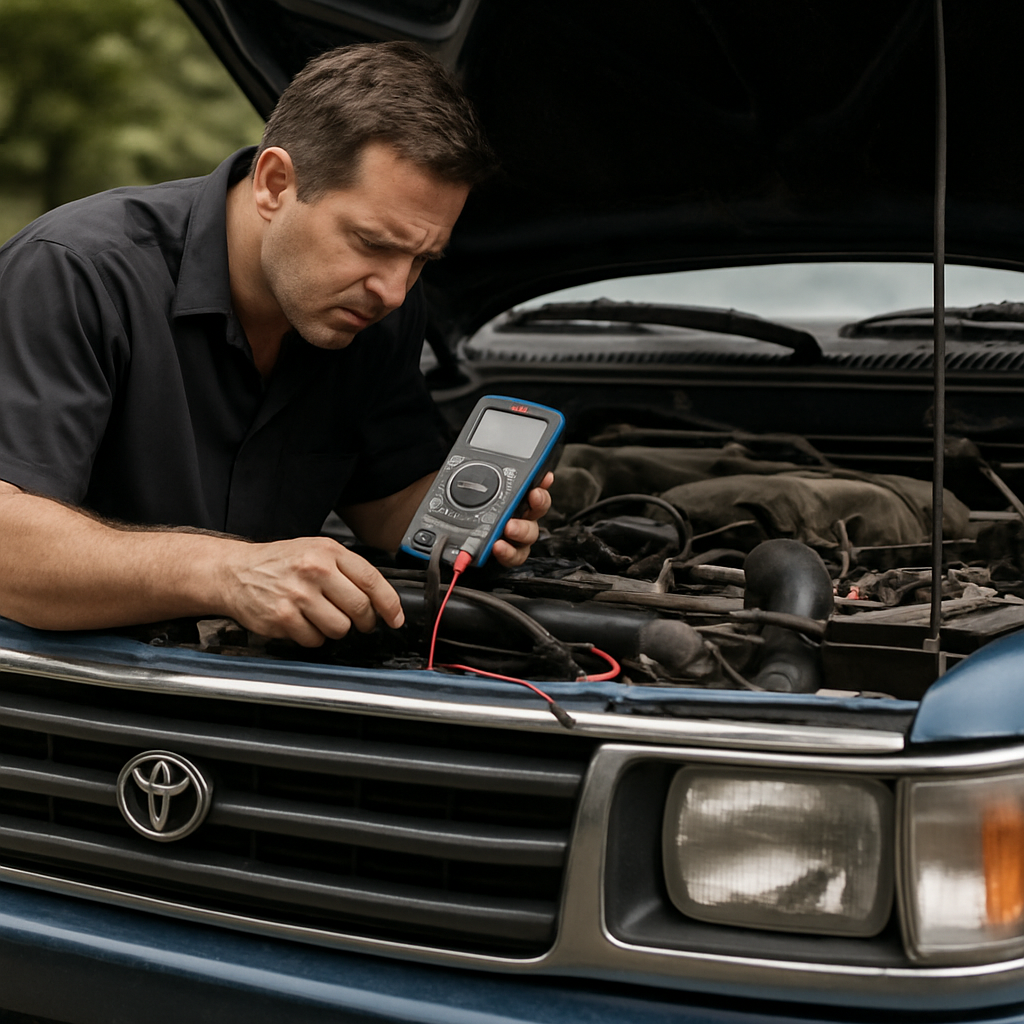
If your Toyota T100 cranks but will not start, the engine is turning over but is not running under its own power. That symptom alone does not identify the failed part. The research available for this article does not confirm a specific cause or establish a statistically most common cause across T100s, so replacing a component based only on the symptom would be guesswork.
Toyota T100 cranks but won’t start: what to check next
Fuel delivery, ignition or spark, and engine timing are areas raised in online discussions about crank-no-start problems. They are possibilities to investigate, not verified diagnoses for your truck. The available live sources are parts catalogues rather than T100 diagnostic manuals, so they do not establish a test sequence, specifications, or which system is at fault.
That distinction matters: the same starting symptom can prompt checks of different systems, and a part listing does not show that the part has failed. Do not assume that a fuel pump, fuse, filter, pressure regulator, spark plug, injector, sensor, wiring component, or timing part is the cause without testing.
Why the T100’s year and engine matter
Identify your truck’s model year and engine before looking up parts or service information. The catalogues show different T100 year-and-engine applications. For example, listings include 3VZ-E engine parts for 1993 and 1994, a 3RZ application for 1997, and a 5VZ-FE application for 1998. These are examples of fitment differences, not a complete engine guide or evidence that any listed component commonly fails.
You can see these example applications in the catalogues for the 1993 T100 3VZ-E, 1997 T100 3RZ, and 1998 T100 5VZ-FE. A general T100 parts catalogue also advises selecting the year, make, and model to check fitment. Confirm the engine in your truck rather than assuming it from a parts listing.
What information should you gather?
Before arranging diagnosis, note the truck’s year and engine, if known; whether it cranks consistently; and what happened just before the problem began. You can also record visible warning lights and any recent work or changes. These observations help describe the problem; they do not confirm a failed component.
For the next step, use service information that matches the T100’s year and engine, or consult a qualified technician who can test the relevant systems. Avoid replacing parts based solely on a suspected cause from an online discussion or a catalogue. The supplied sources do not provide T100-specific diagnostic procedures or test values, so this article cannot responsibly provide a vehicle-specific testing sequence.
Could a sensor be involved?
A sensor may be among the topics considered during diagnosis, but the evidence here does not establish a crankshaft-position-sensor fault in your T100. If you want general background, you can learn more about crankshaft position sensor symptoms and checks. That article is further reading, not proof that this sensor is responsible for your truck’s no-start.