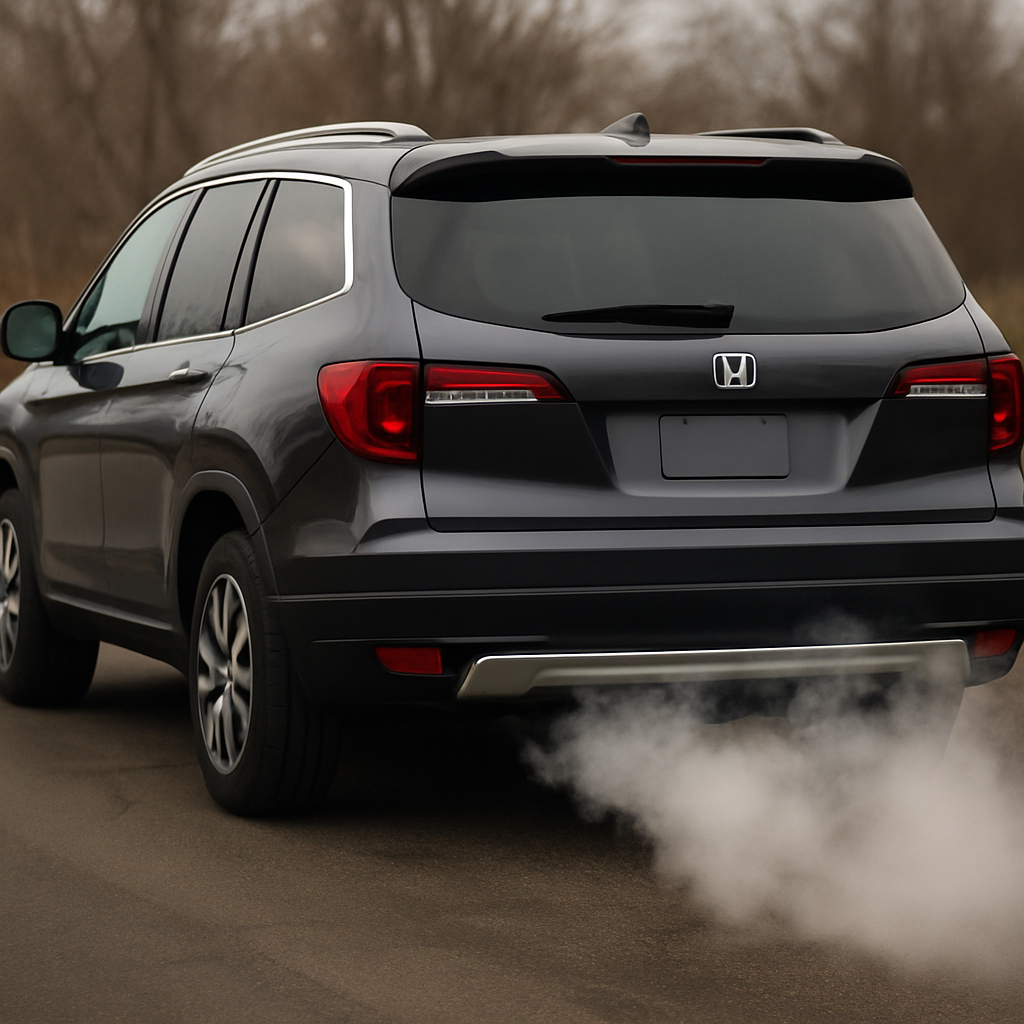
If your Honda Pilot displays an “Emissions System Problem” message, the vehicle has detected a concern related to its emissions-control system. The message may appear with the malfunction indicator lamp, commonly called the check-engine light, but it does not identify a failed part or confirm the cause. Record any diagnostic trouble codes and arrange a diagnosis rather than replacing components or clearing the warning based on guesswork.
What the Honda Pilot Emissions System Problem warning means
The message is a system-level alert: something the vehicle monitors in its emissions controls may need attention. A warning message and check-engine light can appear together, but neither tells you on its own whether the cause is a sensor, exhaust component or another fault. A technician needs to read the codes and, where necessary, carry out further checks to establish what is actually wrong.
The warning explanation here is based on a Honda dealer’s secondary explainer, not an extract from a Honda owner’s manual or factory service information. Check the owner’s manual for your particular model year and follow its instructions.
If you have a 2016 Honda Pilot with this message, the supplied information supports the same general interpretation: the vehicle has detected an emissions-control concern. It does not establish a specific 2016 failure or repair. Note when the warning appeared, whether the vehicle’s behavior changed and any codes retrieved by a suitable scan tool. Arrange professional diagnosis, particularly if you notice drivability symptoms.
The available evidence does not establish whether every Pilot displaying this warning is safe to drive. Consult your owner’s manual and seek prompt professional advice. If the Pilot is running roughly, hesitating, stalling or accelerating poorly, do not assume it is suitable for routine driving; get advice based on the symptoms and vehicle condition.
For a related overview of a similar Honda dashboard message, see our Honda Accord emissions-system warning guide. It is a general comparison, not evidence of a Pilot-specific fault.
Possible causes, symptoms and repair options
Several faults can trigger an emissions-related warning, and a symptom or code should not be treated as proof that one particular component has failed. Secondary automotive sources mention oxygen sensors and catalytic converters as possibilities. These are diagnostic possibilities, not established failure rates or confirmation that either part is faulty in your Pilot.
One secondary article specifically discusses oxygen-sensor malfunction in 2018–2020 Honda Pilots and also mentions catalytic-converter problems more generally. That information does not establish a confirmed cause for every vehicle in those years. A Honda Pilot warning-light explainer likewise lists oxygen sensors and catalytic converters as possible triggers; it does not diagnose an individual vehicle.
Possible symptoms reported in connection with emissions-system problems include poor acceleration, rough idling, stalling and hesitation. A Pilot may not have any of these symptoms, and their presence does not prove an emissions component has failed. Other faults can also affect how an engine runs, so the codes and test results matter.
What about the 2019 Honda Pilot?
For a 2019 Pilot, the supplied evidence does not identify one common or confirmed cause, nor does it establish a definitive repair. An article discussing Honda emissions problems names oxygen sensors for 2018–2020 Pilots, but this is a reported possibility rather than proof that a 2019 vehicle has a faulty sensor. Catalytic-converter problems are also mentioned more generally.
A video also names fuel injectors and Variable Cylinder Management (VCM) as possible considerations, but the supplied material does not provide diagnostic detail to substantiate those as causes of a particular 2019 warning. Treat them as unconfirmed possibilities, not a parts list or a model-wide defect. The video’s suggestions do not replace a code-based diagnosis.
The practical repair sequence is to retrieve and interpret the vehicle’s diagnostic trouble codes, then verify the suspected fault before replacing a sensor, catalytic converter, injector or other component. The code can help direct diagnosis, but it is not necessarily a verdict that the named part has failed. The supplied evidence does not provide a verified 2019-specific test procedure or fix.
Haynes’ Honda Pilot page describes its manuals and repair information, but the material available here does not include a specific diagnostic test or repair step. It should not be read as support for a particular DIY procedure. No repair cost, labor time, recall conclusion or confirmed service-bulletin remedy is established by the information available for this article.
What should you do first?
- Note the warning and symptoms. Record when it appeared and whether you noticed rough running, hesitation, stalling or reduced acceleration.
- Check the owner’s manual. Follow the guidance for your Pilot’s model year and do not assume that a general online explanation overrides it.
- Have the diagnostic trouble codes read and recorded. Ask for the codes before they are cleared, so diagnosis can start with the information the vehicle has stored.
- Arrange diagnosis before authorizing parts. Ask how testing supports the proposed repair. A warning message alone does not confirm that a sensor, converter, injector or other part needs replacement.
- Seek prompt advice if drivability is affected. The available evidence does not support a blanket safe-to-drive answer. If the Pilot is stalling or its performance is significantly affected, get professional guidance rather than continuing as normal.
Can you reset the Honda Pilot emissions warning?
The supplied sources do not establish a verified, model-year-specific reset procedure for the Honda Pilot. Do not treat clearing the message as a repair, and do not clear it before the diagnostic codes have been recorded. If a fault remains, simply dismissing the warning does not establish that the underlying concern has been fixed. Ask a Honda dealer or qualified technician for advice appropriate to your model year and diagnosis.
Is an emissions-system problem the most common Honda Pilot problem?
The available sources do not compare Honda Pilot faults by frequency, model year, mileage or repair data, so they cannot establish the most common problem with the Pilot overall. This warning deserves attention, but the evidence does not support ranking it above other issues or claiming it is a widespread model defect.
Pingback: Chevy Malibu Service ESC: Meaning, Causes and What to Do - Premier Motoring Blog