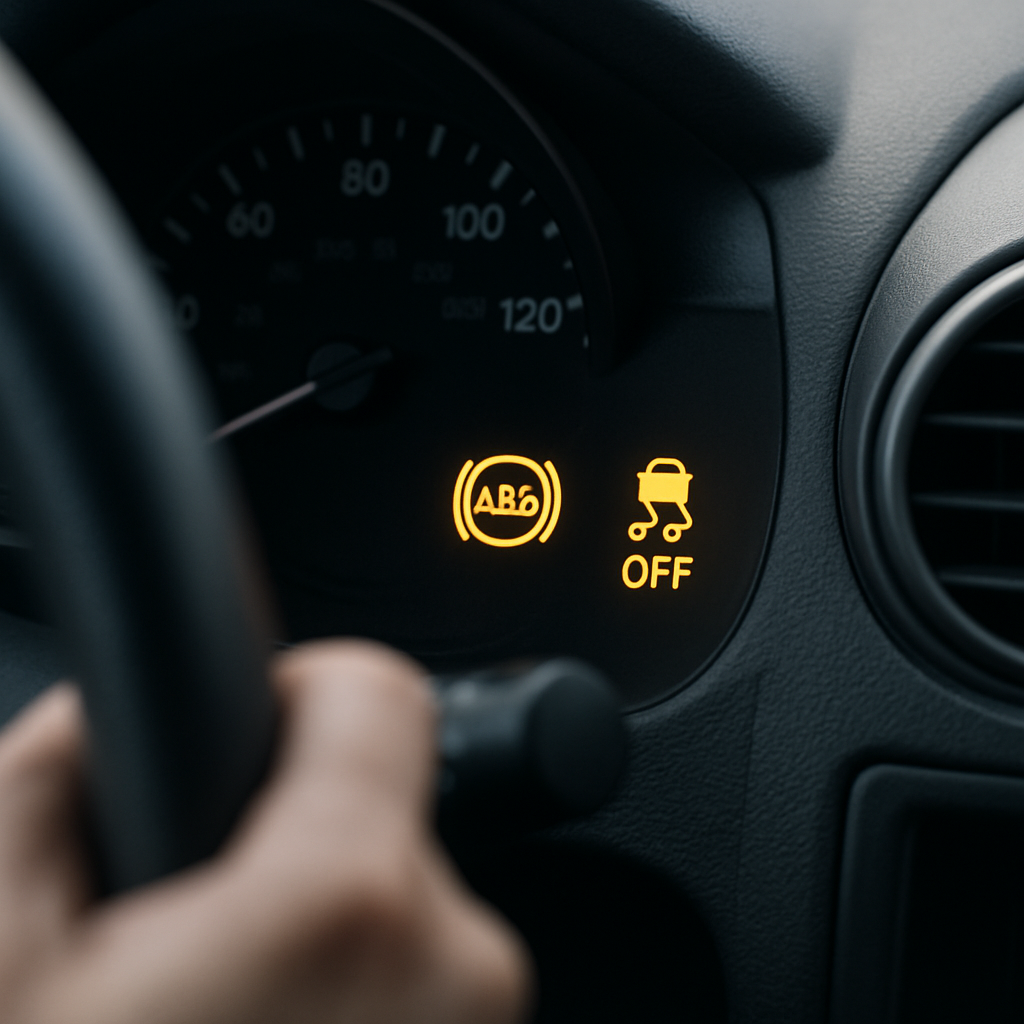
When the ABS light and traction control light come on together and remain illuminated, the vehicle has commonly detected a condition that has made one or both of those automated safety functions unavailable or limited. A shared wheel-speed signal, wiring fault, electrical issue or control-system input can trigger both warnings. The lights do not, however, identify the failed part by themselves. The car may still have conventional hydraulic braking, but you should not assume that normal pedal feel means ABS, traction control or stability control is working as intended.
What It Means When the ABS and Traction Control Lights Come On Together
ABS means anti-lock braking system. During hard braking, especially on a wet, icy or otherwise low-grip road, ABS is designed to help prevent the wheels from locking so that the driver has a better chance of retaining steering control. As this overview of ABS and traction-control warnings explains, wheel lock during emergency braking can otherwise make a vehicle harder to control.
Traction control has a different job: it looks for driven-wheel spin as the vehicle accelerates. Using wheel-speed information, the system may reduce engine power, apply a brake to a spinning wheel, or do both to help it regain grip. It is often shown by a car with wavy or squiggly lines beneath it, although dashboards may instead use labels such as TCS, TRAC or a manufacturer-specific symbol.
The systems are closely related. Both commonly rely on wheel-speed sensors and may share wiring, electronic control hardware and links to electronic stability control. A problem that makes wheel-speed data unreliable can therefore disable more than one function and illuminate both warnings at once. On vehicles with stability control, a stability-control warning may also appear.
This is important, but it is not automatically evidence that the entire braking system has failed. An amber ABS warning generally concerns the anti-lock function rather than proving a loss of ordinary braking. Equally, it is not a clearance to ignore the warning: unavailable ABS can allow wheel lock during severe braking, while unavailable traction control can make driven-wheel spin more likely on slippery or loose surfaces.
The Squiggly-Lines Light: When It Is Normal and When It Needs Attention
The traction or slip-control symbol does not always mean the same thing. Its behaviour matters.
| What the traction/slip light does | What it can indicate | Appropriate response |
|---|---|---|
| Flashes briefly while accelerating on rain, snow, gravel or another loose surface | The system may be actively detecting wheelspin and intervening to restore grip. | Ease off the accelerator and drive for the conditions. Consult the handbook if the symbol or behaviour is unfamiliar. |
| Remains on after normal grip conditions return | Traction control may have been switched off, may be unavailable, or may have stored a fault. | Check whether it was intentionally switched off; if not, arrange diagnosis. |
| Remains on with the ABS light | A shared ABS/traction-control input or related system fault is possible. | Treat it as a persistent combined warning, not merely a traction-control setting. |
A brief flashing light can be a normal indication that traction control is working. A solid light is different. The distinction between flashing intervention and a persistent fault/status warning is also set out in this explanation of traction-control-light behaviour.
Before assuming there is a fault, check whether traction control has been deliberately disabled using its dashboard switch. The exact switch, symbol and warning behaviour vary by make and model, so use the owner’s manual for the vehicle in question. If the light stays on after the system should be enabled—particularly if the ABS lamp is also on—do not rely on repeatedly restarting the engine, clearing the warning or a supposed reset as a repair. The underlying condition still needs to be identified.
Common Reasons Both Warning Lights Come On
These warnings can have several causes. A warning-light combination is a symptom of a system problem, not a reliable diagnosis of a particular sensor, module or wiring section. Vehicle-specific fault codes and suitable testing are needed before parts are replaced.
Wheel-speed sensor signal problems
A wheel-speed sensor issue is a common possibility because ABS and traction control use wheel-speed information. The problem may involve the sensor itself, its connector or the wiring that carries its signal. If the control system cannot trust the speed reading from one wheel, it may switch off linked functions rather than attempt to operate them with poor information. That makes a wheel-speed sensor a sensible diagnostic starting point, not a confirmed answer from the dashboard lamps alone.
Wiring, connections and electrical conditions
Damaged wiring, poor connections and low-voltage or other electrical conditions can affect the same network of sensors and controllers. A fault can be intermittent, which may explain warnings that appear after driving, over bumps or in wet conditions, but those circumstances do not prove the source of the problem. The diagnostic process should establish whether the issue is a signal fault, a power or ground problem, a connection issue or something else.
ABS module or other shared-control faults
Faults involving the relevant control module and its shared inputs are also possible contributors. Some vehicles use inputs beyond wheel speed to support traction and stability functions. Depending on the vehicle’s equipment, an implausible signal from a brake-light switch, steering-angle sensor or yaw sensor can lead to linked ABS, traction-control or stability-control warnings. The system layout is not identical across all makes and models.
Brake-system-related concerns, including low fluid
A condition related to brake-fluid level can be associated with ABS and traction warnings, but low fluid should not be treated as a simple top-up issue or as a confirmed explanation for both lamps. The reason for a low level needs to be established, and brake-system concerns deserve professional assessment. If a red brake warning is present as well, the situation requires more caution than an amber ABS/traction warning alone.
Engine or transmission faults on some vehicles
On certain vehicles, a serious engine or transmission issue can cause traction or stability functions to be limited as a secondary effect. That does not apply to every car, and ABS and traction warnings alone do not diagnose an engine or transmission failure. For Toyota owners specifically, a Toyota TRAC OFF and check-engine-light guidance is a useful next step when those two warnings appear together.
The key point is that replacing a wheel-speed sensor, module or other part on assumption can waste money and may leave the real fault unresolved. A diagnostic provider needs to retrieve the vehicle-specific ABS/stability fault codes and test the implicated circuit or component before recommending a repair. The fact that both systems use common wheel-speed data is why simultaneous warnings are frequent, as described in this discussion of their shared inputs and stability-control connections.
Can You Drive With Both Lights On? Safety Checks and Next Steps
There is no universal yes-or-no answer. Do not declare a vehicle safe to drive simply because the warnings are amber, the engine runs, or the car still stops. If ABS is unavailable, hard braking may lock the wheels and make steering control harder to retain. If traction control is unavailable, wheelspin can be more difficult to manage on snow, ice, wet roads, gravel and other low-grip surfaces.
Separate amber warnings from a red brake warning
An amber ABS lamp and amber traction/slip lamp normally call attention to those electronic assistance systems. A red brake-system warning appearing alongside them is a more serious combination. It can indicate a brake-system-related concern that should not be treated as routine driving. Use heightened caution and seek prompt professional assessment rather than casually continuing to use the vehicle.
The same applies if there is abnormal brake feel, unusual noise, pulling under braking, a noticeable change in how the vehicle behaves, or other warning lamps. These observations can help a technician, but they do not substitute for diagnosis. If braking feels abnormal or you are concerned about the vehicle’s ability to stop safely, do not continue driving it; obtain appropriate assistance.
If movement is unavoidable before diagnosis
Where the vehicle otherwise behaves normally and movement cannot be avoided, reduced-risk driving is only an interim measure, not a repair. Avoid slippery routes where practical, hard acceleration, close following distances and situations likely to demand emergency braking. Arrange prompt inspection rather than waiting for the lights to disappear. This approach recognises the possible loss of automated assistance without pretending it eliminates the risk.
Useful information to record
- Whether the traction/slip light flashed first or came on and stayed on.
- Whether the warnings appeared at start-up, after moving off, during rain, after hitting a bump or while turning.
- Any red brake, check-engine, stability-control, tyre-pressure or other dashboard warnings.
- Any change in brake feel, pulling, vibration, noises or drivability.
- Whether the traction-control switch had been intentionally turned off.
Those details may help narrow the diagnostic path. Owner-level action should stop there: consult the handbook, confirm the system has not been manually disabled and book a qualified workshop or properly equipped diagnostic provider. Avoid bypassing sensors, attempting brake-system repairs without the correct expertise, or fitting parts simply because an online symptom list mentions them.
Will an ABS or Traction-Control Repair Be Expensive?
The repair expense depends entirely on the confirmed fault. A sensor or input issue, a wiring or connection problem, a brake-system concern and a control-module-related fault can involve very different diagnosis and repair scope. No responsible price range can be given from the warning lights alone, and it is not useful to label the repair cheap or expensive before the vehicle-specific codes and test results identify the actual problem.
Ask the repairer to explain the stored fault codes, the testing used to identify the cause and why the proposed part or repair addresses that evidence. That is more useful than authorising a speculative replacement based only on an ABS light and traction control light appearing together.
The Bottom Line
Persistent ABS and traction-control warnings usually mean that one or more automated safety functions are limited or unavailable, often because the systems share wheel-speed data and related electronics. Check whether traction control was deliberately switched off, but do not mistake a reset or a disappearing warning for a diagnosis. Treat a red brake warning or abnormal braking behaviour with particular urgency, and have persistent combined warnings assessed with vehicle-specific fault-code retrieval and proper testing before any parts are replaced.