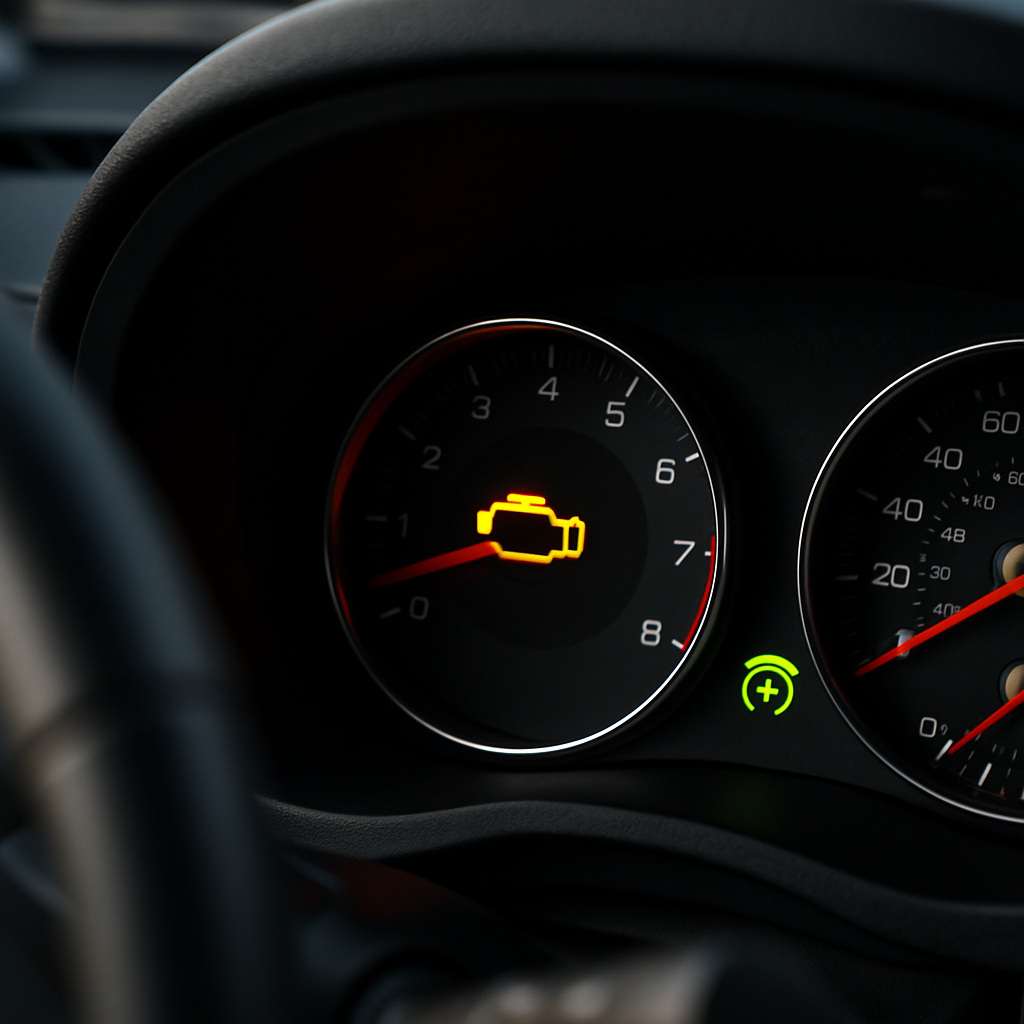
If your Subaru has a check engine light and a flashing cruise-control indicator, it generally means the engine-management system has recorded an engine- or emissions-related fault and cruise control has been disabled in response. It does not, by itself, prove that the cruise-control hardware has failed. The first priority is to determine whether the check engine light itself is steady or flashing, then retrieve the stored diagnostic trouble codes rather than trying to repair the cruise-control light in isolation.
The check engine light is also called the malfunction indicator lamp, or MIL. A flashing cruise indicator is easy to confuse with a flashing MIL, but the distinction matters: the supplied technical sources describe a flashing MIL as an urgent possible misfire warning, while the flashing cruise light is ordinarily a status indication that the vehicle has taken cruise control out of service.
What a Check Engine Light and Flashing Cruise Light Means on a Subaru
Based on the available evidence, this warning combination is best understood as one underlying fault and one system response:
- Check engine light/MIL on: the engine-control system has detected a fault, often related to engine operation or emissions.
- Cruise-control indicator flashing: cruise control has been disabled while that fault is present.
That is why replacing a cruise-control switch, actuator or other cruise-related part solely because the cruise symbol is flashing would be premature. The dashboard pattern cannot identify the failed component. It cannot, on its own, confirm a fuel-cap issue, an EVAP-system fault, a sensor, wiring, a solenoid, a catalytic converter or a wheel-speed sensor.
Online owner discussions often point to a loose fuel cap or one particular sensor. Those suggestions may explain why the combination is worrying, but they are not a diagnosis for an individual car. A fault code, the vehicle’s running symptoms and year- and model-specific information are needed before a repair decision is made.
What does a blinking cruise-control light mean?
A blinking or flashing cruise-control light with an illuminated MIL normally means the cruise function is unavailable because of the other recorded fault. It is a warning/status response, not a standalone confirmation that cruise control is broken. Do not attempt to override it or rely on cruise control until the underlying fault has been diagnosed and corrected.
Some vehicles may also show reduced power when a significant engine fault is present. One supplied secondary source reports that this can happen, but it is not a universal Subaru response and should not be used to diagnose the cause from the dashboard alone.
Steady vs Flashing Check Engine Light: When to Stop Driving
Look closely at the MIL, not just the cruise symbol. The following comparison is the most useful first triage step.
| What you see | What it can indicate | Appropriate next step |
|---|---|---|
| Steady check engine light with flashing cruise indicator | An engine/emissions fault has been stored and cruise control is disabled. Supplied sources describe a steady MIL as generally less urgent than a flashing one, but it still requires diagnosis. | Do not use cruise control. If the engine is running normally and there are no severe symptoms, arrange code retrieval promptly and drive only as necessary for diagnosis. |
| Flashing check engine light, with or without a flashing cruise indicator | The supplied sources associate this with an active or severe misfire and potential catalytic-converter damage. | Stop driving as soon as it is safe. Avoid continued operation and arrange qualified assistance or towing as appropriate. |
| Check engine light was flashing, then becomes steady | The urgency pattern has changed, but the dashboard alone does not reveal why. | Do not assume the fault has repaired itself. Retrieve the codes and assess current symptoms before resuming routine use. |
If the check engine light is flashing
A flashing MIL is the important red flag. Sources supplied for this article connect it with an active misfire, which can allow unburned fuel to overheat and damage the catalytic converter. Pull over safely, switch off the engine when safe to do so, and seek professional help rather than continuing a journey simply because the engine still runs.
If a scan later returns P0300, that code means random or multiple-cylinder misfire detection; it is not, by itself, a parts list. See our guide to what a P0300 random/multiple-cylinder misfire code means for the distinction between the code and the underlying cause.
If the check engine light is steady
A steady MIL is often described as a non-emergency or emissions-related warning in the supplied material, but “less urgent” is not the same as “ignore it.” Do not use cruise control while its indicator is flashing. Obtain the exact codes promptly, and escalate to immediate professional help if you notice rough running, significant loss of power, overheating, smoke, a strong fuel smell or another serious symptom.
Can you use cruise control if the check engine light is on? Where the cruise indicator is flashing, the practical answer is no: the system has indicated that cruise control is disabled. Do not try to defeat that condition.
Possible Causes and the Right Next Diagnostic Steps
Diagnose the fault that triggered the MIL first. The available research supports engine and emissions faults as a broad category, and identifies an active misfire as the major concern when the MIL itself flashes. It does not support a ranked Subaru-specific list of failed parts or a code-to-part replacement chart.
For a steady MIL, a fuel cap that was recently removed or not refitted correctly is a reasonable, low-risk item to check. It is only a possible example, not the usual cause or a guaranteed fix. It should never be offered as an explanation for a flashing MIL.
A sensible owner-level sequence
- Identify which light is flashing. Confirm whether it is the check engine light, the cruise-control indicator or both.
- Assess how the vehicle is behaving. Note rough idle, hesitation, misfiring, reduced power, smoke, unusual smells, overheating or abnormal noises. A flashing MIL or serious symptoms change the decision from routine diagnosis to stopping safely and getting assistance.
- Record every warning lamp. Photograph the instrument panel if possible. Traction-control, X-Mode, brake or other lamps can be relevant to the diagnostic path.
- Check the fuel cap only if it was recently handled. Ensure it is correctly installed and tightened. Do not treat this check as proof that the cap caused the warning.
- Retrieve the exact diagnostic trouble codes. Use a suitable scan tool or have a qualified workshop read the codes. Ask for the code numbers and retain them.
- Diagnose before replacing parts. A trouble code is a starting point that directs testing; it does not automatically prove that the component named in a code has failed.
This approach is more reliable than buying a sensor, EVAP part, connector, solenoid or catalytic converter based solely on warning lamps. Persistent warnings, reduced power, rough running, uncertainty about the codes or any flashing MIL warrant professional diagnosis.
It is also worth separating the code from the cause. A code may identify a system that reported an implausible condition; further testing may be needed to establish whether the underlying issue is a component, wiring, an air/fuel problem, a mechanical problem or something else. The light pattern cannot make that distinction.
Can You Reset the Flashing Cruise Light?
There is no supported universal Subaru “cruise-control reset” for this situation. The flashing cruise indication should be treated as a consequence of the MIL-triggering fault, not as a setting to reset first. The responsible route is to identify and correct the underlying fault, then confirm that the warning state has cleared using the procedure appropriate to the particular vehicle.
Key cycling, disconnecting the battery and clearing codes may turn a warning off temporarily, but they do not repair the cause or establish that the problem has gone away. They can also remove useful diagnostic information before a technician has assessed it. If the MIL remains on or returns, consult the owner’s manual for the exact year and model, or have a qualified technician perform the relevant post-repair checks.
A secondary overview of Subaru cruise-control flashing with a check engine light likewise frames the cruise warning as linked to the engine-management fault rather than evidence of an isolated cruise-control defect. That relationship is useful context, but it does not replace code-based diagnosis for a specific vehicle.
Does It Mean Something Different on an Outback, Forester, Impreza or Crosstrek?
The general explanation can be relevant to a Subaru Outback, Forester, Impreza or Crosstrek: an engine/emissions fault can illuminate the MIL and be accompanied by disabled, flashing cruise control. However, the available research does not establish that every model year, engine, trim, transmission or market uses identical warning logic or has the same likely causes and repairs.
This limitation matters particularly for searches such as a 2017 Subaru Outback check engine light, flashing cruise control and traction-control light. Some Outback cases discussed in the supplied material include traction-control-related warnings, and an Outback-focused secondary source also discusses combinations of warnings. However, extra lamps do not prove that a wheel-speed sensor, corroded connector, EVAP fault or any other individual part has failed.
If traction control, X-Mode, brake or other indicators appear alongside the check engine and cruise warnings:
- record all illuminated lamps and any messages;
- retrieve the complete set of stored codes rather than focusing on one code;
- note the model year, engine, trim and fitted equipment; and
- use the correct owner’s manual and qualified diagnosis for that vehicle.
Those additional warnings may change the diagnostic route, but dashboard lamps alone cannot establish a model-specific repair. The same caution applies to Outback, Forester, Impreza and Crosstrek owners: avoid assuming that a repair reported for another year or trim applies to yours.
When to Arrange Professional Help
Arrange prompt professional diagnosis for any persistent MIL and flashing cruise indicator, even if the vehicle seems to drive normally. Make it urgent, and avoid driving further where practical, if the MIL is flashing or the vehicle has rough running, pronounced power loss, smoke, overheating, a fuel smell or another severe symptom.
Bring the exact codes, a description of when the lights appeared and a record of every other warning lamp. That information gives a technician a much better starting point than a report that the “cruise light is flashing.” The dashboard combination is useful evidence of a system fault and disabled cruise control, but it is not a confirmed diagnosis or a substitute for the vehicle-specific manual and proper testing.