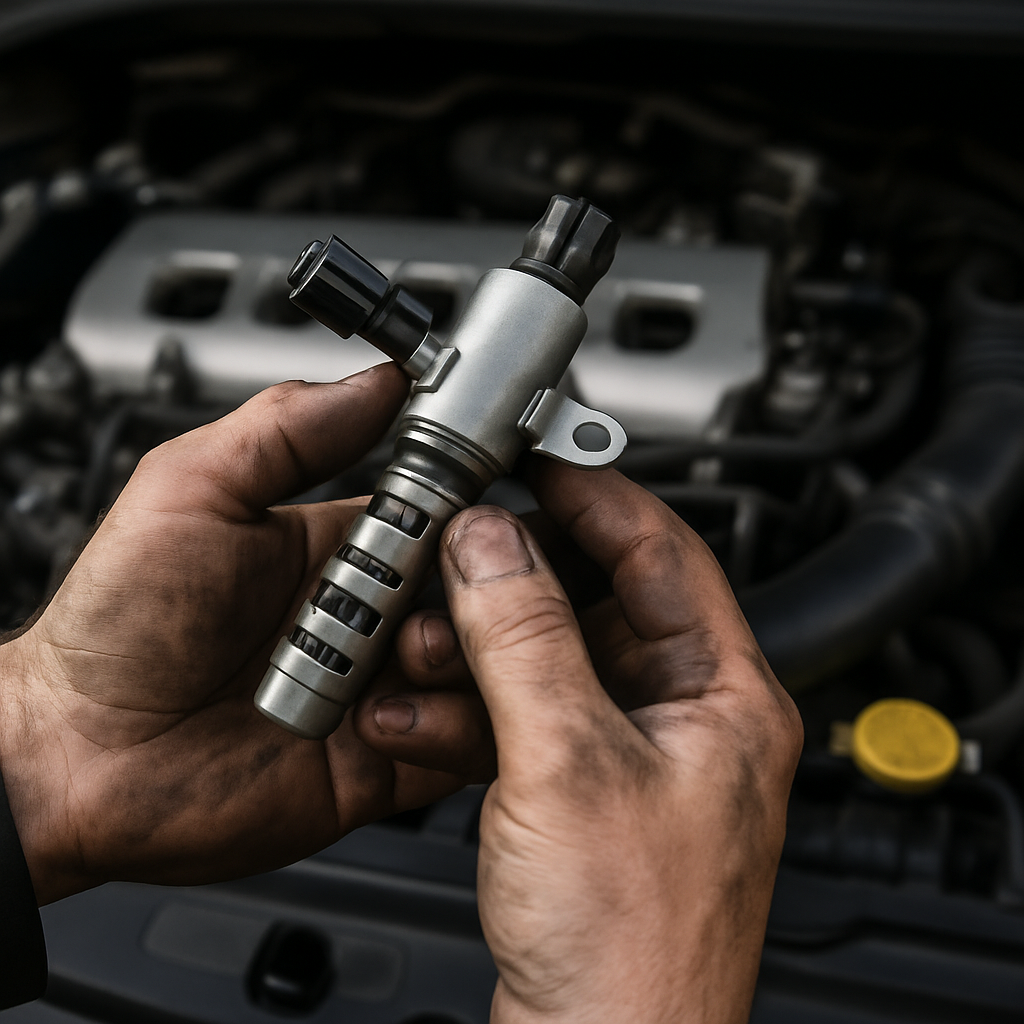
Possible variable valve timing solenoid symptoms include a Check Engine Light, a rough or unstable idle, hesitation, reduced acceleration or overall performance, and sometimes poorer fuel economy. These signs can point to a VVT-system problem, but they do not confirm that the solenoid itself has failed. Similar symptoms can come from oil-flow problems, wiring or connector faults, sensors, cam phasers, other timing components, or unrelated engine issues.
The practical first step is to have the stored fault codes read and to assess the result in the context of the exact vehicle, engine and oil-service condition. Replacing a VVT solenoid solely because a warning light is on can turn a relatively simple diagnosis into unnecessary parts spending.
What Does a VVT Solenoid Do?
A variable valve timing (VVT) solenoid—also called an oil control valve on some applications—is an electronically controlled valve that regulates engine-oil flow for the VVT system. The engine control module (ECM or ECU) commands the solenoid as operating conditions change. That controlled oil flow helps the system alter camshaft timing so the engine can manage power delivery, efficiency and emissions across different speeds and loads.
The hardware is not identical on every engine. Some engines use separate intake- and exhaust-side solenoids, while others use a different arrangement or terminology. An intake-side VVT solenoid, for example, controls oil flow associated with intake-cam timing on that particular design. The underlying principle is that the solenoid controls oil flow used by the cam-timing system, as outlined in this explanation of an intake-side VVT solenoid and cam-timing control.
Oil condition matters because debris, dirt or degraded oil can obstruct passages or the solenoid itself. YourMechanic notes that contaminated oil can clog the passageway associated with the solenoid and VVT gear assembly. That does not mean every overdue oil change has damaged a solenoid, nor does it prove that a suspected VVT code is an oil-pressure diagnosis. It does mean oil quality and the vehicle’s specified maintenance requirements are relevant diagnostic context.
Common VVT Solenoid Symptoms and Early Warning Signs
The most consistently reported early sign is a Check Engine Light. A driver may notice no obvious change at first, or the light may appear with drivability symptoms. Rough idling, hesitation, reduced acceleration or performance, and a fuel-economy decline are also possible when the engine cannot control cam timing as intended.
| Possible sign | What it may indicate | What it does not prove |
|---|---|---|
| Check Engine Light | The ECM has detected a condition requiring a diagnostic trouble code. | That one particular VVT solenoid must be replaced. |
| Rough or unstable idle | Cam timing may not be responding as intended, among several other possible engine causes. | A confirmed VVT solenoid fault. |
| Hesitation or reduced acceleration | The engine may not be achieving expected timing control or performance. | That a VVT component is the only possible cause. |
| Reduced fuel economy | The engine may be operating less efficiently than normal. | A diagnosis without scan results and vehicle-specific checks. |
Symptoms may occur alone or together, and their severity can vary with the engine design, the operating condition and whether an intake- or exhaust-side part is involved. A VVT solenoid may be electrically faulty, mechanically stuck, restricted by contamination, or not be the underlying issue at all.
Do not treat every poor-acceleration complaint as evidence of a VVT fault. For example, there are many other causes of slow acceleration in a 2016–2022 Honda Accord, which illustrates why a symptom needs diagnosis before a component is blamed.
Dirty engine oil is best understood as a possible contributing condition rather than an owner-observable symptom of solenoid failure. Likewise, this article does not treat ticking, rattling, pinging, stalling, a no-start condition or load-only hesitation as universal VVT-solenoid signs. Those concerns deserve vehicle-specific assessment, but they are not sufficient on their own to identify the solenoid.
What Happens If a VVT Solenoid Goes Bad?
If a VVT solenoid is faulty or blocked, it may not regulate oil flow to the VVT system normally. The ECM can then be unable to manage cam timing as intended. In practical terms, that may trigger a warning light and may be associated with rough running, hesitation, reduced performance or fuel economy.
There can also be a broader maintenance consequence when the real problem involves oil-flow restriction or inadequate lubrication. YourMechanic says blockage and a lack of proper lubrication can contribute to premature wear or failure of the VVT timing-chain and gear assembly. That is a potential consequence of an oil-flow or lubrication problem, not an inevitable outcome of every failed solenoid or every VVT-related code.
It is important not to collapse the entire system into one part. A VVT-related symptom can arise from the solenoid, its electrical circuit, oil condition or oil-flow control, a cam phaser, a sensor, timing hardware, or another engine fault. A code and a rough idle are useful clues, not confirmation of the root cause.
Driving and urgency
There is no universal answer to whether a particular vehicle is safe to drive with a suspected VVT issue. The supplied evidence does not establish one drivability verdict for all makes and engines. Avoid prolonged operation and arrange prompt, vehicle-specific assessment when the engine is running poorly, the Check Engine Light is illuminated, or notable mechanical noise is present. Follow the owner’s manual and the advice of a qualified technician for the specific vehicle; do not assume that a car is safe simply because it still starts and moves.
Check Engine Lights and VVT Codes: What They Can—and Cannot—Tell You
A scan tool is needed to retrieve the stored diagnostic trouble code or codes. Sources discussing VVT faults give examples including P0010, P0011, P0014 and P0016. They are examples only: code definitions, likely causes and applicability vary by manufacturer, engine and camshaft position. A code that appears VVT-related is a diagnostic starting point, not automatic authorisation to fit a new solenoid.
A sensible diagnostic path starts with the precise code and the correct vehicle and engine identification. Depending on the application and the code, assessment may include the engine-oil condition and service history, relevant oil-flow concerns, connectors and wiring, the solenoid, and other VVT or timing-system components. It should also consider whether the symptom has a different engine cause.
Generic online procedures cannot safely provide a universal resistance value, pinout, swapping method, torque figure or code-reset routine because those details are engine-specific. For Hyundai owners who need broader context on reading and interpreting warning-light information, see our guide to Hyundai Check Engine Light codes. It is a Hyundai-specific resource, not a substitute for the diagnostic information for every make.
Can You Clean or Replace a VVT Solenoid, and What Does It Cost?
Replacement may be appropriate once the diagnosis identifies the solenoid as the failed component. Fitment is essential: a VVT solenoid that looks similar may not be correct for a vehicle, and some engines use more than one. Confirm the model year, engine and applicable intake or exhaust position through the owner’s information, manufacturer or dealer parts catalogue, or reliable vehicle-specific service data before ordering a part.
As a broad third-party estimate, FIXD places VVT-solenoid replacement at roughly $50 to $400, depending on whether the work is DIY or completed by a mechanic. This is not a current quote, a fixed price or a vehicle-specific total. Diagnosis, access, the correct part, local labour rates and any underlying electrical, oil-flow or timing-system fault can all change the scope and cost.
FIXD also says replacement takes less than an hour for most trained mechanics. That may be useful context, but it should not be read as a promise for every engine: component access and required procedures vary considerably. High-level replacement information is safer than a universal step-by-step guide, because battery handling, component location, seals, specifications and reassembly checks depend on the engine.
Will Sea Foam clean a VVT solenoid?
Debris-related restriction is possible, but the supplied research does not establish that Sea Foam—or any other additive—will clean, restore or safely repair a VVT solenoid. It also does not distinguish which apparent VVT faults are removable contamination, electrical solenoid failures, or faults elsewhere in the timing system. An additive should therefore not be treated as a proven substitute for diagnosis or correct repair. Use the oil grade and service approach specified for the vehicle, and seek vehicle-specific advice before adding a chemical product.
Ford and Nissan VVT Solenoid Symptoms: What Is General and What Is Vehicle-Specific
Ford and Nissan vehicles equipped with VVT can show the same general warning signs discussed here: a Check Engine Light, rough running, hesitation, reduced performance and possible fuel-economy decline. Those signs remain non-specific. They cannot identify the exact failed component, solenoid position or repair for a particular Ford or Nissan.
Application-specific parts listings reinforce why details matter. A Ford catalogue listing, for instance, identifies a VVT solenoid for selected 2013–2020 Ford applications rather than every Ford model; see this Ford VVT solenoid catalogue example. Nissan and Infiniti also have application-specific VVT-solenoid listings, so owners should not select a part purely from a generic photograph or symptom description.
For either make, verify the exact model year, engine, stored codes, component location and part fitment using the owner’s manual, manufacturer or dealer catalogue, and vehicle-specific diagnostic information. This article does not assign Ford- or Nissan-specific code meanings, failure rates, locations, model years or procedures because the supplied evidence does not establish them.
What to Do Next
- Do not assume the solenoid has failed. Treat the warning light and symptoms as a reason to diagnose the VVT system and the engine properly.
- Read the stored codes. Record the exact code numbers rather than relying on a generic description from a dashboard light or parts listing.
- Check the basics appropriate to the vehicle. Confirm that the engine has been maintained with the specified oil and that there is no obvious reason to suspect neglected oil service. Do not turn that observation into an oil-pressure diagnosis.
- Use vehicle-specific information. The engine, model year and cam position determine the relevant parts and diagnostic path.
- Escalate poor running or mechanical noise promptly. A technician can distinguish a solenoid concern from electrical, oil-flow, cam-phaser, sensor and timing-system faults before replacement is authorised.
In short, the most useful response to possible VVT solenoid symptoms is neither to ignore them nor to buy a part immediately. Retrieve the codes, preserve the distinction between a symptom and a confirmed fault, and match any repair to the exact vehicle and diagnosis.