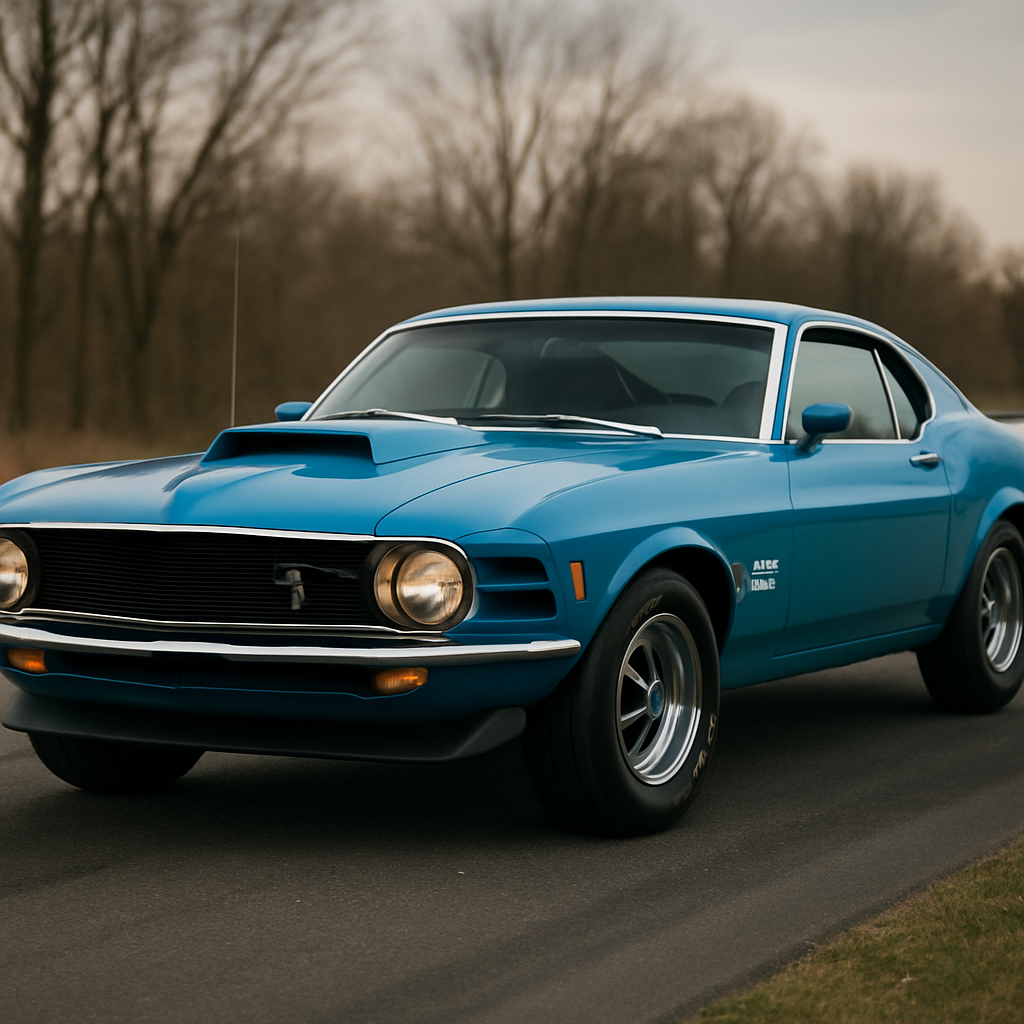
The 1970 Ford Mustang Boss 429 is one of the most collectable factory muscle cars Ford built: just 499 were produced, each centred on a NASCAR-derived 429 cu in (7.0-litre) V8 and a four-speed manual gearbox. Its appeal is tied as much to rarity, originality, and documented provenance as outright performance. For anyone considering one for sale, the right identification and condition checks matter far more than a headline asking price.
What makes the 1970 Boss 429 special?
The Boss 429 was built for only the 1969 and 1970 model years to help homologate Ford’s 429 engine for NASCAR competition. It was not simply a regular Mustang fitted with a large engine. The race-oriented powerplant required substantial installation work, helping to make the model expensive to build and comparatively rare.
Ford made 499 examples for 1970, following 859 for 1969, for a total original production run of 1,359 cars. The Boss 429 model history and production summary also notes that 1970 was its final year as demand declined and production costs remained high.
The 1970 cars had a distinct colour palette: Grabber Orange, Grabber Green, Grabber Blue, Calypso Coral, and Pastel Blue. Buyers could choose black or white-and-black interior trim, while the bonnet scoops were finished in matte black.
1970 Ford Mustang Boss 429 specs
The headline specification is the 429 cu in, or 7.0-litre, Boss V8 with semi-hemispherical cylinder heads. Ford officially rated the engine at 375 horsepower, although period gross-horsepower ratings are not directly comparable with modern net-horsepower figures. The advertised number also does not tell the whole story about a car’s current output, which can be affected by engine condition, tuning, exhaust changes, and whether the original components remain fitted.
- Engine: 429 cu in (7.0-litre) Boss V8
- Factory power rating: 375 horsepower
- Transmission: four-speed manual
- Shifter: Hurst shifter, fitted as standard
- 1970 production: 499 cars
The standard Hurst shifter is an important detail for an authenticity inspection. A contemporary MotorTrend drive of a low-mileage 1970 Boss 429 describes the long-throw character expected of a period four-speed Ford performance car. That feel may be part of the experience, but it should not be mistaken for evidence that a specific car’s gearbox is original or healthy.
How much horsepower does a 1970 Boss 429 Mustang have?
A 1970 Boss 429 was rated by Ford at 375 horsepower. It is a useful historical specification, but buyers should avoid treating it as a guaranteed measured figure for every surviving example. Modified cars can produce very different results, and a dyno reading depends on the test method as well as the condition and specification of the engine.
The Boss 429’s reputation comes from more than its quoted horsepower. It was a limited-production Mustang created around an unusually exotic engine for the road-car range. That combination is why an authentic, correctly restored car attracts interest even when another classic Mustang may offer similar or greater performance for much less money.
1970 Boss 429 performance and 0-60 expectations
Published 0-60 mph times for classic muscle cars vary widely because tyre technology, road surface, weather, driver technique, gearing, and testing methods all have a large effect. A claimed period figure should therefore be treated as context rather than a reliable prediction of what a particular 1970 Boss 429 will do today.
If performance is important to your purchase, assess the actual car rather than relying on catalogue figures. Confirm its engine specification, ignition and carburettor set-up, rear-axle ratio, tyre condition, brake operation, and cooling-system health. A careful pre-purchase inspection is particularly sensible on a valuable collector vehicle that may have spent long periods unused.
How much is a 1970 Boss 429 Mustang worth?
There is no single defensible price for every 1970 Boss 429. Values can differ dramatically according to originality, matching-number status, restoration quality, mileage evidence, colour combination, ownership history, documentation, and the quality of any modifications. A concours-level car with a known history is not directly comparable with an incomplete project, a car with replacement major components, or a heavily modified example.
The Boss 429 is widely treated as one of the most desirable first-generation Mustangs. Classic.com’s Boss 429 market page tracks the model as a 1969-1970 high-performance Mustang, but an aggregate market figure should be only a starting point. Before making an offer, compare recent sales of cars with closely matching condition and originality, then account for the individual vehicle’s records and inspection findings.
Be especially cautious with listings that use the words “Boss 429” loosely. A genuine car, a tribute, a continuation build, and a standard Mustang carrying a 429 engine are fundamentally different vehicles, with very different values.
What to check when a 1970 Ford Mustang Boss 429 is for sale
Authenticity should be the first priority. The small production run makes paperwork, correct identification, and knowledgeable inspection more important than they would be on an ordinary classic Mustang. Ask the seller for a clear account of the vehicle’s history before focusing on cosmetic details.
- Check the VIN, body tags, ownership documents, and any specialist authentication records.
- Establish whether the engine, transmission, and other major components are original to the car, where that can be documented.
- Review restoration invoices and photographs, not just a seller’s description of a “full restoration”.
- Inspect the body structure carefully for corrosion, crash repairs, poor panel alignment, and concealed filler.
- Look for evidence of overheating, oil leaks, fuel leaks, smoke, poor cold starting, clutch problems, or gearbox noise.
- Confirm that brakes, steering, suspension, tyres, lighting, and wiring are safe and serviceable before road use.
- Have a marque specialist inspect the vehicle independently, particularly before a high-value private sale or auction purchase.
A non-original exhaust or period modification does not automatically make a car undesirable. It does, however, change the originality discussion. The MotorTrend survivor car, for example, retained headers installed by its original owner decades earlier, illustrating why a thorough history can be more useful than assuming every deviation from factory specification is recent.
Is John Wick’s Mustang a Boss 429 or a Mach 1?
The Mustang associated with the John Wick films is generally identified as a 1969 Mustang Mach 1, styled to resemble a Boss 429, rather than an original Boss 429. The distinction matters because a Boss-style bonnet, badges, or body treatment do not establish that a car is a factory-built Boss 429.
That confusion is useful for prospective buyers to remember. Attractive Boss 429-inspired builds can be enjoyable and may be well executed, but they should be described and priced as modified or tribute cars unless their identity can be independently verified. A genuine 1970 Boss 429 deserves careful preservation, informed maintenance, and a purchase decision based on evidence rather than appearance alone.