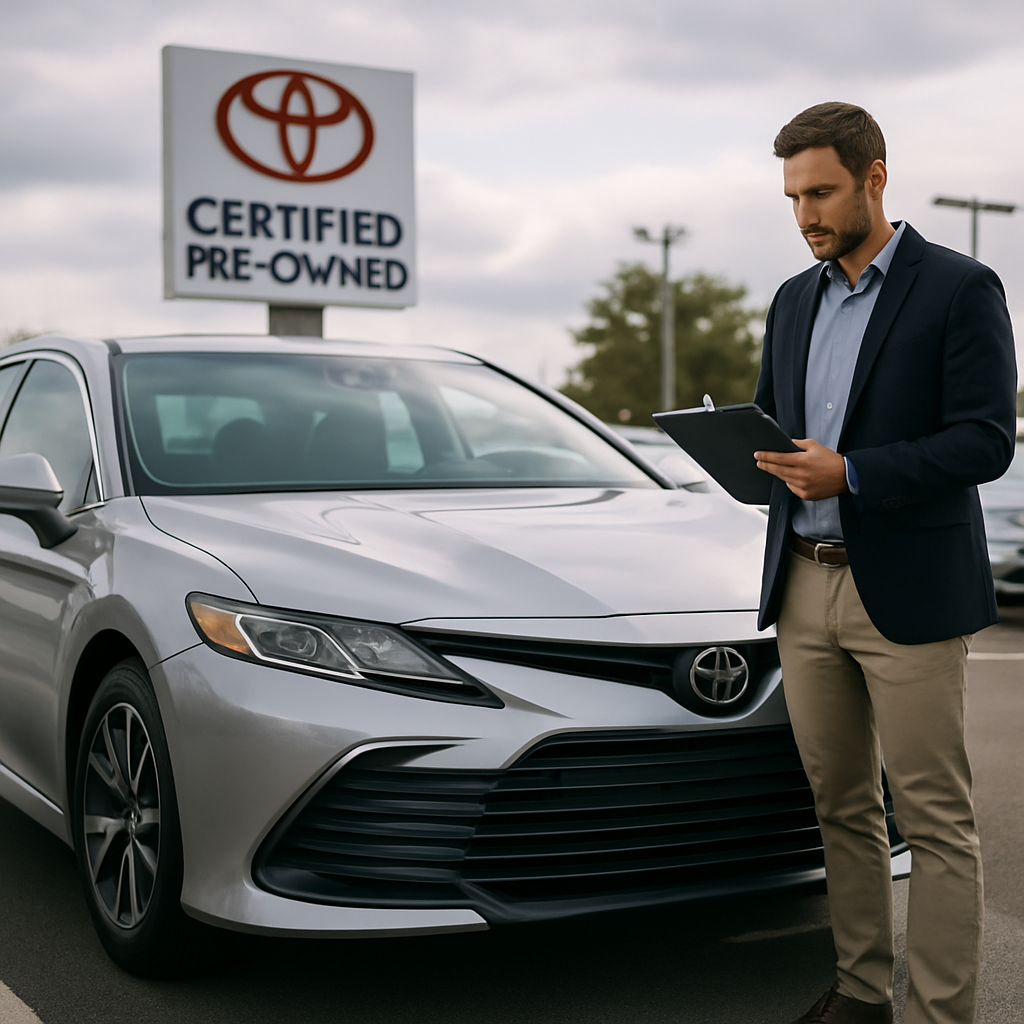
A Toyota certified pre-owned vehicle is a used Toyota sold through Toyota’s certified programme rather than simply as an ordinary used car. The practical benefit is that the vehicle has met the programme’s entry requirements and is sold with specified warranty and assistance benefits. It can be a sensible middle ground between new and used, but the certificate does not replace a careful inspection, a history check, or a close read of the paperwork.
What does it mean if a Toyota is certified pre-owned?
It means the car has been selected and prepared for sale under Toyota’s Certified Used Vehicles programme, with benefits attached to that certified sale. In the US, Toyota presents its certified inventory through its Toyota Certified Used Vehicles website, where buyers can search participating dealer stock.
Certification is not a universal description for every used Toyota. A privately advertised car, or one sold by an independent dealer, is not automatically certified because it is a Toyota. Ask the selling dealer to show you the certification documents and identify the programme that applies to that specific vehicle.
Programme rules, warranty wording, and eligibility can differ by country and market. This matters when comparing online advice: a result about Toyota U Trust in India or a Canadian programme may not describe a vehicle offered by a US dealer. Confirm the terms in the country where you will buy and register the car.
Toyota certified pre-owned warranty and roadside assistance
Warranty coverage is often the main reason to choose certified stock, but do not rely on a listing headline alone. A Toyota dealer in Greensboro describes certified vehicles as including a 7-year/100,000-mile limited powertrain warranty and one year of 24-hour roadside assistance; see its certified-inventory programme summary. The exact coverage, start date, exclusions, deductibles, transferability, and remaining factory warranty must be confirmed in the agreement for the car you are considering.
Before signing, ask for the warranty booklet or contract and establish:
- which components are covered by the certified warranty, and which are not;
- when each coverage period starts and ends;
- whether roadside assistance applies from purchase or another date;
- what maintenance records you must retain; and
- where warranty repairs may be carried out.
Wear items are especially worth discussing. Tyres, brake friction material, wiper blades, cosmetic trim, and routine servicing can be inspected or replaced during preparation, but that does not mean every future wear-related expense is covered.
Is it worth buying a certified pre-owned car?
It can be worth it if the additional price buys coverage and condition that matter to you, and the total deal remains competitive with a comparable non-certified Toyota. Certification is most useful for buyers who want a newer used car, prefer a dealer-backed process, and would rather reduce some early ownership uncertainty than pursue the lowest possible purchase price.
It is less compelling if the certified premium is large, the warranty duplicates coverage that is still in force, or a well-documented non-certified example is materially cheaper. Compare like for like: model year, mileage, trim, service history, tyres, brakes, accident history, and finance terms all affect value. A lower monthly payment can conceal a longer term or a higher overall borrowing cost.
Compare the car, not just the certified badge
Request the vehicle identification number, the history report offered by the dealer, service records, and the inspection or reconditioning record. Take a proper test drive from cold if possible. Check that warning lights illuminate during the start-up self-test and go out as expected, and test the air conditioning, infotainment, cameras, driver-assistance features, windows, locks, and keys.
A pre-purchase inspection by an independent technician can still be worthwhile. It may identify previous repair work, uneven tyre wear, fluid leaks, battery condition concerns, or faults that are not obvious during a short drive. Certification should make a car more reassuring; it should not make you stop asking questions.
How to find Toyota certified pre-owned cars near you
Start with Toyota’s certified-vehicle search, then contact a nearby participating dealer to confirm that the advertised car is physically available and remains certified. Dealer stock can change quickly, and photos or option lists are not always a substitute for checking the exact vehicle.
When comparing dealers, obtain an itemised out-the-door figure that includes the vehicle price, taxes, registration charges, dealer fees, accessories, and any required finance conditions. For example, a Fort Worth dealer advertises certified Toyota cars, trucks, and SUVs, but its page should be treated as a starting point for local inventory rather than proof of a particular car’s final price or equipment.
If you are shopping for a Toyota Certified Pre-Owned Land Cruiser or another scarce model, broaden the search radius and allow for transport costs. Scarcity can make comparison shopping more important, not less: confirm the specification, condition, service record, and warranty documents before placing a deposit.
What is the best second-hand Toyota to buy?
There is no single best second-hand Toyota for every buyer. The right choice is the one that suits your use, budget, and running-cost expectations, with a condition and history that stand up to scrutiny. A commuter may prioritise fuel economy and ease of parking, while a family may need rear-seat space, luggage capacity, and suitable safety equipment. A Land Cruiser buyer may place greater weight on towing needs, off-road use, and evidence of correct maintenance.
Choose the individual vehicle before choosing the badge. Compare service history, mileage, condition, equipment, and ownership costs among the models that fit your needs. A clean, well-maintained example with complete documentation can be a better purchase than a more fashionable model with vague history, even if both appear in certified listings.
Who has the best certified pre-owned cars?
There is no objective dealer or manufacturer that is best for every buyer. The stronger certified offer is the one with transparent terms, a vehicle in demonstrably good condition, a fair all-in price, and a dealer that answers specific questions clearly. Read the actual warranty terms rather than assuming that every certified programme provides identical protection.
Use dealer pages to identify stock, but judge the transaction from the documents and the car in front of you. A dealer such as Bredemann Toyota’s certified inventory page may help you locate available vehicles, while the final decision should rest on the exact vehicle’s records, test drive, inspection findings, and written sales terms.
A practical Toyota certified pre-owned buying checklist
- Confirm that the exact vehicle is certified, not merely described as used.
- Read the warranty and roadside-assistance terms before agreeing to buy.
- Check the vehicle identification number, service documentation, and any history report available.
- Test every key feature and take a meaningful road test.
- Compare the complete price and finance offer against similar certified and non-certified cars.
- Arrange an independent inspection if you have any doubt about condition or past repairs.
A Toyota certified pre-owned car can offer useful reassurance, particularly where its warranty and support terms suit your ownership plans. Treat the certification as one part of the buying decision, then verify the documents, assess the vehicle’s condition, and make sure the final price still makes sense for you.