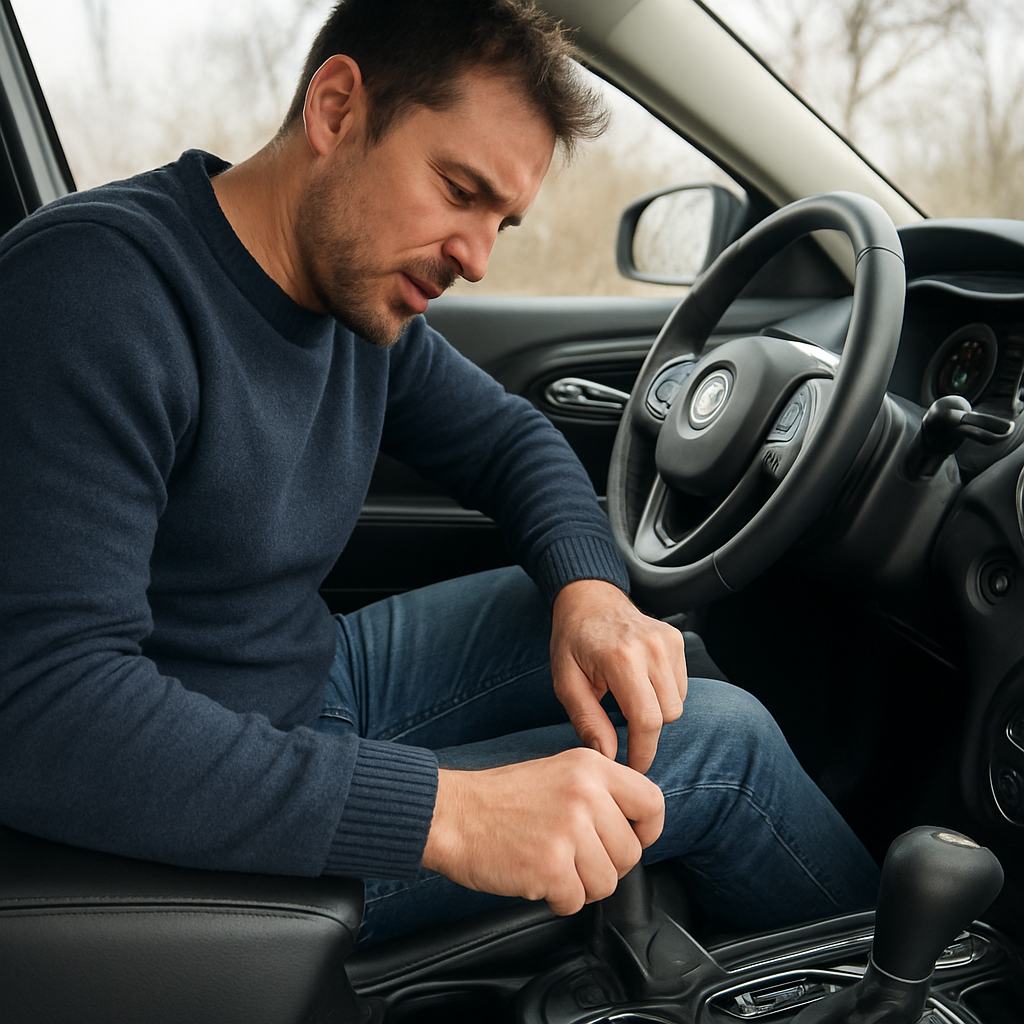
A Jeep that shifts roughly, late, inconsistently or not at all could have a fluid, electronic-control, sensor, solenoid, clutch or shifter-linkage problem. These are possibilities, not a diagnosis: several faults can produce similar symptoms, and the right checks depend on the Jeep’s year and whether it has an automatic or manual transmission.
Pay attention to exactly what happens. A delayed shift, a jolt between gears, an engine revving without the Jeep accelerating as expected, failure to upshift, inability to select a gear and a selector stuck in Park are different symptoms. Note when the problem occurs and whether it repeats; timing can help a technician investigate, but does not prove the cause.
Why a Jeep may struggle to shift gears
Possible causes include low or contaminated transmission fluid, a fault in the electronic controls or a sensor, or a malfunctioning solenoid. In a manual Jeep, worn clutch components or a damaged or stretched shifter cable or linkage may also make gear engagement difficult. Automatic and manual transmissions do not share all of these possible causes, so the transmission type matters.
Transmission fluid helps lubricate transmission components, and a low level or contaminated fluid can contribute to sluggish or rough shifting. A visible leak is a reason to seek assessment, but it does not by itself establish the condition of the transmission or prove that an internal component has failed. Fluid-check procedures and specifications vary, so do not assume your Jeep has an owner-accessible dipstick or use a generic fluid-check method. Consult the correct owner’s manual for your model year and transmission.
Automatic transmissions rely on electronic controls and sensors as well as hydraulic and mechanical components. A sensor or control-system fault, or a solenoid problem, may affect shift timing or gear selection. A diagnostic scan can help identify stored fault codes, but a code is a clue for diagnosis—not proof that the component named or associated with it has failed. For more context, see what a P0706 code can mean; this does not mean that a P0706 code is present or applies to every Jeep.
General automotive guidance also identifies fluid condition, sensors, solenoids and, in manual vehicles, clutch wear as possible contributors to shifting trouble. A general guide to why a car may not shift properly can help explain these categories, but it is not a model-year-specific Jeep diagnosis.
Describe the symptom before looking for a cause
- Delayed engagement: There is a pause after selecting a gear before the Jeep responds. Record which gear you selected and whether the delay happens consistently.
- Hard or jolting shifts: A gear change feels abrupt or produces a noticeable jolt. This can have more than one cause and does not, by itself, confirm transmission failure.
- Slipping or a missed shift: The Jeep does not seem to transfer engine power to the wheels as expected, or it fails to change gear when you expect it to. Avoid trying to reproduce the symptom in traffic.
- Failure to upshift or staying in one gear: Note whether this occurs from the start, after driving for a while, or under particular conditions. Those details may help diagnosis, but do not identify a failed part on their own.
- Shifter will not select a gear: This is different from a transmission that shifts roughly while driving. Do not force the selector.
Write down the model year, transmission type, warning lights or messages, the gear involved, and when the symptom begins—for example, after starting, after driving, or only intermittently. Note any visible fluid beneath the vehicle and unusual sounds. These observations help a technician distinguish a repeatable pattern from a one-off event without treating the pattern as proof of a particular fault.
If your Jeep will not go into gear
A Jeep that cannot engage a gear needs a different assessment from one that simply shifts harshly. Possible areas include low fluid, an electronic-control fault, or a shifter cable or linkage problem. On a manual, clutch or clutch-control issues may also prevent normal engagement; those possibilities do not apply in the same way to an automatic.
Do not force the shifter or keep trying to drive if the Jeep will not engage reliably, moves unpredictably, has a significant visible leak or makes an unusual noise while you attempt to select a gear. Stop attempts to drive and arrange qualified diagnosis or recovery as appropriate. A leak or inability to engage a gear is a symptom, not confirmation that the whole transmission needs replacement.
For further general guidance on this distinct problem, read what to check when a transmission will not go into gear. Any checks on your Jeep should be limited to those permitted by its owner’s manual. Do not crawl beneath a vehicle that is not properly supported or open a hot transmission system.
If your Jeep is stuck in Park
A selector that will not move out of Park may involve the gear-selector or shift-interlock system; it does not automatically mean the transmission has an internal failure. A brake-light switch fault is one possible reason a shift interlock may not release in some vehicles, but that does not establish the cause in a particular Jeep.
If it is safe to do so, ask someone to observe whether the brake lights illuminate when you press the brake pedal. Treat this only as an observation, not a definitive test. Check the correct owner’s manual and arrange qualified diagnosis if the selector remains stuck. Do not force the selector or bypass the interlock; model-specific release instructions cannot be established here.
Wrangler shifting problems: what can and cannot be inferred
Wrangler owners should first distinguish a transmission shift problem from a gear-selector or linkage problem. A manual Wrangler may also have a clutch-related issue. For an automatic, rough or delayed changes while driving are different from a selector that cannot be moved or a gear that cannot be engaged.
The available general sources do not establish a Wrangler-specific common fault, affected model years, confirmed transmission diagnosis or repair. Do not treat a symptom reported on another Wrangler as proof that your vehicle has the same problem. When seeking help, provide the model year, transmission type, exact symptom, warning lights and operating conditions, and follow the procedures in the correct owner’s manual. A qualified technician can assess the vehicle and its applicable service information.
What should you check first?
- Record what the Jeep does. Note whether the issue is delayed, harsh, intermittent, slipping, limited to one gear, or a failure to select a gear. Include when it happens and whether it repeats.
- Check for warning lights or messages. Record what appears and when. A warning or stored code can guide investigation but does not, by itself, confirm a failed part.
- Look for visible leaks from a safe position. Do not crawl beneath an unsupported vehicle. A leak should be assessed rather than treated as proof of a particular internal fault.
- Use the correct owner’s manual. Only check fluid if the manual describes an owner-serviceable procedure for your specific Jeep. Do not guess the fluid type, level-check method or service interval.
- Arrange diagnosis if the problem persists or worsens. A technician may use a suitable diagnostic scan and further inspections to identify the cause. The results need to be interpreted alongside the symptoms and vehicle-specific information.
If the Jeep also feels low on engine power, that is a separate symptom worth reporting rather than assuming it confirms a transmission fault. See other reasons a Jeep may feel low on power.
What a Jeep transmission repair may cost
There is no dependable dollar estimate for a Jeep transmission repair in the available evidence. The cost depends on the diagnosed cause, the Jeep’s model and year, transmission type, required parts and labour, and whether the work is an adjustment, a component repair or major transmission work. The fact that a Cherokee shifts hard does not establish that it needs a replacement transmission.
Ask for a written diagnosis and an itemised estimate before authorising major work. The estimate should make clear what has been found and what repair is proposed. A symptom alone—or a code without supporting diagnosis—is not enough to justify assuming that a complete transmission replacement is required.
Could the shifting problem be a recall?
A shifting symptom alone does not show that a Jeep is affected by a transmission recall. The available evidence does not identify a specific recall, affected models or years, remedy, or vehicle eligibility. Do not infer recall status from the symptom or from another owner’s report. For an answer about a particular vehicle, seek official recall information using the vehicle’s details or contact a Jeep dealer; no specific recall applicability can be confirmed here.
Can you reset a Jeep Cherokee transmission?
No universal Jeep Cherokee transmission reset procedure can be established from the available information. The correct process, if one applies, may depend on the model year and transmission, and no applicable manufacturer procedure or prerequisites are provided here. Do not rely on restarting the vehicle, disconnecting the battery or following a generic button sequence as a verified reset. Consult the correct owner’s manual or a qualified Jeep technician.
Bottom line: Fluid condition, electronic controls, sensors, solenoids, manual-transmission clutch components and shifter linkages are possible areas to investigate, but only a vehicle-specific diagnosis can identify the cause. If shifting is unreliable, getting worse, unpredictable or impossible, stop attempts to drive and arrange qualified assessment.