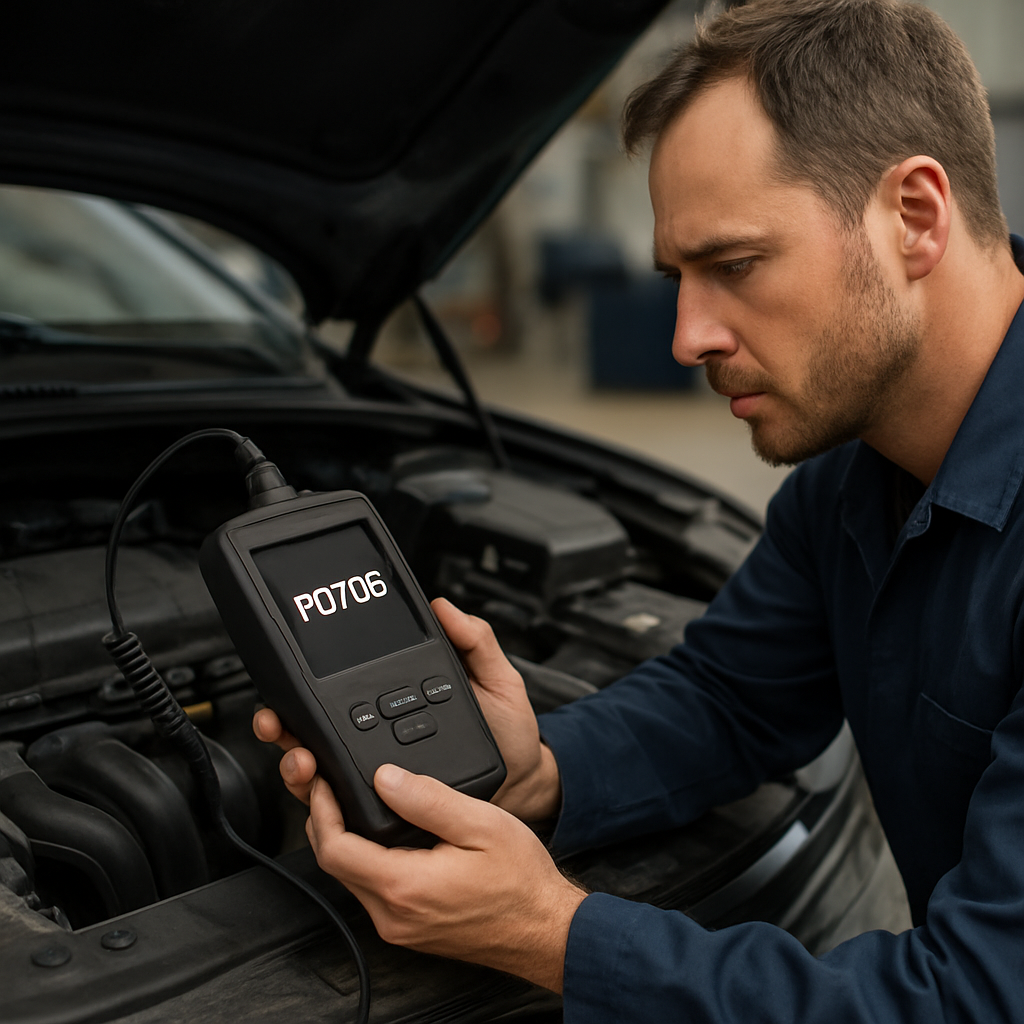
P0706 can cause difficulty selecting or changing gears, delayed engagement, an incorrect gear indication, or trouble starting, but some vehicles show no obvious symptoms. The code means the vehicle’s control system has detected a transmission range-sensor signal that is out of range or does not make sense for the selected gear. It does not, by itself, prove that the sensor has failed.
What does P0706 mean?
The transmission range sensor reports the gear-selector position—such as Park, Reverse, Neutral, or Drive—to the vehicle’s control system. P0706 is stored when that system detects a signal it considers implausible, inaccurate, inconsistent, or outside the expected range. The sensor may be at fault, but a wiring or connector problem, shifter linkage issue, or another transmission or control-system fault may also need investigation. More on what P0706 indicates is available from iCarsoft.
The general meaning applies to searches about P0706 on a Ford Fusion, Ford Ranger, Nissan, or Nissan Rogue, but it is not a model-specific diagnosis. The precise naming, system behaviour, diagnostic criteria, and follow-up tests can vary by year and transmission. The information here does not establish a particular cause, test value, or sensor location for any of those models; consult the relevant vehicle service information or a qualified technician.
If a scan also reports P0707 or a P1921 variant, do not assume those codes are interchangeable with P0706 or interpret them from their wording alone. They need to be identified and assessed using vehicle-specific diagnostic information.
What symptoms can P0706 cause?
Symptoms vary by vehicle, and a stored P0706 may not produce an obvious change in how the vehicle drives. When symptoms do occur, possible signs include:
- Difficulty selecting or changing gears: The shifter may be difficult to move from Park or Neutral, or the transmission may not respond as expected. If your transmission will not engage a gear, see what to check when a transmission will not go into gear; the cause is not necessarily P0706.
- Delayed gear engagement: There may be a pause before the transmission engages after a gear is selected.
- An incorrect or missing gear indication: The instrument display may show the wrong range, show no selected range, or behave inconsistently with the shifter position.
- Starting trouble: The vehicle may not start in Park or may start only in Neutral. This behaviour is not present on every vehicle with the code.
- Fail-safe behaviour or unusual shifting: Some vehicles may limit transmission operation or enter limp mode. Harsh shifts, slipping, or being stuck in one gear are also possible reported drivability problems, but they are not inevitable consequences of P0706.
A check-engine light or a transmission-related warning may appear, but a warning beyond the stored code is not guaranteed. These symptoms are clues, not confirmation that the range sensor is defective. For a general overview of possible symptoms and causes, see CarParts.com’s P0706 guide.
How is a P0706 fault diagnosed?
A technician should confirm what the control system is seeing before replacing parts. A sensible diagnostic process generally includes:
- Use a scan tool capable of reading transmission-related information, not just basic engine codes. Record P0706 and any accompanying codes before clearing anything.
- Compare the gear shown on the instrument display or scan tool with the position selected at the shifter. A mismatch can help identify where further checks are needed.
- Inspect the relevant wiring and connector for visible damage, corrosion, or a poor connection, and assess the shifter cable or linkage where appropriate.
- Where the vehicle supports it, monitor live range-sensor data while moving the selector through its available positions. The readings and acceptable limits are vehicle-specific; generic voltage figures should not be treated as universal specifications.
- Use the manufacturer’s service information to guide electrical tests and determine whether the sensor, wiring, linkage, or another transmission or control-system issue is responsible.
A stored code and a symptom alone cannot distinguish these causes. A qualified diagnosis is particularly appropriate if the vehicle will not start reliably, cannot select a gear, enters fail-safe mode, or shifts abnormally. If other transmission-control or communication codes appear, they should be assessed separately; what a separate TCM communication code can mean does not imply that U0101 is caused by P0706.
Where is the transmission range sensor located?
Its location depends on the vehicle and transmission. A range sensor may be mounted on top of or beside the transmission, but neither position is universal. The supplied information does not establish a specific location for a Ford Ranger, Ford Fusion, or Nissan Rogue, and a model name alone is not enough to identify the correct component or access method. Check service information for the vehicle’s year and transmission rather than relying on a generic location or attempting removal without the correct instructions.
How much does it cost to fix P0706?
There is no verified price estimate in the available research, so a reliable dollar figure cannot be given. The cost depends on the vehicle, local parts and labour rates, and what the diagnosis finds. A sensor replacement, wiring or connector repair, shifter cable or linkage work, and a less common transmission or control-system repair are different jobs and are not interchangeable.
Ask for an itemised diagnosis and estimate before authorising repairs. Replacing the sensor automatically may not address the cause if the fault is elsewhere. A P0706 diagnosis and repair overview also describes the need to consider the signal and its circuit rather than relying on the code alone.
What should you do if P0706 appears?
If the vehicle still selects and holds gears normally, arrange a prompt diagnosis rather than treating the code as proof of a particular failed part. Do not assume the vehicle is safe to drive solely because it is still moving. If gear selection is unreliable, drive is lost, the transmission slips, or shifting is severe, avoid continuing to drive and arrange qualified help. Do not work beneath a vehicle that is inadequately supported or probe transmission circuits without the correct service information and equipment.