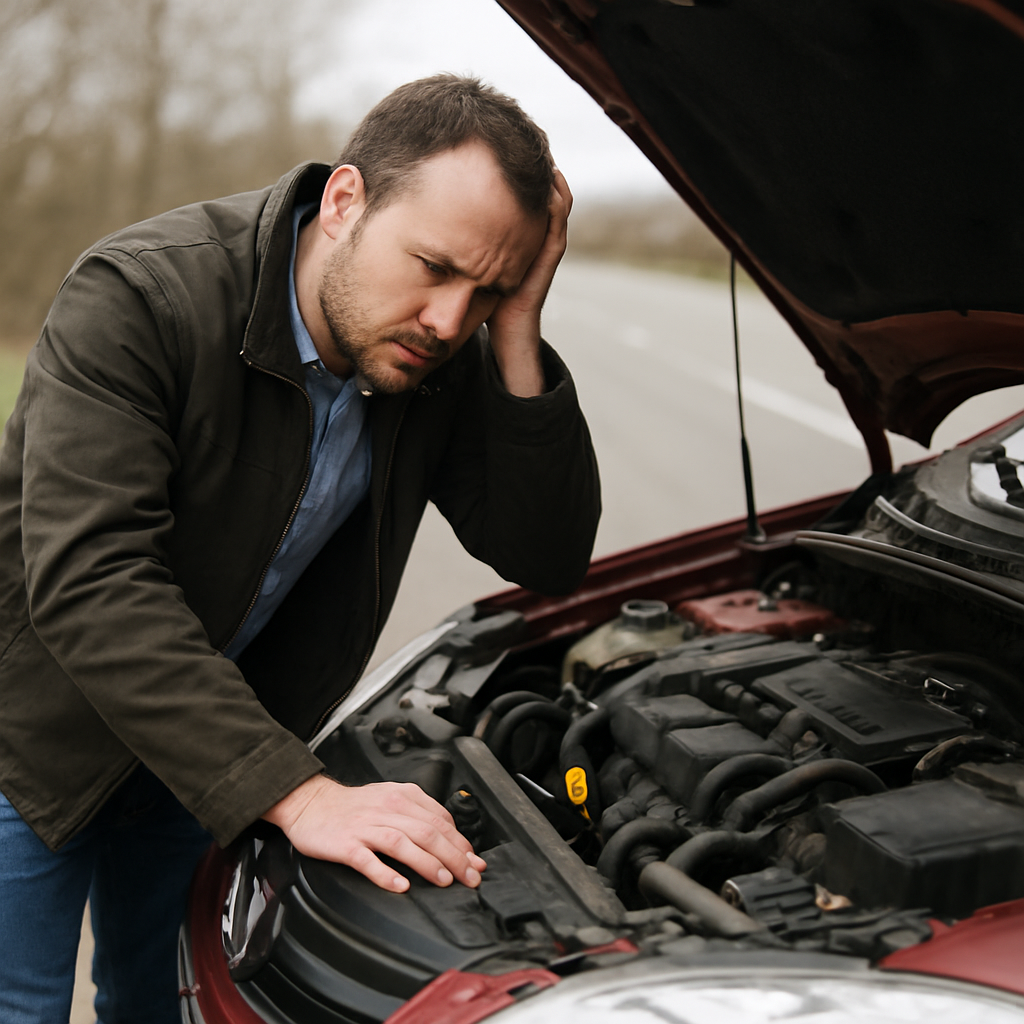
If your car stalls and then will not restart, fuel-supply trouble and faulty spark plugs are among the possibilities supported by the available evidence. However, the symptoms do not identify a failed part on their own. Start by noting whether the engine cranks, checking the fuel gauge and recalling whether it sputtered, ran roughly or lost power before stopping.
Why a car may stall and then not start
A cranking no-start is different from a no-crank condition. If the engine turns over but does not start, an AAA guide to no-start symptoms identifies inadequate fuel reaching the engine as one possible explanation. That is a clue rather than a diagnosis, and it does not establish why the engine stopped in the first place. If the engine does not crank, the evidence covered here is not sufficient to identify the cause.
Low fuel is a simple possibility to check. A gauge near empty and sputtering shortly before shutdown can fit with low fuel, but neither proves that the tank is empty or that a fuel-supply fault is the underlying problem. Treat the gauge reading and the symptoms as observations, not confirmation.
Faulty spark plugs are another possibility. AAA associates them with misfiring or sputtering, rough idling, sluggish performance and, in some cases, a check-engine light or fuel smell. These signs can help describe what happened, but one sign alone cannot confirm that the plugs caused a stall or a no-start.
A CarTalk discussion mentions a fuel pump, fuel-pump relay and crankshaft-position sensor in connection with a stall followed by a delayed restart. This is an individual discussion, not an authoritative diagnosis or proof that any of those parts has failed in your car. If a professional diagnosis points towards a pump on a Nissan Maxima, this Nissan Maxima fuel-pump guide is model-specific and does not confirm a fault on other vehicles.
If the car starts and then stops immediately, a faulty part is one general possibility mentioned by CarParts.com. That limited point does not establish that the battery, or any other particular component, is responsible.
What to check first when the car will not start
- Notice whether the engine cranks. Record whether it turns over or does not crank. These are different starting symptoms, but the distinction alone does not identify the failed part.
- Check the fuel gauge. Note whether it is near empty. If it is, that may be relevant, but it is not proof of the cause.
- Recall what happened before the stall. Note any sputtering, misfiring, rough running, sluggish acceleration, fuel smell or check-engine light, and whether the stall happened at idle, while stopping or under acceleration.
There is no single first check that diagnoses every no-start. If the engine cranks but does not start, more checks for a car that cranks but won’t start may help you understand that symptom. Do not replace parts or handle fuel-system components based only on these observations; recurring or intermittent problems need vehicle-specific diagnosis.
When the engine stalls at idle or at a stop
An engine that shuts off while idling, waiting at a traffic light or slowing down presents a useful symptom pattern to report, but the evidence available here does not establish a specific cause for a stopped or red-light stall. AAA lists rough idling as a possible symptom associated with faulty spark plugs; that does not prove the plugs caused the engine to stop.
Notice whether the engine ran unevenly or roughly before shutting off, or whether it stopped abruptly. This distinction helps describe the event, but it is not a diagnostic rule. The available evidence also does not identify an automatic-transmission-specific cause for stalling as the car comes to a stop. A recurring stall needs diagnosis rather than an assumed transmission or engine-part diagnosis. For separate component-specific reading, see how purge-valve problems may relate to stalling; that article does not establish that a purge valve is responsible for your symptom.
If the car stalls or struggles under acceleration
Sluggish acceleration and frequent stalling, particularly uphill or under heavy load, are among the symptoms described in AAA’s guidance. Sputtering or rough running may also be useful details to report. These symptoms do not identify a particular failed part or prove that the fuel, ignition or another system is at fault.
If the car has stalled while moving or will not restart, the information covered here does not establish a safe, step-by-step response for a motorway or freeway stall, nor does it determine whether the vehicle is safe to drive. Treat the driving circumstances as important information for a qualified diagnosis rather than assuming the car can continue to be used.
Manual-transmission stalls and clutch concerns
The available evidence does not explain why a manual car may stall, distinguish driver technique from a mechanical fault, or establish whether a particular stall damaged the clutch. It is not possible to predict clutch damage from the stall alone using these sources. If the problem is repeated, or the car also stalls outside of a manual gear change, describe the circumstances when arranging a vehicle-specific diagnosis.
In short, low fuel, fuel not reaching the engine and faulty spark plugs are possibilities, not confirmed explanations for every car that stalls and will not start. Whether the engine cranks, the fuel-gauge reading and the symptoms immediately before shutdown are useful first observations; repeated or intermittent stalling requires proper diagnosis.