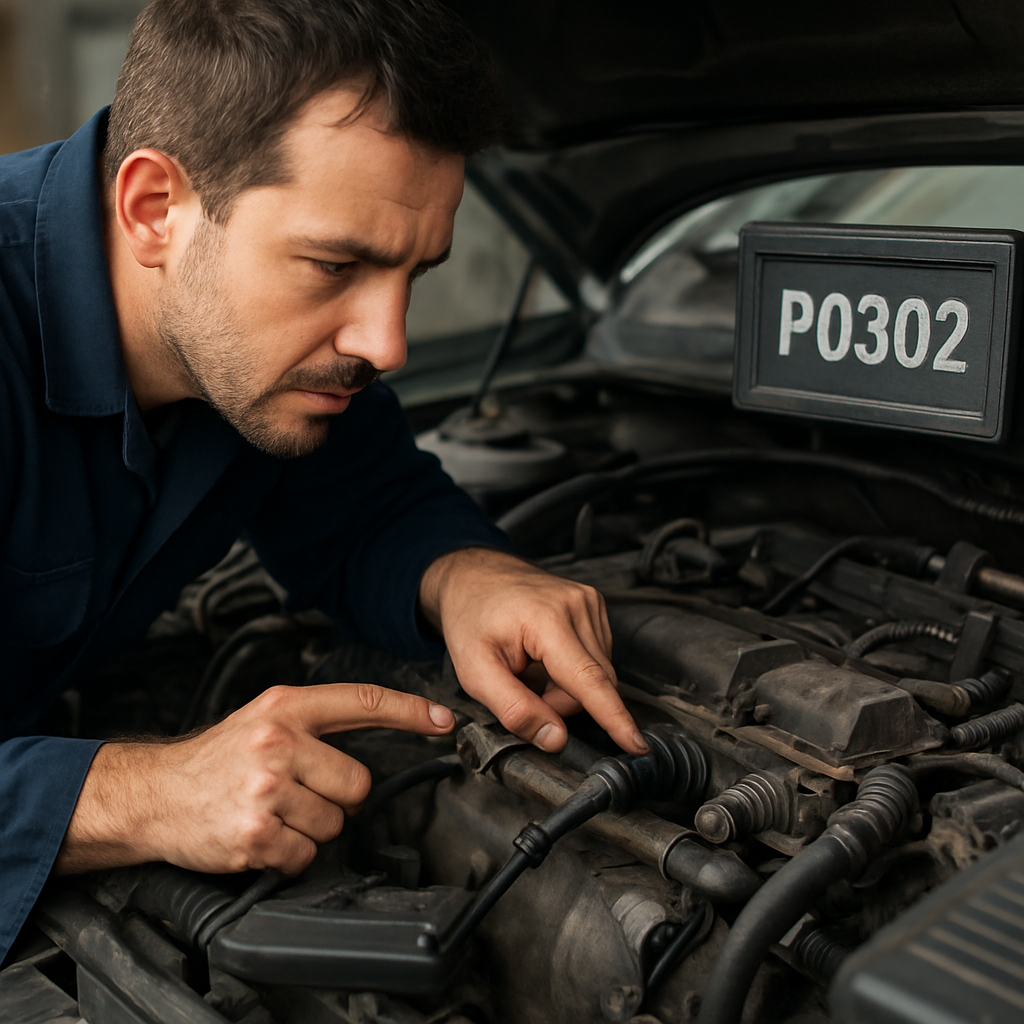
On engines with coil-on-plug ignition, a failed ignition coil for cylinder 2 is identified as the most common cause of P0302 by one repair reference. That is not a universal diagnosis: a worn or damaged spark plug, a faulty fuel injector, or a compression or other mechanical problem can also cause the code. P0302 means that a misfire has been detected in cylinder 2; it identifies the affected cylinder, not the failed part.
What does the P0302 code mean?
P0302 is an engine diagnostic trouble code meaning “Cylinder 2 Misfire Detected”. The engine control module (ECM) has detected irregular or incomplete combustion in cylinder 2. The code does not say why the misfire occurred, and it does not by itself confirm that a particular component has failed. Edmunds’ explanation of P0302 sets out the code’s general meaning; the cause must be assessed separately.
If your vehicle has other misfire codes as well, their meanings may differ. For example, our explanation of the P0300 random or multiple-cylinder misfire code covers a related code that does not identify cylinder 2 alone.
What is the most common cause of P0302?
A failed ignition coil serving cylinder 2 is described as the most common cause on coil-on-plug engines in the Fixxr guide to P0302. That qualification matters: the available evidence does not establish one most common cause across every vehicle, ignition design or engine.
Other supported possibilities include:
- A worn, fouled or damaged spark plug: A plug that is no longer operating correctly can contribute to a misfire in that cylinder.
- A faulty ignition coil: The coil serving cylinder 2 may not be producing a reliable spark.
- A faulty fuel injector: An injector fault can affect combustion in the cylinder.
- Low compression or another mechanical engine issue: If ignition and fuel-related checks do not account for the misfire, the cylinder’s mechanical condition may need investigation.
These are possible causes, not parts that should automatically be replaced when P0302 appears. The CarParts.com overview of P0302 causes also lists spark-plug, coil, injector and mechanical issues; identifying the actual fault requires diagnosis of the particular vehicle.
How is a P0302 misfire diagnosed and fixed?
The repair depends on what testing finds. A sensible diagnostic approach is to assess the cylinder 2 spark plug and ignition components first, consider the fuel injector if the initial checks do not explain the misfire, and investigate compression or other mechanical condition when appropriate. This is a general outline, not a vehicle-specific test procedure: the correct checks depend on the exact engine and its service information.
- Confirm the code and identify the correct cylinder. Use the vehicle’s service information to establish the cylinder numbering for that engine.
- Inspect the spark plug and ignition components. A visual inspection may reveal a worn, fouled or damaged plug, but it cannot rule out every electrical or ignition fault.
- Assess the fuel-injector possibility. Injector diagnosis may require suitable equipment and should follow the vehicle’s service information.
- Check compression or mechanical condition if needed. If ignition and fuel checks do not explain the misfire, further testing by a suitably equipped technician may be required.
- Repair the confirmed cause and verify the result. Do not treat clearing the code or replacing a part without supporting test results as proof that the fault has been fixed.
Some basic visual checks may be within an owner’s abilities, but electrical, fuel-system and compression testing can require appropriate tools and technical knowledge. Component-swapping tests are not suitable for every engine or vehicle; only use one where the vehicle’s service information supports it and the test can be performed appropriately. The YourMechanic P0302 reference also identifies spark-plug, ignition and compression issues among the possible causes.
Does P0302 mean something different on a Honda, Ford or Toyota?
The general meaning remains a detected misfire in cylinder 2, whether the code appears on a Honda, Ford, Ford Escape or Toyota Camry. The code alone does not establish a make- or model-specific cause, known defect or repair. The evidence available here does not confirm a unique Honda failure pattern or a particular repair for any of those applications.
Diagnosis and cylinder identification depend on the exact year and engine configuration. Consult the service information for your vehicle or a qualified technician rather than assuming that a cause or procedure reported for another model applies to yours. If your question concerns a 2017 Explorer specifically, see our guide to P0302 on a 2017 Ford Explorer; its scope is that named vehicle and it should not be taken as evidence of a Ford-wide or Escape-specific issue.
Where is cylinder 2 located?
P0302 tells you which numbered cylinder has the detected misfire, but it does not tell you where that cylinder sits in the engine bay. There is no universal left, right, front or rear location that applies to every vehicle. The engine’s make, model, year and configuration matter, so check the vehicle’s owner or service information for the correct cylinder numbering, or ask a qualified technician.
Why does a cylinder 2 misfire keep coming back?
A returning P0302 means that the cylinder 2 misfire has not been resolved or has occurred again; the code does not reveal the reason. The ignition coil, spark plug, fuel injector, or compression and mechanical condition may need to be reassessed. A recurring code is a reason to investigate the underlying fault rather than repeatedly clearing it or replacing parts speculatively.
Because several different faults can produce the same code, a technician may need to use vehicle-specific service information and suitable tests to distinguish between them. No single cause or recurrence pattern can be established from P0302 alone.
How much does it cost to fix P0302?
A reliable estimate cannot be given from the code alone. The cost depends on the diagnosed fault, the vehicle and local labour rates; the available research does not provide parts prices, labour times or a confirmed repair for a particular vehicle. Ask for an estimate after the cause has been identified rather than assuming that a coil, plug, injector or mechanical repair will be needed.