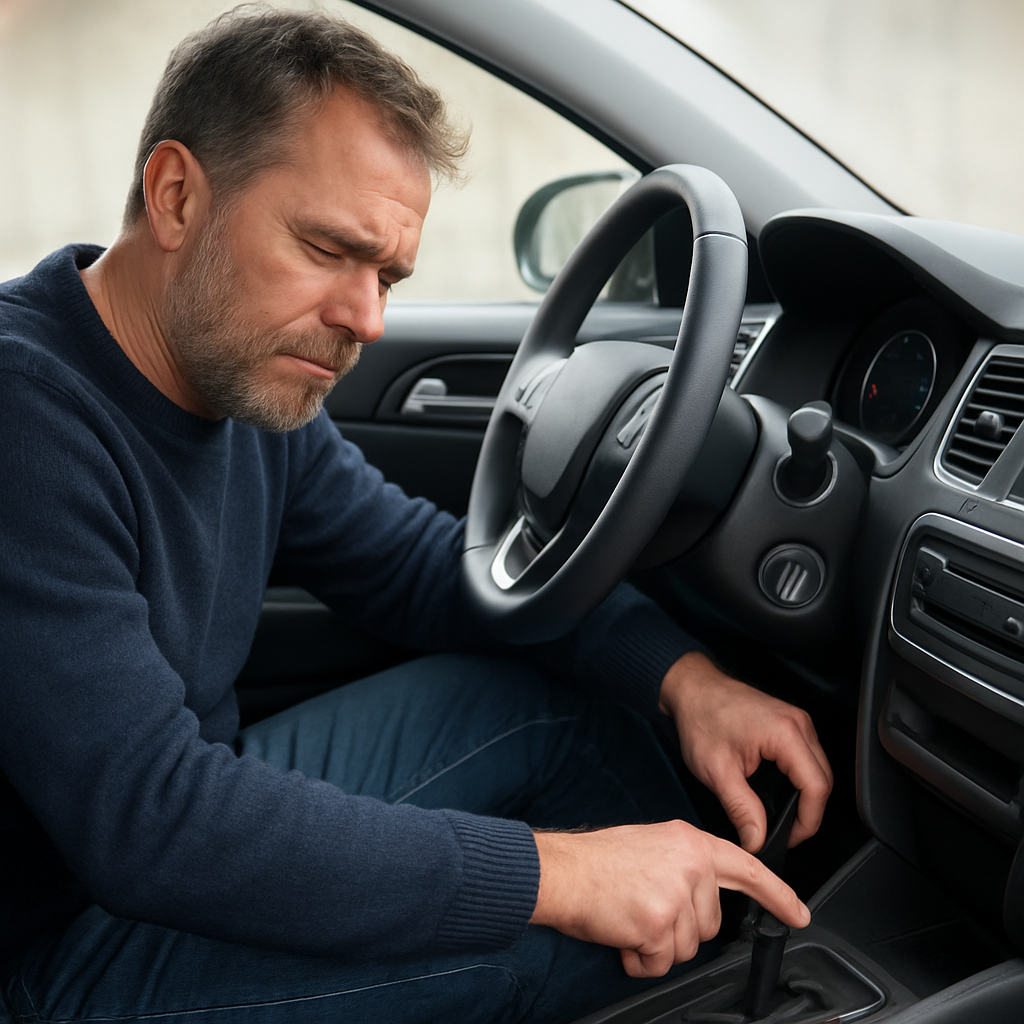
A hard brake pedal when the car will not start does not identify one failed part. If the engine has been off, pressing the brake may use up some of the stored power assistance, making the pedal feel firm. A separate battery or starting-system problem, or a fault that stops the car recognising the brake-pedal signal, may also prevent it from starting. The key distinction is whether the pedal becomes unusually hard while the engine is running or braking is impaired.
Why the brake pedal gets hard while parked—and how to press it to start
Some vehicles retain a reserve of brake assistance after the engine is switched off. In vehicles with vacuum-assisted brakes, pressing the pedal while the engine is off can use up that reserve, making the pedal feel firm or hard. A firm pedal by itself does not prove that the brakes are mechanically locked or broken. A consumer Q&A about this symptom also describes depleted reserve vacuum as one possible reason for a stiff pedal after the engine is off.
The amount and type of assistance vary by vehicle, so follow your owner’s manual rather than assuming every car works the same way.
If you are trying to start the car, make these simple checks:
- Make sure the vehicle is in Park. Use Neutral only if the owner’s manual permits it for starting.
- Check that a floor mat or another object is not obstructing the pedal.
- Press the brake with a firm, controlled movement while using the normal starting procedure. Do not stand on, jump on or force the pedal, and do not try to bypass the brake-start interlock.
- Check the manual for the correct procedure for your key or push-button system, including any model-specific instructions.
If the pedal stays unusually hard after the engine starts, or braking feels reduced, arrange a professional inspection. A change in pedal feel does not by itself confirm that the brake system is healthy.
When the car does not recognise that you are pressing the brake
Many push-button cars need a brake-pedal signal before they will start. A faulty or misadjusted brake switch, or a problem elsewhere in its wiring or control circuit, is one possible reason the car does not recognise that signal. A car that will not start does not necessarily have a mechanical device locking the brake pedal.
If the button cycles through accessory or ignition modes without cranking, a missing brake signal is one possibility, not a confirmed diagnosis. A brake-switch or circuit problem needs to be tested rather than assumed. Do not bypass the interlock; if the problem persists, have the switch and related circuit checked.
Check the no-start symptoms too: battery, starter and ignition faults
The hard pedal and the no-start may have separate explanations. A firm pedal after the engine has been switched off can result from depleted stored assistance, while a weak battery or a fault in the starter circuit or ignition system may independently prevent cranking.
Clicking or the car remaining in accessory or ignition mode without the starter turning are symptoms to report when arranging diagnosis. They do not identify a failed component on their own. A battery and its connections are reasonable things to have checked. If considering a jump-start, follow the vehicle manual and its safe procedure; a jump-start is not appropriate for every situation. For help separating battery symptoms from possible charging-system symptoms, see how battery and alternator symptoms differ.
If the engine cranks normally but does not start, the hard pedal alone does not identify the cause. Repeated failures, warning messages or unusual braking behaviour are reasons to stop troubleshooting and arrange professional diagnosis.
Owner reports illustrate why symptoms should not be treated as a diagnosis: accounts on The Nissan Club describe different no-start and hard-pedal experiences in Altimas, including cases where the cause was not immediately identified. These reports do not establish a failure rate or prove that a particular part has failed.
If the pedal goes hard while the engine is running
A hard pedal while the engine is running is different from a firm pedal after the car has been parked. Loss of brake assistance is one possibility. On a vehicle that uses vacuum assistance, a problem involving a hose, check valve or booster could contribute, but the symptom alone cannot confirm which component, if any, has failed. Other vehicles may use different assistance systems.
If the pedal remains hard or braking assistance seems reduced, do not continue the journey. Pull over as safely as possible and arrange professional inspection or towing. A pedal that still moves, or the absence of a warning light, is not enough to establish that the car is safe to drive. For more on how to recognise possible brake-booster or master-cylinder symptoms, see our related guide; a technician is needed to diagnose the fault.
If the car is not stopping normally, treat it as an emergency
If braking is impaired while the vehicle is moving, focus on getting to a safe stop rather than troubleshooting or trying to restart the car. Do not continue driving. Once stopped, seek roadside assistance or emergency help as appropriate. A hard pedal can indicate a loss of assistance, but it does not by itself establish the exact failure or prove that the car has no braking at all. Do not use a start-up check or booster test as a substitute for responding to an immediate braking problem.
A hard pedal is different from a soft or sinking pedal. If your symptom is the latter, read what a soft or sinking brake pedal can mean.
If you drive a Toyota
The general distinction still applies: a pedal may become firm after the engine has been off as stored assistance is used, but a pedal that remains unusually hard with the engine running needs attention. These symptoms alone do not identify a Toyota-specific fault or repair. Check your owner’s manual for the starting instructions for your model and consult a qualified service provider if the problem persists.
If you drive a Nissan Sentra
A brake-switch signal problem or an independent battery or starting-system fault is possible, but the symptom does not confirm any of them. The Nissan owner report cited above concerns an Altima, not a Sentra, and does not establish a Sentra-specific fault or repair. Use the Sentra owner’s manual for its start procedure and seek diagnosis from a qualified Nissan service provider if the issue continues.
If you drive a Nissan Kicks
The same general checks may help frame the issue: distinguish a firm pedal after the engine is off from a persistent hard pedal while it is running, and consider that a brake signal or a separate starting-system fault may be involved. The Nissan report cited above concerns an Altima, not a Kicks, and does not establish a Kicks-specific fault or repair. Check the Kicks owner’s manual and contact a qualified Nissan service provider for model-specific guidance. If an Altima also displays “No Key Detected,” see what to check for that Altima key-detection message; its information should not be treated as a Sentra or Kicks procedure.