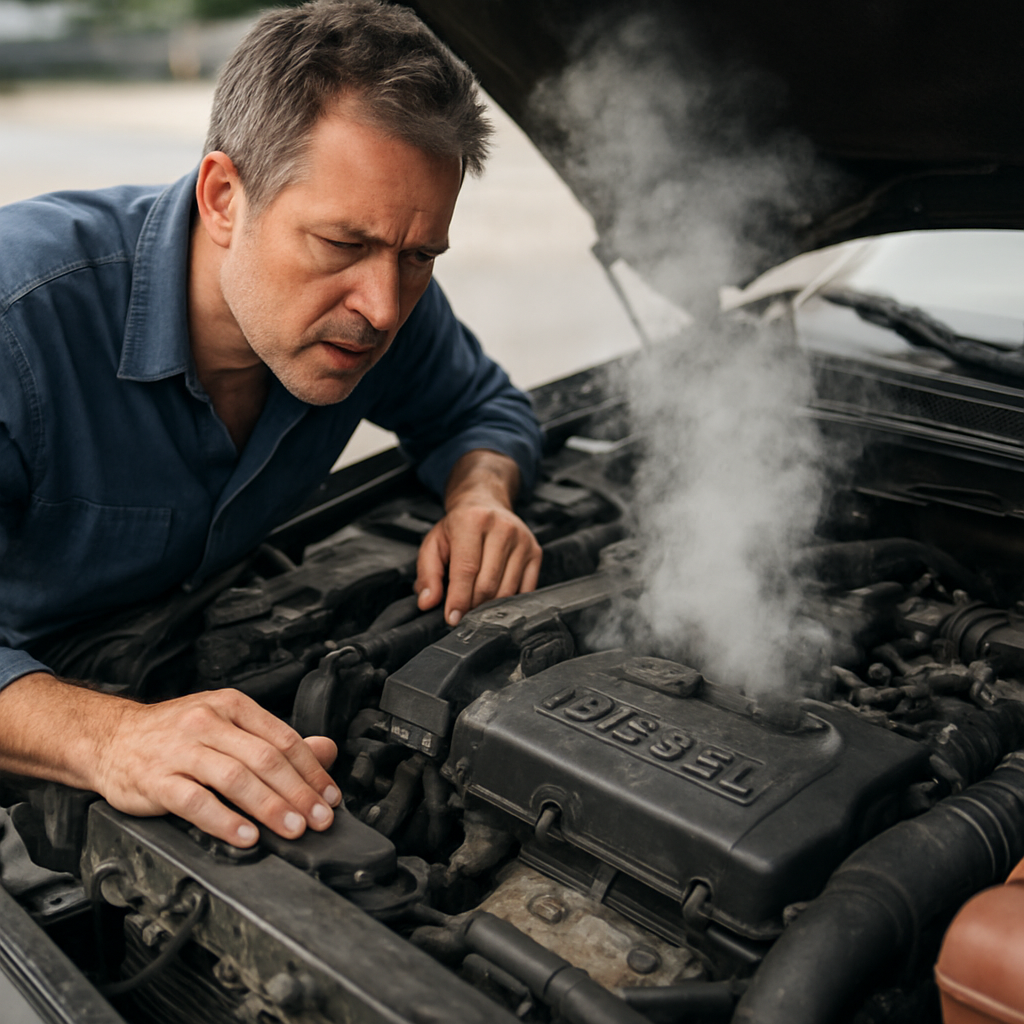
Diesel engines can overheat for several reasons, but the strongest recurring explanation in the supplied evidence is a cooling-system problem—especially low coolant caused by coolant loss. A thermostat that restricts flow, a radiator or airflow problem, or a fault affecting coolant circulation may also be involved. These are possible causes, not a diagnosis: much of the available guidance covers general automotive cooling systems rather than diesel-specific testing or failure rates.
Common causes of diesel-engine overheating
The cooling system must carry heat away from the engine and release it through the radiator. Coolant loss, restricted circulation, or inadequate heat dissipation can interfere with temperature control. A temperature warning alone does not identify which, if any, component has failed.
Low coolant or a leak
Low coolant is a common reason for overheating. Coolant may escape from a hose, radiator, or water-pump seal, among other cooling-system parts. A leak can reduce the amount of coolant available to carry heat away from the engine. The overview of diesel-engine overheating causes discusses coolant loss and restricted airflow; general guidance also identifies cooling-system leaks as a frequent cause of overheating.
A leak may not be obvious from a quick look. Conversely, a wet patch or residue does not by itself identify the failed part. A technician may need to inspect and test the system to find the source of coolant loss.
A thermostat that does not open correctly
A thermostat that sticks closed or does not open as it should can restrict coolant flow and contribute to overheating. Thermostat faults do not all behave the same way, so an overheating reading is not enough to confirm that the thermostat is at fault.
Radiator, fan, or airflow problems
Radiator damage or restricted heat dissipation may reduce the system’s ability to release heat. A cooling fan that is not operating when needed, or airflow obstructed at the radiator, can also be possible factors. These are separate possibilities: a fan or airflow concern does not prove that the radiator itself is faulty. General overheating guidance on fans, hoses, and coolant circulation describes these as potential areas to check.
Water-pump or other circulation problems
The water pump helps circulate coolant through the system. A pump fault, including a possible seal leak, or another circulation problem may contribute to overheating. A visible leak, unusual temperature reading, or other symptom cannot confirm a pump failure on its own.
Coolant condition or compatibility
Coolant condition can matter, but the correct type and service requirements depend on the vehicle. Use the coolant specified in the owner’s manual, and do not mix coolant types unless the manufacturer says they are compatible. The available guidance discusses coolant compatibility and deterioration in general terms, not a specification for every diesel vehicle. This concerns coolant—not mixing old and new diesel fuel.
An inaccurate temperature reading
A faulty sensor or gauge can produce a misleading or erratic temperature reading. That possibility needs verification; an unusual reading does not, by itself, prove that the engine is overheating. A technician can compare the displayed reading with diagnostic information and assess the system.
An internal coolant leak or head-gasket fault
An internal coolant leak or head-gasket fault is another possible cause, but overheating alone does not confirm either one. These faults require professional diagnosis. General overheating guidance that includes internal leaks should not be treated as evidence that a particular diesel engine has a head-gasket problem.
The available evidence does not establish a diesel-specific ranking for these causes. It also does not verify air-filter restriction, a DPF fault, heavy loads, uphill driving, or cold weather as general causes of diesel-engine overheating. Vehicle-specific diagnosis may require the relevant manufacturer service information.
What happens when a diesel engine overheats?
Warning signs can include the temperature gauge reaching the red zone or a temperature warning appearing. A burning or coolant-like smell, or unusual ticking or thumping sounds, may also be noticed. These are warning indicators, not proof of a particular failed component or of how much damage may have occurred.
If the gauge reaches the red zone, pull over safely and switch the engine off. Do not continue driving to see whether the temperature comes down. The supplied evidence does not establish a universal diesel temperature threshold, how quickly damage might occur, or what damage a particular engine has sustained. If overheating persists, coolant is being lost, or the warning returns, arrange a professional assessment rather than assuming that restarting or topping up has made the vehicle safe to drive. For broader context on how engine temperature readings should be interpreted, bear in mind that no single figure necessarily applies to every diesel engine.
General automotive safety guidance from AAA on overheating warning signs and what to do supports stopping safely when the gauge reaches the red zone. It is not a diesel-specific owner-manual procedure.
Three checks you can make safely
These are preliminary observations, not a way to confirm the cause. If the gauge is in the red or a severe temperature warning is displayed, first pull over safely and switch off the engine. Do not carry out checks beside a running, overheating engine.
- Check the gauge or warning. Note whether the gauge is in the red or a temperature warning is displayed. If the reading seems implausible or fluctuates, record what you observe, but do not assume that the engine is either overheating or unaffected without verification.
- When the engine is fully cool, check the coolant level. Use the reservoir markings and look for visible signs of coolant loss around accessible hoses or beneath the vehicle. Never open a hot, pressurised cooling system. A normal-looking level or no visible leak does not rule out a hidden leak or another cooling-system fault.
- Look for obvious airflow or fan concerns from a safe position. Check for a clear obstruction to radiator airflow and, only if it is safe and appropriate to observe, whether the cooling fan appears to operate. Keep hands and tools away from the fan and all moving parts; do not run a hot engine as a test. Fan operation depends on vehicle conditions, so not seeing it run is not by itself a diagnosis.
Simple checks cannot rule out a thermostat fault, a circulation problem, a hidden leak, or an inaccurate temperature reading. Seek a qualified technician if overheating continues, coolant loss recurs, a warning returns, or you are uncertain about the reading. General guidance on cooling-system leaks and overheating can help explain why a visible leak is one possibility, but it cannot diagnose a specific vehicle.