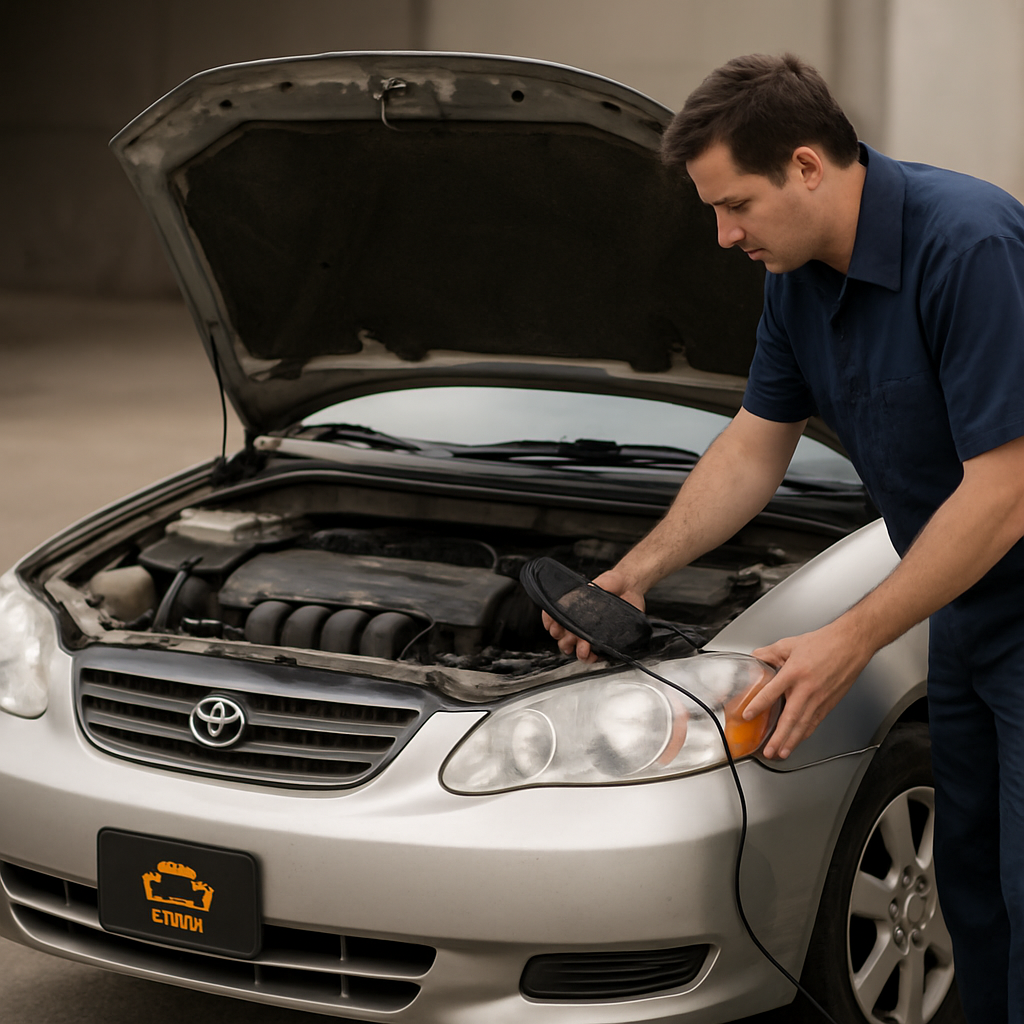
On a 2002 Toyota Corolla, P0420 means Catalyst System Efficiency Below Threshold (Bank 1). The engine computer has detected that the catalytic converter system is not meeting its programmed efficiency threshold. The code points to a system-performance problem; by itself, it does not prove that the catalytic converter or either oxygen sensor has failed.
The computer assesses the converter using information from oxygen sensors before and after it. When the converter is working properly, the downstream sensor reading is generally steadier than the upstream sensor reading as the air-fuel mixture changes. If the readings do not match the computer’s expected pattern, it may store P0420. This is a general explanation of the monitoring system, not a confirmed diagnosis of your Corolla.
What P0420 means on a 2002 Toyota Corolla
The catalytic converter helps treat exhaust gases, and P0420 indicates that the computer has detected catalyst efficiency below its threshold. The code is sometimes described as a catalytic-converter code, but that shorthand can be misleading: it identifies a monitored system result, not necessarily the failed component. Sensor problems, exhaust leaks, or engine and fuel-control faults can also affect the system’s readings.
Further testing is needed before deciding whether the converter, an oxygen sensor, or another component needs repair. Replacing the converter without finding and addressing an underlying engine or fuel problem may leave the cause unresolved and could damage the replacement part.
Where Bank 1 is—and what can be identified from this code
Bank 1 identifies the engine bank monitored by the code. P0420’s monitoring system uses oxygen-sensor information from before and after the catalytic converter. The code does not, on its own, identify a failed sensor or provide an exact physical location for a particular sensor or converter.
The available research does not include a 2002 Corolla exhaust diagram or an engine-specific sensor map, so it would be unwise to guess where a component sits on your car. If you need to identify a sensor or converter before inspection or repair, use service information specific to your vehicle or ask a technician to locate it.
Can you drive with P0420?
If the check-engine light is steady and the car has no severe symptoms, general diagnostic guidance allows for a short, cautious trip to a repair shop. That is not a guarantee that continued driving is safe, and it is not a reason to ignore the warning or keep using the car as usual.
Stop driving and seek prompt professional help if the check-engine light is flashing, the car is shaking or has a severe misfire, power drops sharply, the engine overheats, or you notice a strong rotten-egg odor. P0420 appearing alongside misfire codes also needs urgent attention, since continued misfiring can damage the catalytic converter. These are general safety guidelines, not a Toyota-specific operating instruction.
For more detail on the symptoms that affect driving decisions, see our guide to driving with a P0420 code.
How to diagnose and fix P0420 without guessing
The right repair depends on what testing finds. A sensible diagnostic approach is to:
- Retrieve all stored codes. Other codes can point to problems that affect engine operation or the catalyst-monitoring results. Do not focus on P0420 in isolation.
- Investigate misfires and fuel-control faults. Check for related engine problems before condemning the converter. Misfires and other unresolved faults can affect converter performance.
- Check the exhaust system for leaks. An exhaust leak is one of the issues a technician should consider when evaluating the readings.
- Assess the oxygen sensors and their signals. The code involves sensor information, but it does not prove that either sensor is faulty.
- Evaluate the catalytic converter after those checks. If testing supports converter inefficiency and other relevant faults have been addressed, converter repair or replacement may be considered.
Possible repair areas include oxygen sensors, fuel injectors, spark plugs, ignition coils, the exhaust manifold or pipes, the muffler, the thermostat, the engine-coolant-temperature sensor, and the catalytic converter. This list describes possibilities for diagnosis; it does not mean that any of these parts has failed on this Corolla.
A repair that does not involve replacing the converter may resolve P0420 if testing identifies another repairable cause. There is no supported guarantee of an easy, cheap, or permanent workaround, and clearing the code, using an additive, or replacing a sensor without diagnosis should not be treated as a proven fix. Converter replacement is commonly considered when testing confirms low converter efficiency, but the available evidence does not establish a quantified “most common” repair for a 2002 Corolla.
If you do not have the equipment or experience to assess the system, have a repair shop diagnose it. Professional help is especially important if the car has a misfire, significant power loss, overheating, or another severe symptom. Do not work beneath a vehicle that is not properly supported or handle hot exhaust components.
For a broader step-by-step overview, see our guide to diagnosing and fixing a P0420 Bank 1 code. General diagnostic guidance is also available from Identifix’s P0420 diagnosis and repair guide.
Will resetting P0420 fix it?
No. Clearing a stored code only removes the record; it does not repair the fault that caused the computer to detect low catalyst efficiency. Diagnose and repair the underlying cause first, then use an appropriate scan tool or a qualified shop to check the result.
The available sources do not establish the exact code-clearing procedure, readiness-monitor behavior, or confirmation drive-cycle requirements for a 2002 Corolla. Do not assume that disconnecting the battery is the right procedure or that the warning will stay off after a reset.
What to do next
Record P0420 and any other stored codes, pay attention to how the car is running, and arrange for a diagnosis rather than replacing parts based on the code alone. If the light is steady and there are no severe symptoms, a short, cautious trip to a shop may be reasonable; if the light flashes or the car shows the warning signs above, stop driving and seek prompt professional help. The P0420 catalyst-system guide from Rohnert Park Transmission also explains why the code should be diagnosed before a converter is condemned.