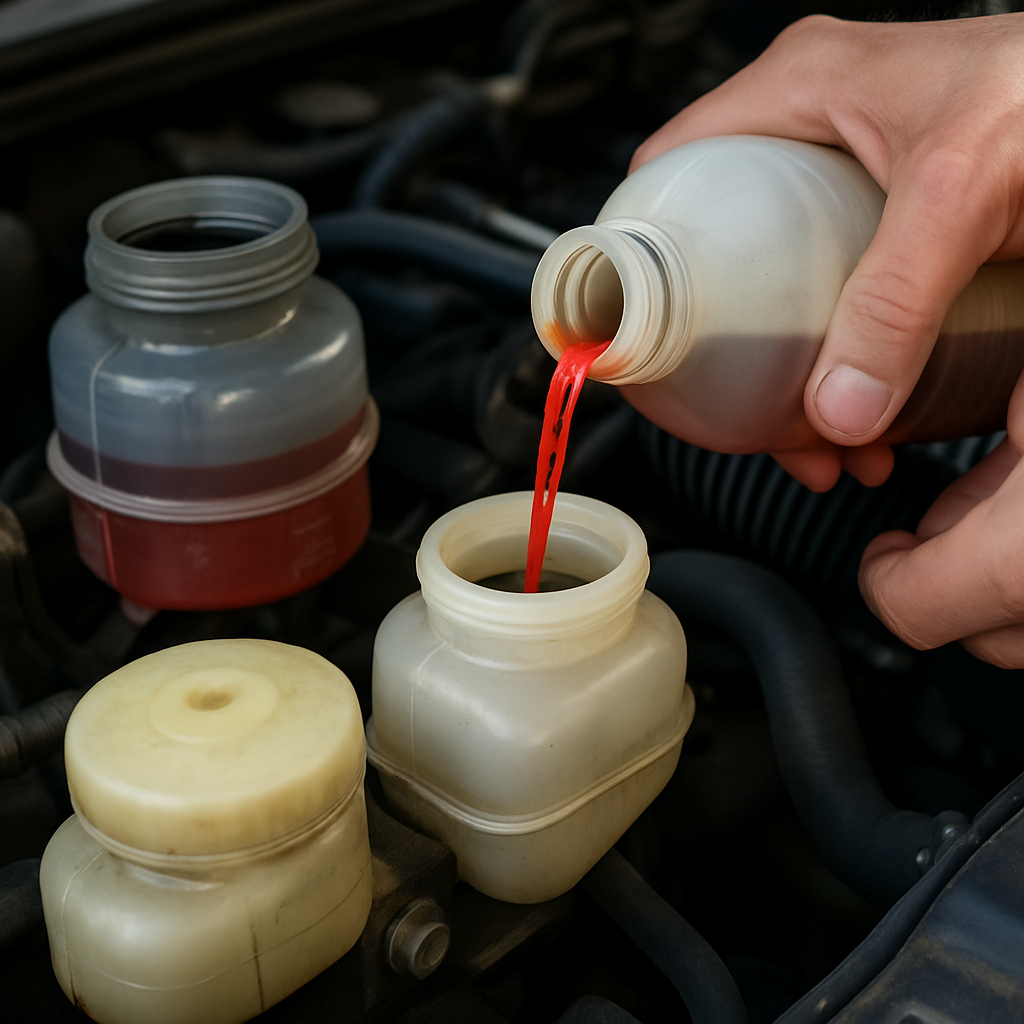
Do not drive the vehicle. If you accidentally put power steering fluid in the brake-fluid reservoir, do not start the engine or press the brake pedal after discovering the mistake. Power steering fluid is not a substitute for brake fluid, and the safest response is to arrange a qualified brake-system assessment and decontamination, usually by having the vehicle recovered rather than driven.
The urgency depends partly on whether the wrong fluid has been moved beyond the reservoir. Finding the error before operating the brakes is preferable, but it does not make the contamination harmless or prove that simply removing visible fluid has fixed it. If the pedal has been pressed, the vehicle started, or the vehicle driven, tell the repairer exactly what happened.
Do Not Drive: What to Do Immediately If Power Steering Fluid Went Into the Brake Reservoir
- Stop and do not use the brakes unnecessarily. Do not start the vehicle, drive it, or pump the brake pedal. Operating the brakes may move contaminated fluid from the reservoir into the brake hydraulic system.
- Do not top up the reservoir with fresh brake fluid. Adding the correct fluid does not remove the wrong fluid or establish that the system is safe.
- Do not rely on siphoning or skimming as a complete repair. Removing fluid visible at the top of the reservoir may reduce exposure in some circumstances, but it cannot confirm that contamination has not reached other parts of the system.
- Arrange recovery and qualified brake service. Explain that power steering fluid was added to the brake-fluid reservoir, give the approximate amount if known, and say whether the brake pedal was pressed or the vehicle was driven.
Guidance from CarParts similarly advises avoiding brake use and driving after the error is discovered. It describes reservoir cleaning or removal and purging of the brake system as possible parts of remediation. Those are not universal DIY instructions: the appropriate repair scope depends on the vehicle and on whether contamination entered the brake lines.
If you noticed before pressing the brake pedal
This is the lower-exposure situation because the wrong fluid may have remained in or near the reservoir. Do not assume it is safe, however. The reservoir and brake system still need assessment, and the repairer must decide what cleaning, fluid replacement, and inspection are required for that vehicle.
If you started, drove, or pressed the brake pedal
Treat this as a higher-exposure situation. Brake use can move fluid through the hydraulic system, increasing the concern that contamination has reached components beyond the reservoir. Do not attempt to drive to a workshop. Have the vehicle recovered and disclose the fluid type, estimated quantity, and use of the brakes.
Nissan and Ford owners
The immediate principle is the same for a Nissan, Ford, or another make: do not drive after power steering fluid has entered the brake reservoir. Brake-fluid requirements and reservoir or system arrangements can vary by vehicle, so use the exact owner’s manual and service information for the particular model rather than applying a generic fluid specification or repair procedure.
What Can Happen If the Wrong Fluid Is in the Brake Reservoir?
Brake fluid and power steering fluid are formulated for different systems and are not interchangeable. Although both are associated with vehicle hydraulic systems, that does not make them compatible. Mechanic Base also advises draining and refilling a system when either fluid has been used in the other system, rather than treating one as an alternative for the other.
If power steering fluid remains in the brake reservoir and enters the brake hydraulic system, it may affect rubber seals. The CarParts guidance specifically warns of possible seal swelling if the contamination is not fully removed. This is a contamination risk that warrants professional assessment; it is not proof that every vehicle will suffer the same damage or loss of braking performance.
There is no reliable universal answer to, “How long does it take for power steering fluid to mess up brakes?” The supplied guidance does not establish a safe number of minutes, miles, days, or a safe contamination quantity. What matters more is whether the wrong fluid remained only in the reservoir or was circulated by brake use. For the same reason, replacing only the visible fluid does not demonstrate that the brake system has been restored to safe condition.
Seek urgent professional assessment if there is a brake warning, a soft or sinking pedal, a brake-fluid leak, or reduced braking performance. Those signs do not by themselves confirm contamination as the cause, but they should not be ignored.
Can Power Steering Fluid Replace Brake Fluid, and Does It Float?
No. Power steering fluid must never be used to top up a brake system, including in an emergency. The two fluids have different formulations and intended functions, so the fact that each can be described broadly as a hydraulic fluid is not a basis for substitution. CarRoar’s comparison of brake and power steering fluid likewise states that the fluids should not be used in place of one another.
One supplied secondary source reports that power steering fluid may initially float above brake fluid in a reservoir. That observation is not a universal test, a dependable way to identify fluids, or evidence that the brake system is uncontaminated. Even if separate layers appear visible, do not treat that as permission to skim the top layer and drive. Do not use colour, smell, or appearance to decide whether a safety-critical fluid is compatible.
If You Put Brake Fluid in the Power-Steering Reservoir Instead
This is the reverse mistake and involves a different system, but it also requires prompt action. Do not use brake fluid as power steering fluid and do not start or operate the vehicle simply to circulate it. The general supported approach is prompt drainage or decontamination and refilling with the power-steering fluid specified by the vehicle manufacturer.
Sources discussing the reverse error warn that brake-fluid contamination can affect power-steering-system seals, hoses, gaskets, pump lubrication, and related components, particularly if it circulates. Rx Mechanic’s guidance on brake fluid in a power-steering system describes risks to seals, hoses, and other components. That does not establish that every small amount will ruin a power-steering pump, especially if the error is discovered before the engine is started, but it is not a situation to ignore or test by driving.
If the engine has not been started
Discovering the error before the system has operated may reduce the opportunity for the fluid to circulate. It does not guarantee that there has been no effect. Keep the vehicle off and obtain vehicle-appropriate advice on draining, cleaning, and refilling the system.
If the vehicle has been operated
If the engine has run or the steering has been used, contamination may have circulated through the hydraulic power-steering system. Do not continue operating it in an attempt to flush it out. A qualified repairer should assess the system and determine the necessary repair scope.
Toyota and the “small amount” question
The same no-circulation principle applies if a small amount of brake fluid was put into a Toyota power-steering reservoir. The supplied evidence does not support a Toyota-specific fluid specification, procedure, or prediction of damage. Consult the owner’s manual for the exact vehicle and use the manufacturer-specified power-steering fluid where the vehicle has a hydraulic power-steering system. Some vehicles use electric power steering, so do not assume that every model has a conventional power-steering-fluid reservoir.
Does Low Power-Steering Fluid Affect the Brakes?
A low power-steering-fluid level should not be treated as a brake-fluid-level diagnosis. The supplied sources describe brake fluid and power steering fluid as fluids for separate systems, so brake-fluid condition and level should be checked independently according to the vehicle manual.
That does not justify diagnosing a brake symptom from the power-steering-fluid level alone. Vehicle designs differ, and a brake warning, fluid leak, soft or sinking pedal, or reduced braking performance calls for prompt professional brake assessment. Do not assume that topping up power steering fluid will address a brake concern.
What to Tell the Technician or Recovery Service
Clear information helps the repairer assess the exposure without guessing. Provide:
- the vehicle’s make, model, model year, and engine or trim details where known;
- that the wrong fluid was power steering fluid in the brake-fluid reservoir, or the reverse;
- the approximate amount added;
- whether the engine was started;
- whether the brake pedal was pressed, or, for the reverse error, whether the steering system was operated; and
- whether the vehicle was driven and whether there are any brake warnings, leaks, or changes in pedal feel.
The key point is simple: power steering fluid will not work as brake fluid. Do not try to dilute, top up, or drive away from the mistake. Prevent further circulation, arrange appropriate inspection and decontamination, and use only the fluid specified for the relevant system once the vehicle has been properly assessed.
Pingback: 2 Gallons of Gas Is How Many Miles? Calculate Your Range From MPG - Premier Motoring Blog