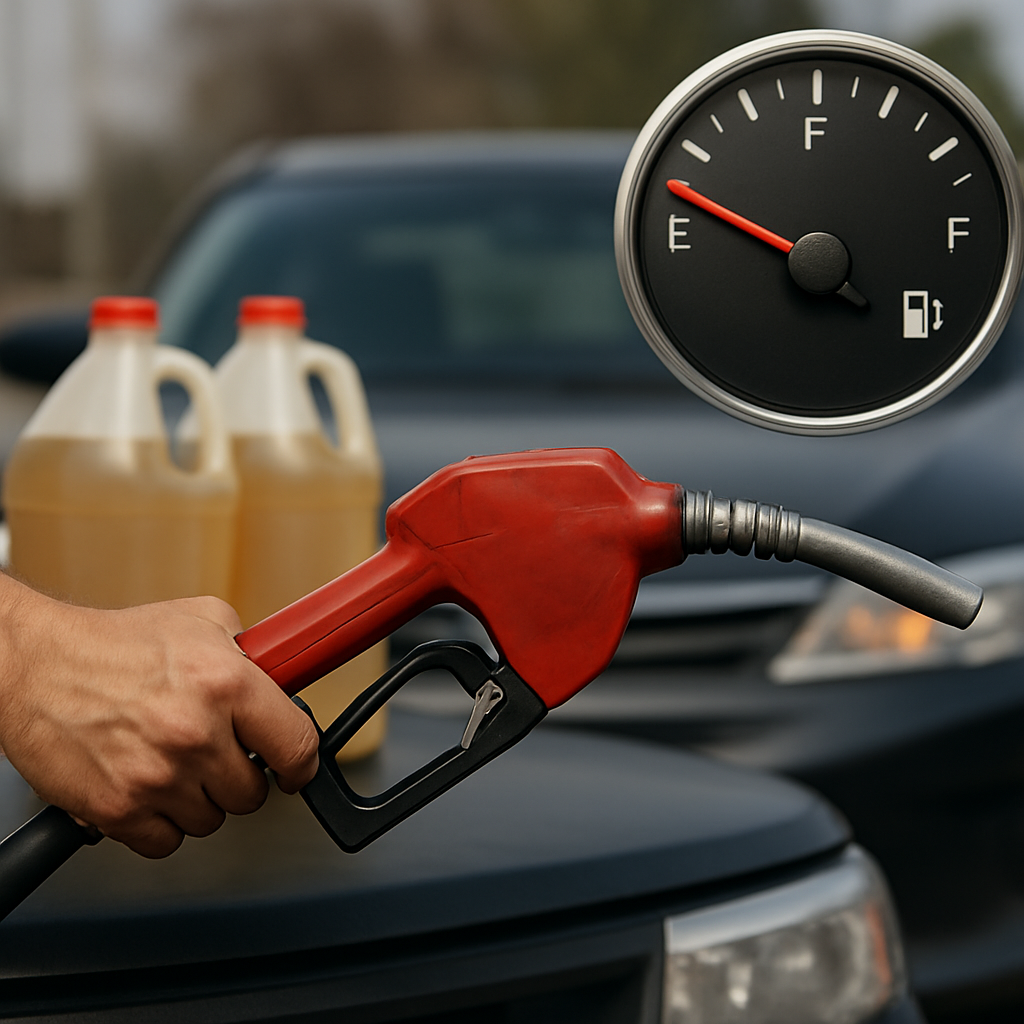
Two gallons of gas will take you about 2 × your vehicle’s MPG. For example, 20 MPG equals about 40 miles, 25 MPG equals about 50 miles, and 30 MPG equals about 60 miles. These are estimates for comparable driving conditions, not a guaranteed remaining range or proof that a tank contains exactly two usable gallons.
The full formula is miles = gallons × MPG. With two U.S. gallons, it becomes miles = 2 × MPG. Traffic, hills, speed, idling, cargo and driving style can all change the distance you actually get.
How Many Miles Can 2 Gallons of Gas Take You?
Quick answer
Estimated miles from 2 gallons = your MPG × 2
If your car gets 25 MPG: 2 gallons × 25 MPG = about 50 miles.
The table below is a calculation lookup, not a list of typical results or a guarantee for every vehicle.
| Vehicle fuel economy | Calculation | Estimated distance from 2 U.S. gallons |
|---|---|---|
| 10 MPG | 2 × 10 | 20 miles |
| 15 MPG | 2 × 15 | 30 miles |
| 20 MPG | 2 × 20 | 40 miles |
| 25 MPG | 2 × 25 | 50 miles |
| 30 MPG | 2 × 30 | 60 miles |
| 35 MPG | 2 × 35 | 70 miles |
| 40 MPG | 2 × 40 | 80 miles |
| 50 MPG | 2 × 50 | 100 miles |
Two-gallon range calculator
Enter your vehicle’s MPG to estimate how far two U.S. gallons could take you.
Estimated miles from 2 gallons: Enter a positive MPG figure.
Formula: MPG × 2. The result assumes the MPG entered is representative of the upcoming drive and is not guaranteed range.
Without JavaScript: multiply your MPG by 2. For example, 25 MPG × 2 = about 50 miles.
So, how far do two gallons of gas get you? They get you roughly twice as far as your vehicle’s MPG figure, provided conditions are similar to those under which that MPG was achieved. A lower-efficiency vehicle and a higher-efficiency vehicle can travel very different distances on the same amount of fuel.
Fuel range depends on efficiency and operating conditions, including the type of vehicle, terrain and driving habits. Those variables are also discussed in this guide to how vehicle efficiency and conditions affect fuel range. That is why a single universal answer, such as 50 miles, is not reliable without stating the MPG assumption behind it.
Known 2 gallons versus 2 gallons left in the tank
The calculation works cleanly when two gallons is a known quantity of fuel. If you think you have two gallons left, however, the calculation cannot confirm that amount. A fuel gauge, low-fuel warning and miles-to-empty display do not precisely establish how many usable gallons remain. Plan a fuel stop rather than relying on the calculation to run the tank nearly empty.
How many miles are in 1 gallon of gas?
One gallon takes a vehicle approximately as many miles as the vehicle achieves in MPG. In other words, MPG literally means miles per gallon.
For example, if your car returns 25 MPG, one gallon represents about 25 miles of driving at that level of efficiency. Two gallons at the same efficiency would represent about 50 miles:
1 gallon × 25 MPG = 25 miles
2 gallons × 25 MPG = 50 miles
MPG is not necessarily constant on every journey. Stop-start traffic, steep gradients, hard acceleration, heavy cargo and extended idling can reduce the distance you get from a gallon. A steady journey may produce a different result from a short urban trip.
How many miles does 2 gallons last?
If “last” means driving distance, use the same formula: two gallons multiplied by your MPG. If it means hours or days, two gallons alone cannot provide a dependable answer. Time depends on how many miles you drive, the route, traffic, idling, speed and the vehicle’s actual fuel efficiency.
For instance, two gallons in a vehicle achieving 25 MPG is an estimate of 50 miles, but it could represent one short trip, several local journeys or part of a longer drive. Fuel volume does not convert directly into a set number of hours or days.
Use Your Own MPG for a Better Estimate
The most useful calculation uses your vehicle’s observed fuel economy rather than an illustrative figure. A practical way to estimate your own MPG is to measure fuel use between fill-ups:
- Fill the tank and reset the trip odometer, or record the odometer reading.
- Drive normally.
- At a later fill-up, record the miles driven and the gallons added.
- Calculate MPG = miles driven ÷ gallons added.
- Calculate your estimated two-gallon range: MPG × 2.
A longer, representative period of normal driving will generally provide a more useful personal estimate than a very short trip. It still may not predict the next journey exactly if the route or conditions change.
For example, if you drove 280 miles and added 10 gallons at the next fill-up, the calculation is 280 ÷ 10 = 28 MPG. Your estimated distance from two gallons would then be 28 × 2 = 56 miles. If that recent driving was mostly motorway travel but the next trip is congested urban driving, the estimate may be optimistic.
MPG and gallons per mile are different measurements
MPG tells you how many miles a gallon can take you. Gallons per mile is the inverse: gallons per mile = 1 ÷ MPG. At 25 MPG, for example, the vehicle uses about 0.04 gallon per mile (1 ÷ 25). For this page’s main question, use the more direct calculation: miles = gallons × MPG.
A dashboard range or miles-to-empty display can be useful as a vehicle-specific indication, but this calculation does not verify its accuracy or establish how much reserve fuel remains. Fuel-gauge calibration, low-fuel warnings, reserve volume and range-display behaviour can vary by vehicle. Do not assume that a displayed range or an empty gauge proves exactly two gallons remain.
What Can Change the Distance You Get From 2 Gallons?
Two gallons remain the same volume, but the miles obtained from them can vary. Important influences include:
- Vehicle and fuel economy: A vehicle with a lower MPG figure uses more fuel for each mile than one with a higher MPG figure.
- Terrain: Hills and changing gradients can alter fuel use.
- Driving habits: Acceleration, speed, braking patterns and idling can affect actual MPG.
- Load and operating conditions: Passengers, cargo, traffic and the nature of the trip can all change the result.
If you think you have 2 gallons left
Only multiply by two if two usable gallons are actually available. A calculation based on a gauge position, a warning light or a range display is less certain because those indicators do not measure an exact remaining quantity of fuel. Use the estimate to plan conservatively, not to guarantee that a particular destination is reachable or to deliberately run the tank close to empty.
Is 2 Gallons of Gas a Lot?
Whether two gallons is “a lot” depends on the vehicle’s tank capacity and, more importantly for driving distance, its MPG. To see how two gallons compares with a nominal tank capacity, use:
2 ÷ tank capacity × 100 = approximate percentage of the tank
For example, in a vehicle with a nominal 16-gallon tank, two gallons represent 2 ÷ 16 × 100 = 12.5% of the tank. That percentage does not tell you how far the fuel will take you: a vehicle’s actual MPG and the driving conditions determine that.
Nominal tank capacity also does not reveal the fuel remaining at any particular gauge position. A fuel gauge, low-fuel warning or miles-to-empty display should not be used to prove that two gallons are in the tank.
The Bottom Line
To answer “how many miles is two gallons of gas?”, multiply 2 × your real-world MPG. At 20 MPG, the estimate is 40 miles; at 25 MPG, it is 50 miles; and at 40 MPG, it is 80 miles. Use your own observed MPG where possible and allow for changing conditions. The result is a range estimate, not proof of how much usable fuel remains in the tank.
Pingback: 2012 Nissan Altima A/C Compressor Replacement Cost: Price and Quote Factors - Premier Motoring Blog