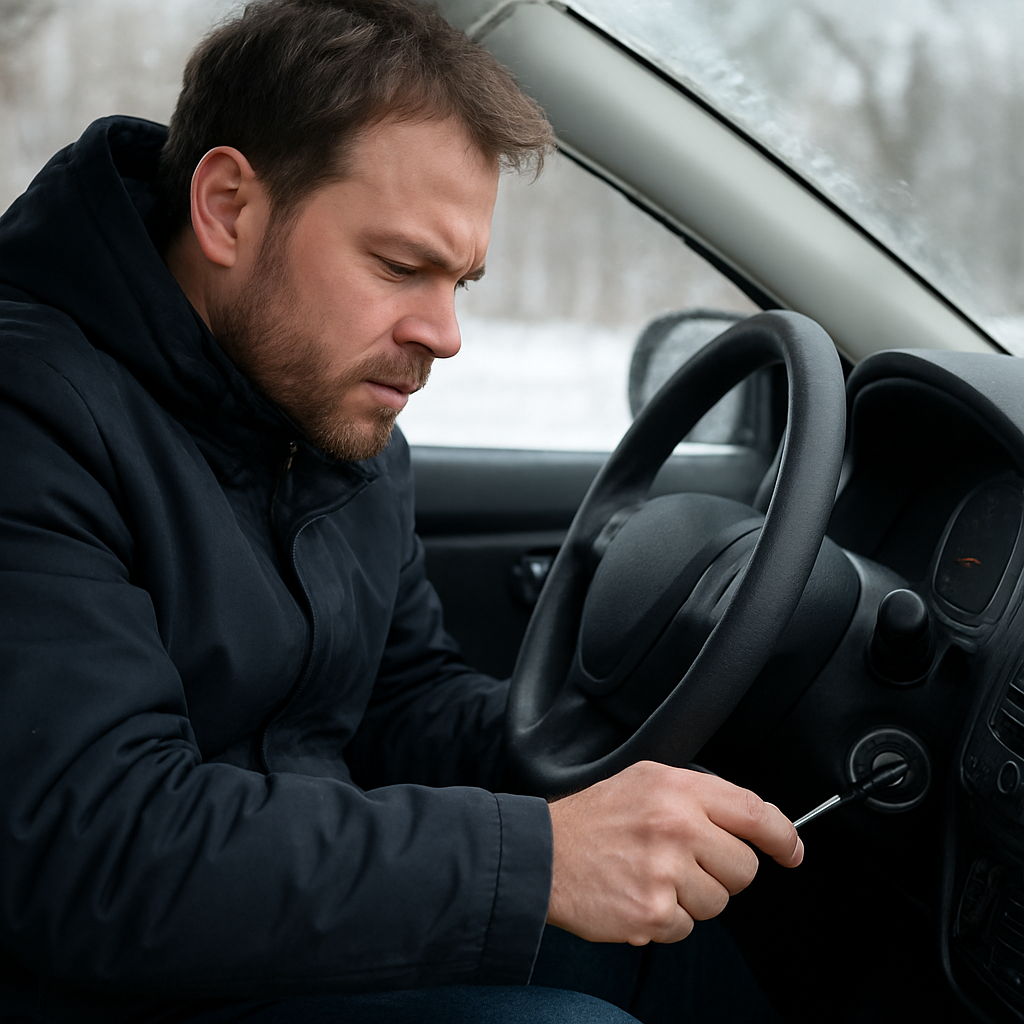
A car that is hard to start when cold may have reduced battery performance, oil that has thickened in low temperatures, an ignition or fuel-delivery problem, restricted airflow, or an engine sensor signal issue. Diesel engines can also be affected by glow-plug or cold-fuel problems. These are possibilities, not a diagnosis: the way the engine cranks and behaves after it fires can help narrow down what needs checking.
What does “cold start” mean?
A cold start is starting an engine after it and its components have cooled, rather than restarting it while it is still warm from running. Cold conditions can reduce a battery’s ability to provide starting power and make engine oil thicker, adding strain during start-up. A normal cold start is not, by itself, evidence of a fault. For more on the term and how cold conditions affect starting, see this overview of cold starting a car.
Why is a car hard to start when the engine is cold?
First, distinguish between two symptoms. Slow cranking means the engine turns over more slowly than usual; a weak battery or the added resistance of cold-thickened oil may be involved. Normal-speed cranking with delayed firing means the engine turns over at its usual pace but takes longer to start running. That pattern can point towards fuel delivery, ignition on a petrol engine, or engine-management inputs. Neither pattern confirms a particular failed part, and there is no single cranking-time threshold that diagnoses the cause.
Cold weather can make an existing weakness more noticeable, but it does not prove that a specific component has failed. Common possibilities include:
- A weak battery: Low temperatures can reduce battery performance. A battery that is ageing or already weak may have more difficulty supplying the power needed to start the engine.
- Cold-thickened engine oil: Oil becomes thicker in low temperatures and does not flow as readily, which can make the engine harder to turn over and place more strain on the starting system. Use the oil specification in the vehicle’s manual; the available evidence does not establish a universal oil grade for cold starting.
- Worn or faulty spark plugs in a petrol engine: Spark plugs ignite the air-fuel mixture. If they are worn or not working properly, starting may take longer and the engine may run roughly after it fires.
- Restricted fuel delivery: A failing fuel pump or restricted fuel filter, injector or fuel line can affect the fuel supply needed for starting. These parts require diagnosis rather than replacement based only on a cold-start symptom.
- Restricted air intake: The engine needs to draw in air. A restricted air filter or another intake problem may contribute to difficult starting, but it is only one possibility among several.
- Engine sensor signals: Incorrect information reaching the engine-management system can affect starting. A sensor signal problem cannot be confirmed from hard starting alone.
These possibilities are reflected in troubleshooting guidance from Sea Foam on hard-start causes and the cold-start overview from West Service Center. The right checks depend on the vehicle and engine.
If the battery seems good, what else can stop a cold engine starting?
Working headlights or dashboard lights do not, by themselves, show that a battery can supply adequate starting power. If the battery has not been properly tested, have its condition checked rather than relying on the lights as proof that it is healthy. If battery condition is confirmed, possible causes still include restricted fuel flow, a failing fuel pump, restricted filters, injectors or lines, petrol-engine spark-plug or ignition issues, restricted air intake, and relevant sensor signals.
Pay attention to whether the engine cranks slowly, cranks normally without firing, or does not crank at all. A no-crank problem is not the same symptom as an engine that cranks but will not start. If the vehicle clicks during a no-start, see what to check when a car clicks but will not start. If the lights come on but there is no click, this guide to no-click starting checks covers that different symptom. Neither clicking nor working lights alone identifies the cause of a cold-start problem.
If you are unsure whether the battery or charging system is involved, this guide explains how to tell a bad alternator from a bad battery. A professional diagnosis may be needed if a properly checked battery does not explain the no-start.
Why does it start when warm but struggle when cold?
A car that starts normally when warm but struggles after sitting cold provides a useful clue, but it does not identify one failed component. The cold may expose reduced battery performance or the extra resistance of thicker oil. A petrol engine may also have a cold-start ignition or fuel-delivery difficulty; on a diesel, glow-plug or fuel issues may be relevant. Incorrect sensor signals are another possibility, but hard starting alone cannot confirm one.
Note whether the engine cranks slowly or at its usual speed, whether it eventually fires, and whether it runs roughly after starting. A warm engine starting normally does not rule out a fault, and waiting for warmer weather is not a reliable repair. A technician can use the symptom pattern alongside vehicle-appropriate tests to investigate further.
Will a car start once it warms up?
It may start more easily if warming reduces cold-related effects such as weaker battery performance or thicker oil, but there is no guarantee. A fuel-delivery, ignition, glow-plug or sensor problem may remain, regardless of the surrounding temperature. Do not treat waiting for warmer conditions as a repair or as proof that the vehicle is dependable. A successful start after warming does not, by itself, establish that the underlying problem is fixed.
Why do diesel engines struggle to start when cold?
Diesel starting checks differ from petrol-engine ignition checks: diesel engines do not use spark plugs to ignite the mixture. Possible cold-start causes include worn glow plugs, a weak battery, a blocked or water-contaminated fuel filter, and diesel fuel waxing in freezing conditions. Fuel and filtration concerns may be relevant, but they are not a universal diagnosis for every diesel vehicle.
Have suspected fuel contamination, filter condition or glow-plug operation assessed using procedures appropriate to the vehicle. Do not dismantle or modify the fuel system based only on the symptom. More detail on these diesel-specific possibilities is available in this guide to cold engine starting problems.
Could a sensor cause cold-start trouble?
There is no single, universally defined component called a “cold start sensor”, and the available evidence does not establish a reliable symptom list for one. Engine sensor signals can affect starting; intake-air temperature and airflow or pressure readings, including those associated with MAF or MAP sensors, are possible areas for model-appropriate diagnosis. That does not mean any one of those sensors is faulty when a car struggles to start cold.
Hard starting alone cannot identify a sensor, and the supplied evidence does not support a definitive sensor-specific code or test. A technician can assess the relevant signals for the particular vehicle. For a related component reference, see symptoms and checks for a crankshaft position sensor; cold-start difficulty alone does not confirm a crankshaft sensor fault.
What to check when a car will not start in the cold
- Observe what happens when you try to start it. Note whether the engine cranks slowly, cranks at its usual speed without firing, or does not crank. Also note whether it fires and then runs roughly.
- Record when the problem occurs. Is it limited to cold starts, or does it happen when the engine is warm as well? This pattern helps with diagnosis but does not prove a cause.
- Arrange an appropriate battery check. Lights working do not establish that the battery can provide enough starting power. If the battery is confirmed as healthy, further checks may still be needed for fuel, ignition, intake or sensor issues.
- Consider the engine type. Petrol-engine checks may include spark plugs and fuel delivery. Diesel checks may include glow plugs and the condition of the fuel and filter.
- Seek qualified diagnosis if the problem persists. This is particularly important when fuel-system or sensor faults are suspected. Follow the vehicle owner’s manual or seek qualified assistance for starting and battery procedures.
If you are asking how to warm a car battery, the available evidence supports only that cold can reduce battery performance; it does not establish a safe, vehicle-specific warming method. Do not improvise a heating procedure. Consult the vehicle and battery manufacturers’ instructions or qualified roadside or service assistance. If the car eventually starts, that fact alone does not establish that it is safe or roadworthy. For a vehicle-specific example of an intermittent morning no-crank symptom, see this Kia Seltos-specific guide; its diagnosis should not be assumed to apply to other vehicles.