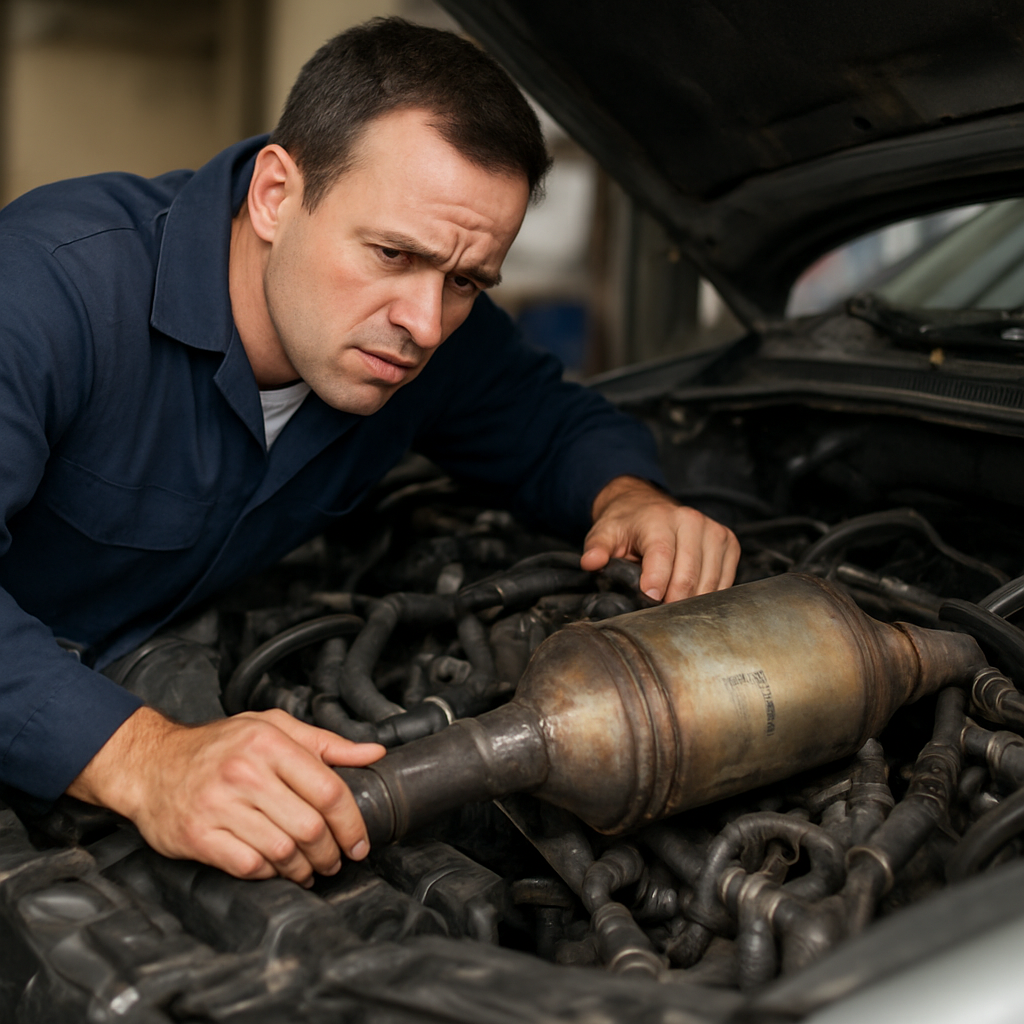
Yes, a catalytic-converter problem can be associated with a misfire, but symptoms alone cannot confirm that the converter caused it. A restricted exhaust may also reduce power, which can feel like an engine-running problem without being the same as a cylinder misfire. The relationship can run the other way, too: an ongoing misfire may damage the converter. Diagnosis is needed to identify the cause.
Can a bad catalytic converter cause a misfire?
Some automotive sources report that a bad catalytic converter can cause or accompany a misfire. For example, Gold Eagle discusses misfiring among reported converter-problem symptoms, and Kempton Chevrolet says a bad converter can cause a misfire. However, rough or misfire-like running does not by itself establish that the converter is at fault.
A misfire means one or more cylinders are not contributing properly to engine operation. A restricted exhaust can instead cause reduced power or acceleration. These problems may feel similar to a driver, but they are not interchangeable diagnoses. Rough idle is also a nonspecific symptom and does not confirm converter failure.
The relationship can run in reverse: an ongoing misfire may damage the catalytic converter. A technician should investigate the engine fault as well as the converter rather than assuming one is the cause of the other.
If a scan identifies a misfire, that does not by itself show that the catalytic converter caused it. You can read more about understanding a P0300 misfire code. A catalyst-related code and a misfire diagnosis are separate questions; a code alone does not confirm a failed converter. See our guide to what a P0420 code means for more on that code.
Symptoms that may point to a catalytic-converter problem
Reported signs include misfiring or misfire-like running, reduced power or acceleration, reduced fuel economy, an illuminated check-engine light, and rattling that may come from damaged internal converter material. These are clues to investigate, not proof that the converter is the cause. Other faults can produce similar symptoms, and a check-engine light does not identify a failed component on its own.
Reduced power or acceleration may be consistent with an exhaust restriction, but it should not automatically be labelled a misfire. Likewise, a rough idle needs diagnosis rather than an assumption that the converter has failed. When misfire symptoms are present, the engine fault and the converter should both be considered.
Gold Eagle describes reported misfire symptoms, warning lights and rattling associated with damaged internal converter material. Those signs are not a definitive diagnosis.
Is it dangerous to drive with a bad catalytic converter?
What to do depends on the fault and how the vehicle is behaving. A symptom or code cannot establish how far a particular vehicle can be driven or whether it needs to be towed. Do not assume that a vehicle is safe based only on a steady warning light, a particular code or the absence of obvious symptoms.
An active misfire deserves prompt professional assessment. An ongoing misfire can damage engine components and the catalytic converter. Significant power loss also warrants prompt attention, since drivability may deteriorate.
If the engine is actively misfiring or the vehicle has lost substantial power, arrange qualified diagnosis rather than continuing to use it as normal. If the check-engine light is flashing, see our guide to what a flashing check-engine light means and seek appropriate advice. A remote article cannot determine whether a specific vehicle should be driven or towed.
How to fix a bad or clogged catalytic converter
Start by identifying the cause of the symptoms. If the engine is misfiring, have that fault investigated before assuming the converter is the original problem or replacing it. A misfire may damage a converter, so replacing the converter without addressing an underlying engine fault may leave that fault unresolved.
Whether a converter can be repaired or needs replacement depends on its condition and the diagnosis. There is no universal repair procedure or guaranteed outcome. Do not rely on a catalytic-converter cleaner, additive or DIY unclogging method as a substitute for diagnosis; ask a qualified repair professional to determine what has failed and what remedy is appropriate.
If you are considering removing the converter, check the applicable local emissions and road-use rules and speak with a qualified repair professional. Do not assume removal is permitted. For general background, see our catalytic-converter purpose and removal guide.
Is it worth fixing an engine misfire?
A misfire should not be ignored: it may damage engine components or the catalytic converter if left unchecked. Prompt diagnosis can establish what repair is needed. Whether the repair is economically worthwhile depends on the cause, the estimate and your vehicle’s circumstances.
Do not assume that replacing the converter will resolve a misfire. Have the engine fault and the converter assessed as separate but potentially related issues, especially if the misfire persists or affects drivability.
Why a catalytic converter may rattle when you accelerate
Damaged internal converter material can break or collapse, and loose pieces may rattle. A rattle is not proof that the converter is at fault, and the noise may occur in situations other than acceleration.
If the noise persists, have its source inspected rather than diagnosing it by sound alone. For other possibilities, see our guide to other causes of a rattle when accelerating.