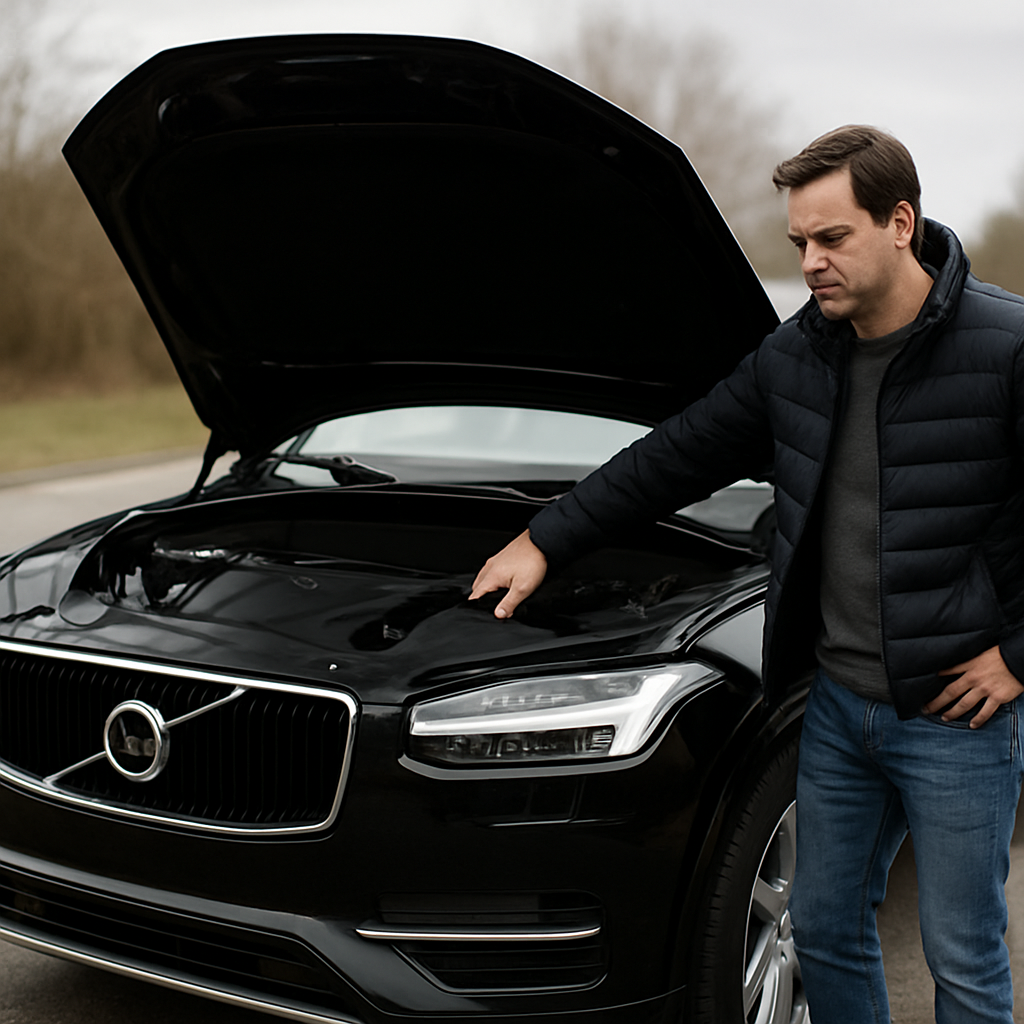
Dashboard lights or working accessories do not show why a 2016 Volvo XC90 will not start or prove that its 12 V battery and starting system are healthy. First, note what happens when you try to start it: Does the engine not crank at all, or does it turn over without starting? Those are different symptoms, and the available information does not identify a specific failed part.
2016 Volvo XC90 Won’t Start but Has Power: What to Check First
A defective 12 V battery is one possibility. Volvo’s support guidance also identifies electrical, hardware, or software faults as broad possibilities, but those descriptions do not confirm which fault is present in your XC90. A lit display, interior lights, or other accessory power is not enough to diagnose the battery or any other component.
Volvo advises charging the 12 V battery with an external charger or jump-starting the vehicle with an external battery. Follow the instructions in your vehicle’s owner’s manual for the applicable procedure, and stop if you cannot carry it out safely. If the XC90 still will not start, contact an authorized Volvo workshop. See Volvo’s XC90 guidance on a vehicle that has no power or is not responding.
Does the Engine Crank, or Is It a No-Crank?
When you attempt to start the vehicle, listen and observe what the engine does. A no-crank condition means the engine does not turn over. In a crank-but-no-start condition, the engine turns over but does not run. Dashboard activity alone does not distinguish between them.
Record the behaviour you notice, along with any dashboard messages and what happens during the start attempt. Give those details to the workshop. The supplied guidance does not provide a diagnostic procedure for an engine that cranks but does not start, so that symptom should not be treated as the same problem as a no-crank condition.
If the engine does not crank, the symptom alone does not confirm a failed starter, starter relay, fuse, ignition switch, immobilizer, or steering-lock module. It also does not establish that the alternator is at fault. Diagnosis may require vehicle-specific checks by a qualified technician. For a general example of how no-crank symptoms are discussed on a different vehicle, see our guide to intermittent no-crank symptoms; its Kia-specific information is not a diagnosis or repair guide for the Volvo.
Should You Look for a Relay, Fuse or Starter Location?
The available manufacturer guidance does not verify the 2016 XC90’s starter-relay location, starter location, or fuse-box assignments, or provide a model-specific test procedure for them. Use the correct owner’s manual for your vehicle and market, or ask an authorized Volvo workshop to identify and check the relevant components. Do not guess at a fuse or relay location or probe electrical connections based on an unverified diagram.
Likewise, the information available here does not confirm an immobilizer or steering-lock fault or provide an approved procedure to reset or bypass either system. A message on the dashboard may help the workshop understand the complaint, so record it rather than assuming what caused it.
Will Rebooting the XC90 Fix the No-Start?
The supplied Volvo guidance does not provide a system-reboot procedure or say that rebooting is appropriate for this no-start symptom. Avoid relying on an unverified reset or workaround as a diagnosis or repair. Follow the manufacturer-supported battery-charging or jump-start guidance in the owner’s manual; if the problem remains, contact an authorized Volvo workshop.
What If the XC90 Starts After Charging or a Jump-Start?
Starting after an external charge or jump-start does not, by itself, establish why the vehicle failed to start. If the issue returns or you have repeated low-battery symptoms, arrange a check rather than assuming the underlying problem is resolved. For general information about recurring battery discharge, see our guide to diagnosing a repeatedly draining car battery; it does not establish the cause of a no-start in this XC90.
The guidance in this article is specifically about the 2016 XC90 and does not confirm that the same details apply to an XC60 or a 2017 XC90. The supplied information also does not establish whether a vehicle with this fault is safe to drive. If the XC90 is not starting, do not treat accessory power, a jump-start, or a reset as proof that it is safe or that the fault has been repaired.