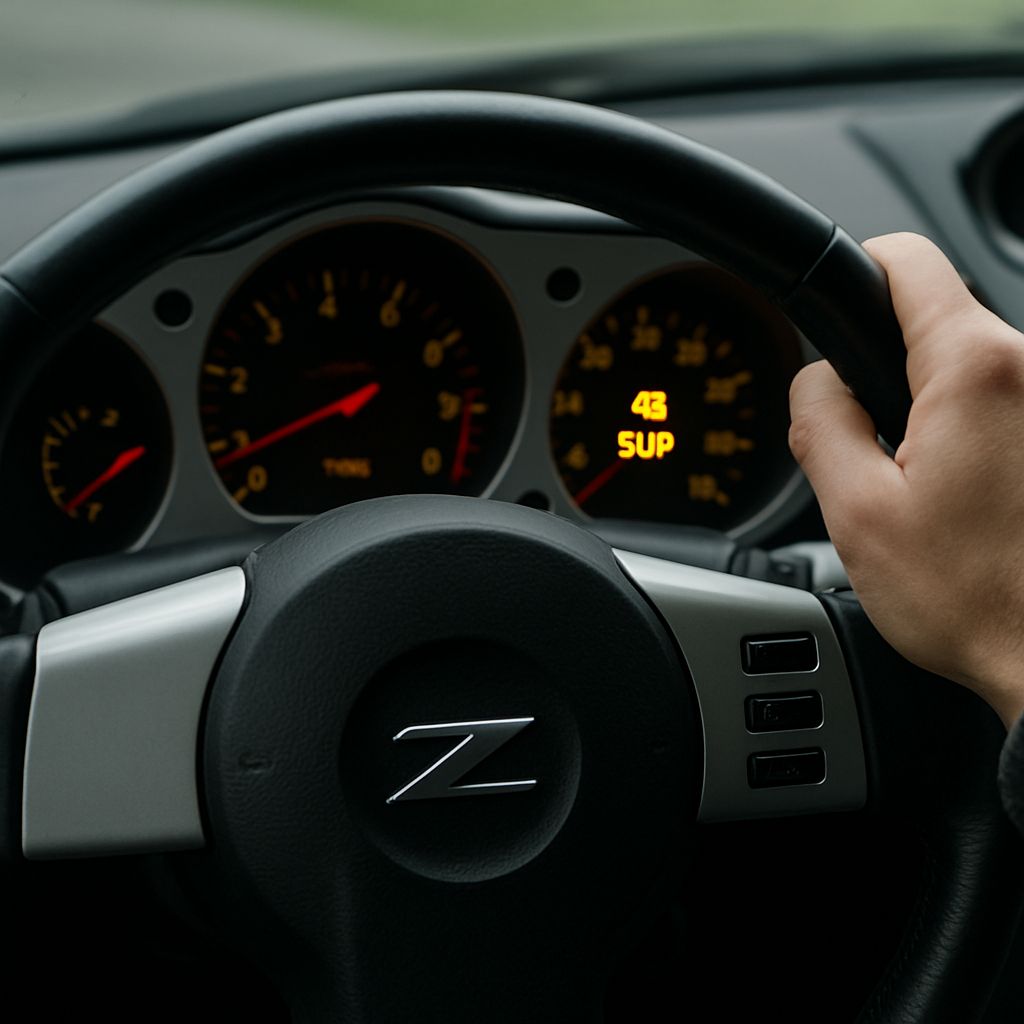
The exact meaning of the slip light on a Nissan 350Z cannot be confirmed from the information available here. Do not treat the lamp alone as proof that a particular part has failed, or assume that a brief, flashing, or continuously illuminated light always means the same thing. Check the owner’s manual for your 350Z’s model year and have a persistent warning diagnosed using information for that vehicle.
What should you do when the 350Z slip light comes on?
First, note when the light appears and whether it stays on, flashes, or goes out. Also note any other warning lights and changes in how the car behaves. These details can help a technician distinguish a temporary event from a warning that needs investigation, but they do not identify the cause on their own.
- Check the correct owner’s manual. Use the manual for your model year and market to confirm what the indicator means and what Nissan advises.
- Watch for other warnings or symptoms. Record whether the ABS or another warning light is also on, and whether braking, handling, or engine performance feels different.
- Arrange diagnosis if the light persists or returns. Ask for the relevant 350Z systems to be checked with suitable diagnostic equipment and vehicle-specific procedures.
A warning light is a symptom, not a confirmed diagnosis. Do not replace a wheel-speed sensor or another component solely because the slip light is on; the available evidence does not verify a specific cause or repair for this warning.
What if the slip light stays on or flashes?
The available information does not verify how a brief, flashing, or continuously illuminated slip light should be interpreted on every 350Z. In particular, it does not establish that a flashing light always indicates normal system activity, or that a light that stays on confirms a particular fault. Check the manual for your car and have a persistent or recurring warning investigated rather than relying on the lamp pattern alone.
If the car also behaves unusually—for example, if braking or handling feels different—avoid trying to diagnose the issue while driving. Find a safe place to stop if needed and seek qualified assistance. The warning by itself is not enough to determine whether the car is safe to continue driving.
Can ABS and traction-control lights come on together?
Several warning lights appearing together call for diagnosis, not a guess based on the pattern. The evidence available here does not confirm how ABS, traction-control, and stability-control warnings relate on a particular 350Z, or what a specific combination means. Record exactly which lights are showing and provide that information to the technician.
For broader context, see our guide to what ABS and traction-control warning lights can indicate. It is general guidance, not a 350Z-specific diagnosis or a substitute for Nissan service information.
Does the answer differ on a 2009 350Z or NISMO?
The available evidence does not establish whether warning-light behavior differs by 350Z model year or trim. The search wording “350z nis” may refer to NISMO, but that is not clear, and no source here confirms whether NISMO equipment changes the indicator’s meaning. Do not assume that guidance for another year, trim, or Nissan model applies to your car; check the correct owner’s manual or ask a Nissan specialist to confirm applicability.
How do you fix or reset the slip light?
There is no verified 350Z-specific repair or reset procedure available here. A reset should not be treated as a repair: without finding the reason for the warning, clearing or switching off an indicator would not establish that the underlying issue has been resolved.
Likewise, do not use a system switch or other control to try to extinguish a persistent warning unless the correct owner’s manual confirms what that control does. System deactivation, where provided, is not the same as diagnosing or repairing a fault. For a light that remains on or returns, have the car checked using procedures suited to its model year.