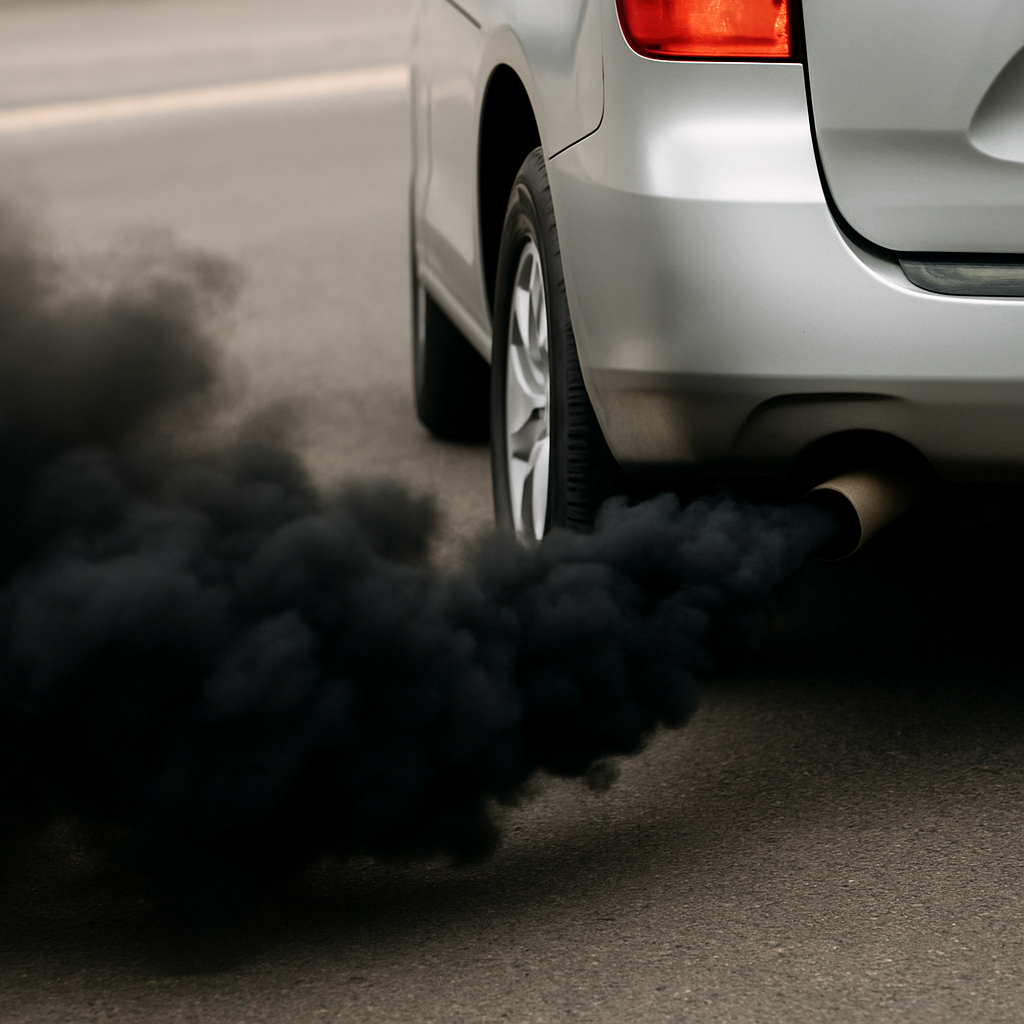
Black smoke from the exhaust when you accelerate generally means the engine is burning too much fuel for the air available, or that some fuel is not burning completely. It is a clue, not a diagnosis: the smoke alone cannot identify a failed part. Acceleration can make an existing problem more noticeable as the engine’s demands change, but visible black smoke should not automatically be treated as normal.
What black smoke from the exhaust means
Engines need the right balance of fuel and air for effective combustion. If that balance is disrupted, or combustion is incomplete, dark particles can leave through the exhaust. This can make the engine run inefficiently and waste fuel. A restricted air intake or dirty air filter, a fuel-injection or fuel-pressure problem, or faulty sensor information affecting mixture control are among the possible contributors. Several faults can produce similar symptoms, so a technician may need to inspect the vehicle and run diagnostic tests to establish the cause.
Black smoke is different from other exhaust colours. A small amount of white vapour that quickly disappears after a cold start can be condensation; persistent white smoke may indicate coolant entering the combustion chamber. Blue or blue-grey smoke can indicate that the engine is burning oil. For more on what blue smoke from the exhaust can mean, see our related guide.
These colour descriptions are useful clues, not definitive diagnoses. Black exhaust smoke and its possible causes are also discussed by FixMyCar, while Sun Auto Tire & Service’s smoke-colour guide describes black smoke as commonly associated with excess fuel.
Why a diesel may blow black smoke under acceleration
In a diesel, black smoke is soot associated with incomplete combustion. It is more apparent on older diesel engines than on modern common-rail diesels, according to NAPA’s explanation of diesel smoke under acceleration. The broad issue is still a mismatch between fuel delivery and available air, or incomplete combustion; smoke alone does not show which part is responsible.
If a turbo diesel is smoking, do not assume the turbocharger has failed. The available information does not establish a turbo fault, boost leak or any other specific turbo-system problem from this symptom alone. A qualified technician can assess the intake and air path, fuel delivery and relevant controls as part of a vehicle-specific diagnosis. Persistent smoke, particularly alongside reduced performance, warrants professional assessment.
Black smoke and loss of power: what the combination tells you
Black smoke together with loss of power is a reason to arrange a prompt diagnosis, but the combination does not prove a single shared cause. Airflow, fuel delivery, injection or sensor-related issues are possibilities; none can be confirmed from the smoke colour or power loss alone. Nor does the symptom by itself establish whether the vehicle is safe to continue driving.
When contacting a repairer, note whether the vehicle is petrol or diesel, when the smoke and power loss occur, whether either symptom comes and goes, and whether there are warning lights, rough running or other changes. Persistent smoke with reduced power should be assessed by a qualified technician rather than treated as a confirmed diagnosis or ignored.
What to check and how black smoke is fixed
There is no single repair that applies to every case. The right fix depends on what testing finds; replacing parts or relying on an additive simply because the exhaust looks black is not a dependable diagnostic approach.
- Record the pattern. Note whether the smoke appears during acceleration, at idle or at start-up; whether it continues or is intermittent; and whether performance, fuel use, warning lights or engine behaviour have changed.
- Make only a low-risk visual check. If the owner’s handbook permits, look for an obviously dirty or damaged air filter. Do not dismantle fuel-system components or attempt pressurised fuel-system work.
- Arrange diagnosis if it persists. A technician can check for relevant fault information and assess airflow, sensor readings, fuel pressure and injectors. EGR-related checks or servicing may also be considered where appropriate for the vehicle and test results.
Depending on the confirmed cause, a repair might involve restoring airflow, addressing a sensor or fuel-pressure fault, or testing and servicing an injector or EGR valve. Those are possibilities, not a parts list for every smoky car. Seek professional assessment promptly if the smoke is heavy or persistent, or if it is accompanied by power loss or warning lights.
If smoke appears at start-up and then disappears
First check what the exhaust plume actually looks like: white vapour, black smoke and blue-grey smoke can point to different issues. Quickly disappearing white vapour after a cold start is commonly condensation, as explained by the RAC’s guide to engine smoke. That explanation does not apply to black smoke. The available evidence does not establish that a brief black puff is harmless or identify its cause.
Note how often it happens, how long it lasts, whether the engine is cold or warm, and whether there are other symptoms. If black smoke repeatedly appears or persists, arrange a diagnosis. A short-lived puff is not enough information to identify a fault or decide that no inspection is needed.
How white smoke differs from black smoke
The evidence does not provide a specific diagnosis for white smoke that occurs during acceleration. In general, brief white vapour that disappears after a cold start may be condensation. Persistent white smoke is different and can indicate coolant entering the combustion chamber; colour alone cannot confirm the cause. If the white smoke continues or you are concerned about coolant loss, seek professional assessment. Our article on what to check if your vehicle is losing coolant concerns a specific Buick Encore, so it is background information rather than a diagnosis for other vehicles.
What if a motorcycle is blowing black smoke?
The car and diesel guidance above should not be treated as a motorcycle diagnosis. Motorcycle-specific causes and checks are not established by the information used here, so have the bike assessed by a qualified motorcycle technician rather than applying car repair steps to it.
Pingback: What Does P2138 Mean on a Chevy Silverado? Causes and Next Steps - Premier Motoring Blog