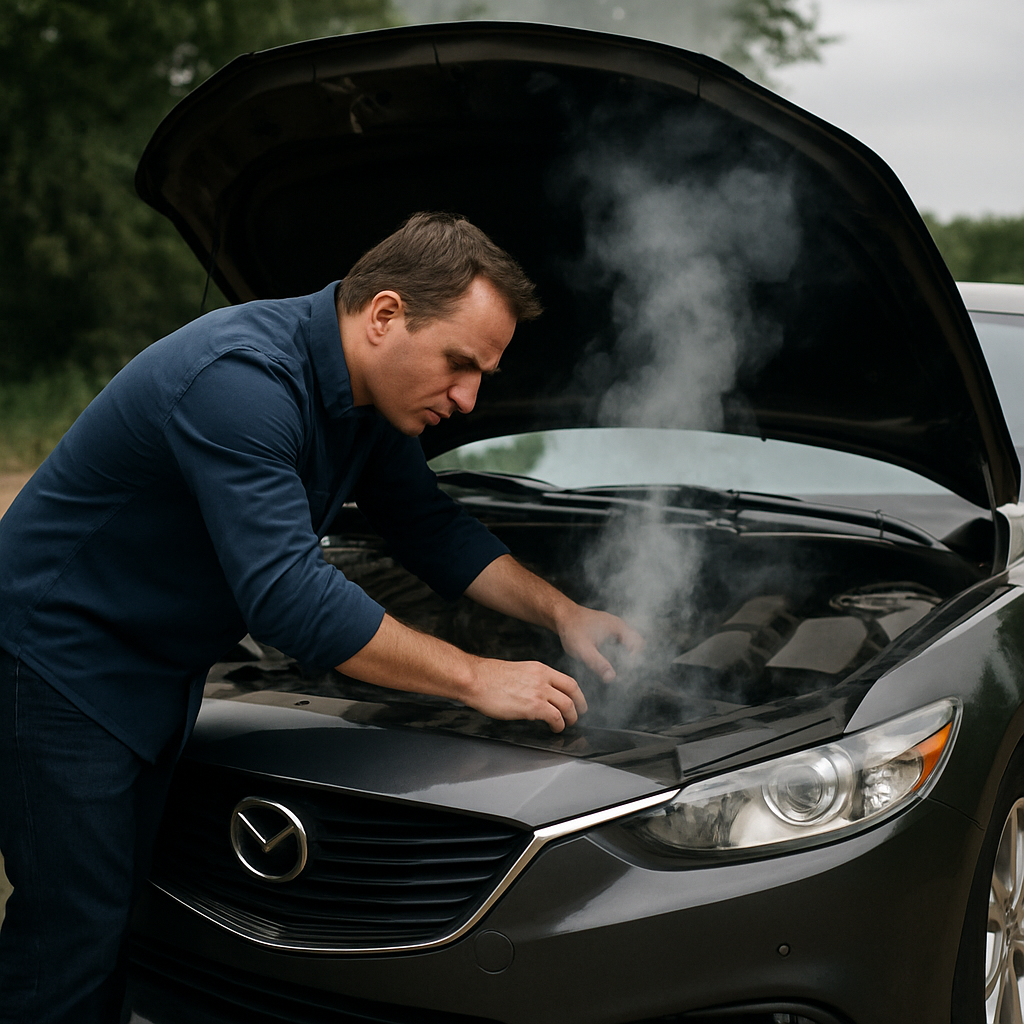
Possible causes of Mazda 6 overheating include low coolant or coolant loss, a leak in the cooling system, a faulty thermostat, or a failing water pump. These are possibilities, not a diagnosis: the available evidence does not establish which cause is most frequent across Mazda 6 years or engines. If the temperature rises repeatedly or coolant is being lost, arrange a professional inspection rather than replacing parts by guesswork.
Common causes of Mazda 6 overheating
The cooling system needs enough coolant and must circulate it properly to carry heat away from the engine. General Mazda cooling-system guidance identifies low coolant, thermostat trouble, and water-pump failure as possible contributors. A fault in any of these areas can produce a similar temperature warning, so the symptom alone cannot identify the failed part.
Low coolant or a coolant leak
Low coolant reduces the amount available to absorb and disperse engine heat. The level may be low because coolant has been lost, including through a slow leak. Potential leak points mentioned in general Mazda service guidance include hoses, the radiator, seals, clamps, and the water pump. These are examples of places a technician may inspect, not a claim that each is a known or equally common Mazda 6 failure.
A visual check that does not reveal an obvious leak does not rule out slow coolant loss. If the level appears to be dropping or overheating returns, have the cause investigated. Mazda overheating guidance also identifies low coolant as a possible cause.
Thermostat trouble
The thermostat helps regulate coolant temperature. If it is not operating correctly, it may interfere with normal temperature regulation and contribute to overheating. However, a rising temperature does not prove the thermostat has failed: coolant loss and water-pump trouble are also possible explanations.
Failing water pump
The water pump circulates coolant through the cooling system. If it fails or cannot circulate coolant properly, heat may not be carried away as needed, and the engine can overheat. A water-pump fault can also be associated with coolant loss, but the temperature symptom alone is not enough to confirm it. The general Mazda cooling-system overview explains the pump’s role and discusses coolant leaks and contamination.
Coolant contamination
Contaminated coolant is another issue that may need attention during a cooling-system inspection. General Mazda service guidance discusses checking for contamination and, where appropriate, flushing and refilling with the recommended coolant. That is not a universal fix for overheating: a technician should identify the underlying issue and determine whether a flush and refill is suitable.
Could the thermostat be causing the overheating?
Yes, a faulty thermostat is one possible cause mentioned in general Mazda overheating guidance, including information from Mazda engine-overheating advice. Its role is to help regulate coolant temperature, so a problem with it can disrupt that regulation. But the same symptom can have other causes, and replacing the thermostat solely because the temperature rises may not resolve the problem.
The available information does not establish a distinct thermostat defect for the 2016 Mazda 6 or confirm that thermostat details and service procedures are identical across every year and engine configuration. It also does not verify a Mazda 6 thermostat location. For location, diagnosis, or replacement details, use service information for the exact year and engine or consult a qualified technician.
Do the likely causes vary by Mazda 6 model year?
The available research does not compare the 2010, 2013, 2016, and 2018 Mazda 6, and it does not verify year-specific overheating patterns, component locations, or repair procedures. Coolant loss or leaks, thermostat trouble, and water-pump failure are general possibilities to investigate—not confirmed faults for any one of these years.
- 2010 Mazda 6: The evidence supplied does not confirm a year-specific cause or failure pattern.
- 2013 Mazda 6: No year-specific comparison or diagnosis is established.
- 2016 Mazda 6: No distinct overheating or thermostat issue is verified by the available evidence.
- 2018 Mazda 6: The available information does not establish a particular cause, component difference, or service procedure for this year.
Cooling-system details can depend on the vehicle’s exact year and engine. Check the correct owner or service information rather than assuming parts and procedures are the same across these model years.
Why can a car overheat when everything looks fine?
A visual check that appears normal does not show whether the cooling system is working correctly. A slow coolant leak may not be obvious, and a thermostat or water-pump fault may require further investigation. The available sources cannot identify the cause of an individual intermittent or apparently unexplained episode.
If overheating happens again, coolant is being lost, or no obvious cause is apparent, seek professional diagnosis instead of replacing parts on suspicion. Do not assume the car is safe to keep driving just because there is no visible leak or other obvious sign. If it is actively overheating, avoid continuing to use it and arrange professional help.
Is overheating the most common Mazda 6 problem?
The available evidence does not establish one definitive most-common Mazda 6 problem or provide comparative failure rates. A Mazda 6 complaints overview mentions overheating alongside transmission noises and abnormal engine ticking, but that list does not rank the issues or show how prevalent they are. It therefore cannot establish overheating as the model’s single most common problem.
Do Mazda cars commonly overheat?
Overheating can occur, and the general Mazda sources describe possible cooling-system causes. However, the evidence available here does not show that overheating is widespread or an inherent problem across Mazda vehicles. A rising temperature should be treated as a vehicle-specific fault to investigate, not as normal behaviour to ignore.
What should you check or do next?
- Note when the temperature rises and whether the problem recurs. This information may help a technician, but it does not by itself identify the cause.
- If you can check coolant safely in accordance with the vehicle’s owner information, look for an apparently low level or signs of loss. A visual check cannot rule out a slow leak or a component fault.
- Arrange an inspection if overheating returns, coolant is being lost, or the cause is unclear. A professional can assess the cooling system and determine whether contamination or another underlying problem is present.
- Do not assume the car is safe to drive while it is overheating. If the symptom occurs specifically while stationary, this general guide to why a car may overheat at idle may provide additional context, but it is not Mazda 6-specific and cannot diagnose your vehicle.