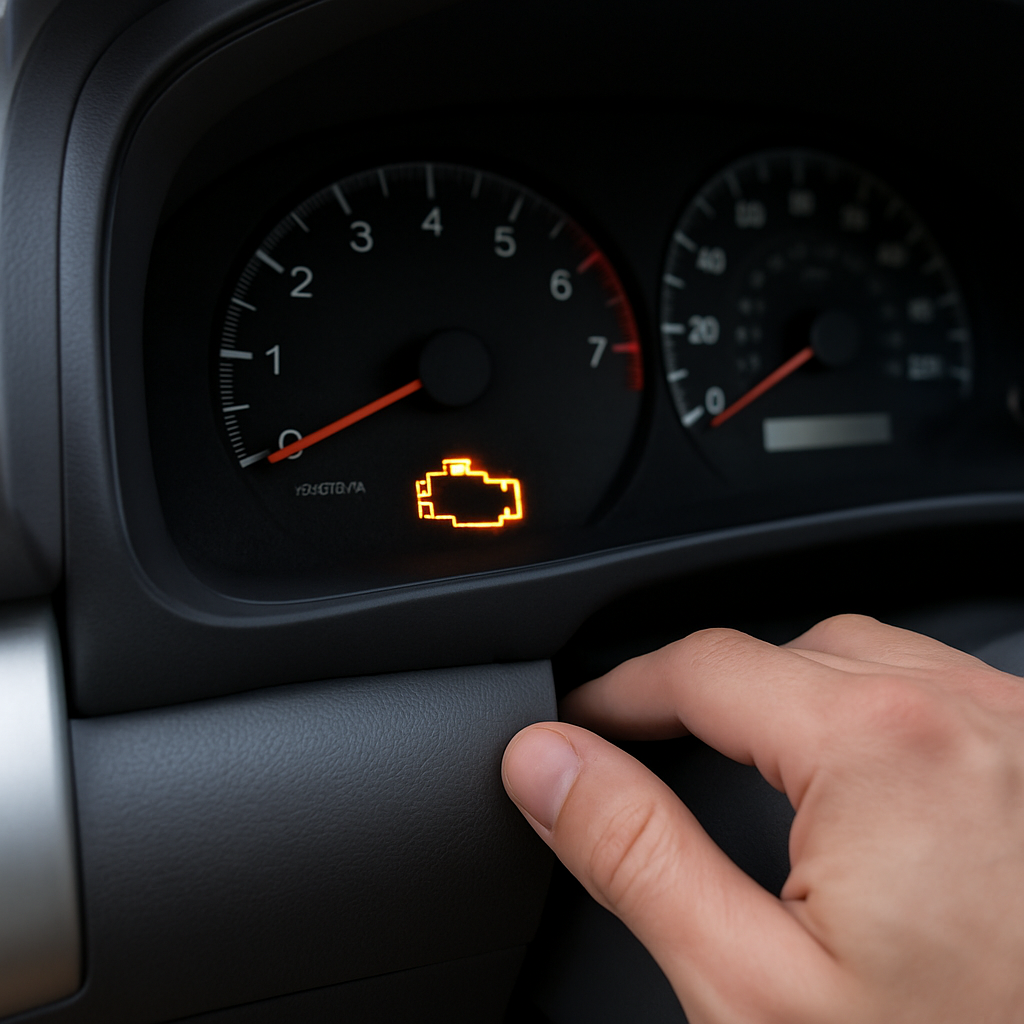
A 2007 Toyota Camry check engine light is an onboard-diagnostic warning, not a diagnosis of a failed part. It tells you that the car has detected a condition requiring attention, but the lamp alone cannot identify whether the issue is related to the fuel cap, an emissions-control system, fuel and air metering, ignition, or another monitored area. The sensible next step is to make a few low-risk observations, then retrieve the stored diagnostic information rather than guessing at a repair.
Why the Check Engine Light Is On in a 2007 Toyota Camry
General Toyota and Camry check-engine-light guidance identifies a range of possible areas, including a loose, damaged, or missing fuel cap; emissions-control concerns; fuel-and-air-related faults; oxygen-sensor-related issues; catalytic-converter trouble; mass-airflow-sensor trouble; worn ignition components such as spark plugs; and transmission-related issues. One dealer source also includes an old battery among the possible contributors. See the general cause categories described by Beaver Toyota, Toyota of Union City, and Toyota of Roswell.
That is useful context, but it is not a ranked list of the most common failures on every 2007 Camry. These are broad possible-cause categories from general Toyota/Camry material, not confirmation that a particular component has failed in your car. Different underlying problems can illuminate the same warning lamp, and the appropriate repair depends on the stored fault information and subsequent testing.
Is there one most common cause?
The available evidence does not establish a 2007-Camry-specific frequency ranking, nor does it support naming one universal most common cause of a check engine light. A fuel-cap problem is a sensible first thing to inspect because the supplied sources specifically identify a loose, missing, or damaged cap as a possible cause. It should not, however, be treated as a guaranteed explanation or an automatic fix.
Low-risk checks you can make first
- Inspect the fuel cap. Check that it is present and does not appear visibly damaged, then make sure it is secured properly. Do not force it or assume a visual inspection proves the fuel system is fault-free.
- Note what the car is doing. Record any rough running, hesitation, unusual starting behaviour, loss of performance, unusual smells, or other changes. These observations can help a repairer interpret the diagnostic results, but they do not confirm the cause by themselves.
- Arrange a diagnostic scan if the lamp remains on. Record the exact fault code or codes and the symptoms before authorising parts replacement or seeking more specific advice.
For more detail on the limited fuel-cap check and why the warning may still need investigation, read our guide to how a loose gas cap can trigger a check-engine light.
When the Light Keeps Coming On
If the check engine light stays illuminated after the fuel-cap check, or returns after it was cleared, the underlying condition may still be present or may have recurred. The return of the lamp is a reason to obtain diagnostic information; it is not reliable evidence that the same part failed again or that one particular part should now be replaced.
It is also important to separate a reset from a repair. Clearing a code or extinguishing the lamp does not establish that the fault has been corrected. This article does not provide a 2007 Camry reset procedure, battery-disconnection method, or drive-cycle instruction because the supplied research does not include manufacturer-supported guidance for those steps. Do not assume that instructions written for a 2006 or 2008 Camry necessarily apply to a 2007 model.
Read the Fault Code Before Assuming What Needs Repair
The check engine light is part of the vehicle’s onboard diagnostic system. Its practical value is that it can prompt retrieval of stored diagnostic information. A scan result gives the diagnosis a starting direction that the dashboard lamp cannot provide on its own.
A diagnostic trouble code is still not the same thing as a confirmed failed component. Depending on the code and symptoms, a code may point towards a system area, a circuit, or a condition detected by the vehicle. Appropriate testing may be needed to establish the root cause before a component is condemned. For example, a code that appears to name a sensor should not automatically be read as proof that replacing that sensor will solve the problem.
When arranging diagnosis, provide the exact code or codes, whether the light is persistent or recurring, and the symptoms you have noticed. This helps distinguish three separate things:
| What you have | What it tells you | What it does not prove |
|---|---|---|
| Check engine light | A monitored condition has caused the onboard system to request attention. | Which part has failed or what repair is required. |
| Stored diagnostic code | A more specific diagnostic direction or affected system area. | That the component named or associated with the code is automatically faulty. |
| Confirmed diagnosis | The result of suitable inspection and testing of the relevant fault path. | That unrelated future faults cannot occur. |
The research used for this article does not provide verified 2007 Toyota Camry code definitions, trim- or engine-specific code applicability, wiring information, test procedures, or confirmed code-to-repair relationships. For that reason, a generic list of purported Camry codes and parts fixes would be more likely to mislead than help.
Flashing Lights, Driving Questions and Other Warnings
The supplied material is not sufficient to give a 2007-Camry-specific verdict on whether a car with a steady or flashing check engine light is safe to drive, or to provide towing criteria. Do not use this article as a certification that the vehicle is safe to continue driving. If the warning is flashing, if there are serious running symptoms, or if you are unsure how to proceed, consult the vehicle’s owner’s documentation and seek qualified assistance rather than ignoring the warning.
Likewise, this article does not identify the exact instrument-cluster location or symbol for the 2007 Camry without verified owner-manual documentation. If you are seeing a TRAC OFF or traction-related warning as well as the check engine light, the relationship between those warnings requires vehicle-specific diagnostic evidence; it should not be assumed from the lamps alone. Our separate Toyota TRAC OFF and check-engine-light guidance may be useful additional reading.
What Diagnosis May Cost
There is no single repair price for a 2007 Camry check engine light. Cost depends on the confirmed cause, the required testing, the parts involved, labour rates, and location. A diagnostic charge is also not the same as a repair quote. Obtain the stored codes and ask the workshop what testing supports its recommended repair before comparing estimates.
The Practical Next Step
Start with the fuel cap because it is a low-risk, evidence-supported check. If it is secure and the warning remains, document the car’s symptoms and obtain the exact diagnostic code or codes. Treat broad categories such as oxygen sensors, catalytic converters, airflow measurement, and ignition components as diagnostic possibilities—not a shopping list. That approach is more likely to identify the real reason the 2007 Toyota Camry check engine light is on and less likely to waste money on an unproven repair.