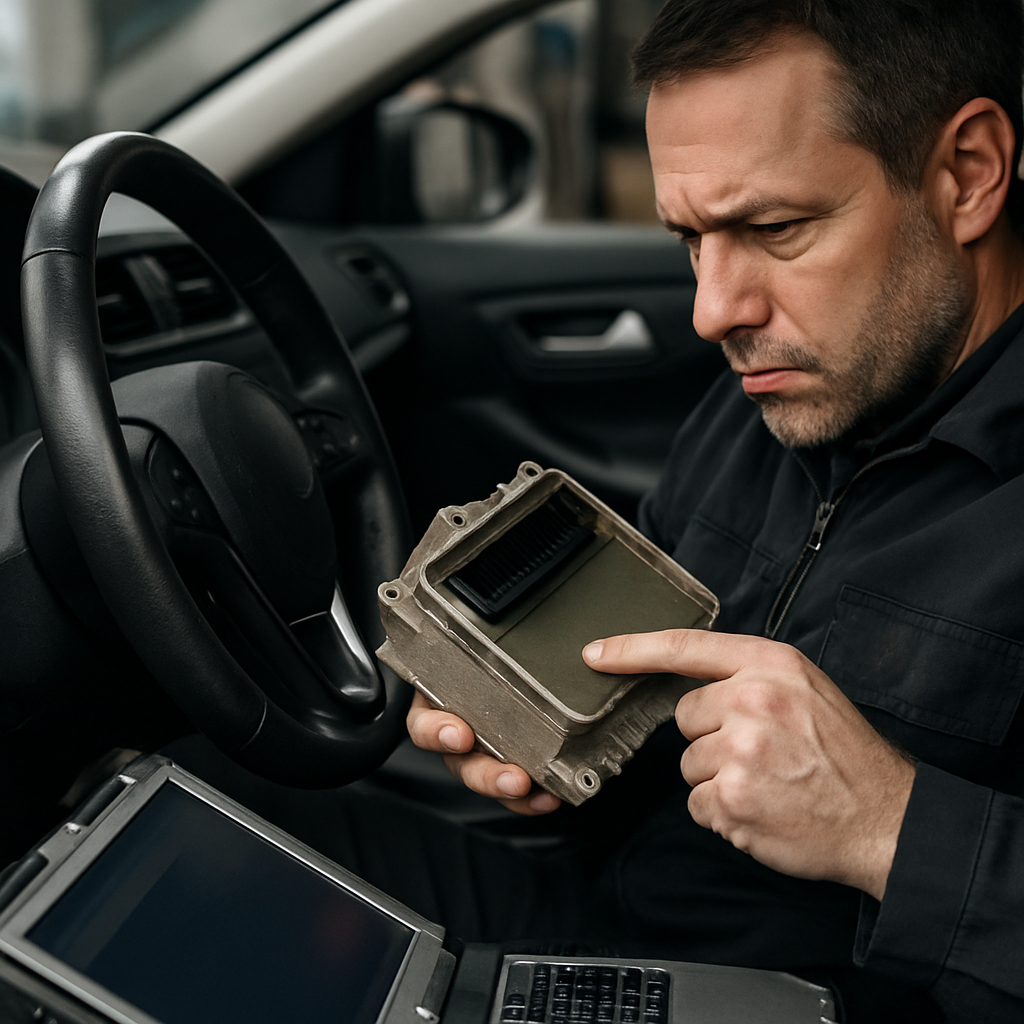
U0131 means that one or more vehicle control modules have stopped receiving the expected messages from the Power Steering Control Module (PSCM). It is a generic OBD-II communication code, not a verdict that the PSCM itself has failed. The fault may involve the module’s power or ground supply, a connector or wiring fault, the vehicle network or—less commonly, after those checks—a failed module. If power-steering assistance has reduced or disappeared, steering effort has suddenly increased, or a steering warning is active, treat it as a safety concern and arrange a qualified assessment promptly.
The PSCM is the electronic controller for the steering-assist system on vehicles equipped with electronic power steering, often called EPAS (electric power-assisted steering). Modern controllers exchange information across a CAN network—the vehicle’s internal communications network. A U0131 code indicates that this conversation has been interrupted; it does not, by itself, say why.
What U0131 Means
U0131 is generally defined as Lost Communication With Power Steering Control Module. In practical terms, a controller that expects messages from the PSCM has not received them within the vehicle manufacturer’s permitted time window. It is a network diagnostic trouble code (DTC) related to missing PSCM messages, typically on a high-speed CAN network shared by multiple vehicle systems.
Depending on the vehicle’s design, the engine control module, transmission control module, ABS/brake module, body control module, instrument cluster or a gateway module may share that network. Therefore, U0131 can be stored by a module other than the PSCM. The code identifies a communication problem involving the PSCM; it does not identify the exact failed wire, connector, network branch, power feed, ground point or control module.
This distinction matters. A scan result that says “power steering control module no communication” is not the same as a confirmed diagnosis of a failed power steering control module. It is the starting point for a vehicle-specific electrical and network diagnosis.
It is also worth reviewing every stored and active code rather than concentrating on U0131 alone. Related communication or voltage-related codes may provide useful context about whether the concern is limited to steering or affects a wider network. Our guide to how to interpret diagnostic trouble codes and plan the next step explains why a full-system scan is more informative than reading a single code in isolation.
Possible Symptoms and When to Stop Driving
A U0131 fault can be present with few obvious driving symptoms, particularly if it is intermittent or stored as a history code. In other cases, it may coincide with a power-steering warning and a noticeable loss of steering assistance. Possible symptoms include:
- A steering-system, power-steering or service warning message.
- Reduced or absent power assistance.
- Much heavier steering effort, especially during low-speed turns or parking.
- An intermittent steering warning or intermittent change in steering assistance.
- Additional warning lamps or communication codes if another electrical or network issue is affecting more than one module.
These symptoms can be consistent with a PSCM communication fault, but they do not prove that the PSCM has internally failed. A poor power supply, ground problem, damaged harness, corroded connector or network fault can produce the same “no communication” result. Similarly, hard steering can have causes outside the module itself, depending on the steering system fitted to the vehicle.
Driving-safety triage
If steering effort has suddenly increased, assistance is lost, steering response feels abnormal, or a steering-system warning is illuminated, avoid continuing to drive except as necessary to reach a safe place. Arrange qualified inspection or towing as the circumstances warrant. Do not assume the vehicle is safe for normal use merely because it can still be steered, and do not assume that U0131 means the steering wheel will lock. The code alone cannot establish either outcome.
Loss of power-steering assistance can be safety-significant because it can require substantially more driver effort. As a limited illustration, reporting on an NHTSA investigation into certain Tesla Model 3 and Model Y vehicles described owner reports of increased steering effort and, in some cases, an inability to turn. That reporting does not establish that U0131 affects all Teslas, all electric vehicles or all steering systems in the same way, but it reinforces why an active loss-of-assist complaint deserves prompt attention.
A U0131 electrical communication concern should also not be confused with a creak, groan or other mechanical noise while turning. Such noises can point to a different steering or suspension issue and need their own inspection path; see our guide to creaking noises when turning the steering wheel.
Common Causes of U0131 and How It Is Diagnosed
The correct fix for U0131 is to repair the confirmed reason communication was lost. Replacing the PSCM simply because the code is present is not a reliable diagnostic strategy. Common diagnostic categories include wiring and connector faults, power or ground problems, circuit opens, shorts or high resistance, and possible module failure.
| Possible fault category | Why it can set U0131 | What it does not prove |
|---|---|---|
| Damaged wiring, loose connectors or corrosion | Interrupted or degraded electrical or network connections can prevent PSCM messages from reaching other controllers. | That a visible issue is the only fault, or that a particular wire is damaged without testing. |
| Open, short or high-resistance circuit | Electrical faults can interrupt module supply circuits or communications. | That a generic code identifies the affected circuit or connector pin. |
| Poor PSCM power supply or ground reference | A module may not operate or communicate correctly if its required supply or ground is compromised. | That a battery, fuse or ground is the cause on every vehicle. |
| Network integrity problem | A fault in the relevant CAN network or its connections can prevent expected messages from being exchanged. | That the PSCM is defective. |
| Failed control module | An internally failed PSCM is one possible reason it may no longer communicate. | That module replacement is justified before external circuits and the network have been checked. |
A sensible professional diagnostic sequence
- Perform a full-system scan. Record all stored, pending and active codes, the modules reporting them, and any warning messages. Accompanying codes can materially change the diagnostic direction.
- Establish whether the scan tool can communicate with the PSCM. A technician needs to know whether the module is completely unreachable, intermittently reachable or communicating normally when tested.
- Use the exact factory wiring and service information for the vehicle. The relevant power supplies, grounds, connectors, harness routing and network architecture differ by year, model, trim and equipment.
- Inspect and test the applicable circuits. This includes vehicle-specific checks of module power, ground, connector and harness condition, followed by network-integrity testing using the manufacturer procedure.
- Repair the verified fault, then clear and recheck. After a confirmed repair, codes should be cleared and the vehicle re-evaluated to determine whether U0131 returns and whether steering assistance and warnings operate normally.
This sequence follows the basic communication-code principle: determine whether the PSCM is powered, grounded and communicating before deciding that it needs replacement. Fuse numbers, module locations, connector pinouts, CAN resistance figures, voltage specifications and test procedures are vehicle-specific, so consult the applicable manufacturer information for those details.
What an owner can do safely
An owner can make useful observations without disturbing wiring or attempting network tests:
- Record the exact dashboard warning message and when it appears.
- Note whether steering effort is normal, reduced or suddenly heavy, and whether the issue is constant or intermittent.
- Obtain a full-system scan report, including all codes rather than only U0131.
- Look for obvious external harness damage or connector disturbance only where safely visible; do not probe, unplug or repair steering-system wiring without the correct information and competence.
- Provide the vehicle’s exact year, model, trim, VIN and scan results to the repairer.
Electrical network testing, circuit repair, module replacement, programming and calibration are best left to a qualified technician with vehicle-specific information. A replacement module may require programming, configuration, calibration or post-repair checks on some vehicles, but that requirement and the correct procedure are not universal.
Can You Reset a Power Steering Assist Module?
There is no responsible universal “reset” procedure for a power steering assist module. The required process, if any, can vary by vehicle and may involve diagnostic equipment, programming, configuration, calibration or post-repair checks specified by the manufacturer.
Clearing U0131 with a scan tool may erase the stored code, but it does not repair the underlying communication fault. If the fault remains, the code can return and the steering warning or loss of assistance may recur. A battery disconnect, generic reset button, scan-tool command or steering relearn should not be recommended without the exact manufacturer procedure for that year, model and equipment.
Does U0131 Mean the Same Thing on Ford or Chevrolet Vehicles?
On Ford and Chevrolet vehicles, U0131 generally carries the same broad meaning: a controller has lost communication with the power steering control module. However, that generic definition is not enough to produce a Ford- or Chevrolet-specific repair.
The precise steering-system design, module naming, network layout, code-setting criteria, wiring, fuse assignments, connector locations and programming requirements can vary by model year, model, engine, trim and fitted equipment. A Ford or Chevrolet with U0131 does not automatically need a steering rack, column module, PSCM, battery or wiring harness.
Before relying on make-specific advice, gather the exact vehicle details, VIN, all scan codes, current warning messages and the circumstances in which the concern occurred. The appropriate Ford or GM factory service information can then be used to identify the correct diagnostic path, applicable service information and any vehicle-specific programming requirements. Informal reports of a flat battery, reversed battery connections, a particular hard-steering repair or a claimed inexpensive fix are not substitutes for that process.
Bottom Line
U0131 is a communication diagnosis, not a parts diagnosis. It means expected messages from the Power Steering Control Module are missing, and the root cause may be a harness or connector issue, an open, short or high-resistance circuit, poor power or ground, a network fault or a failed module. A full-system scan and vehicle-specific testing are essential before replacing components.
If steering assistance is reduced, steering effort is abnormally high or a steering warning is active, prioritise getting the vehicle to a safe location and arranging professional assessment. If the vehicle drives normally and U0131 is stored without an active symptom, it still warrants timely diagnosis—particularly if the code returns after being cleared.