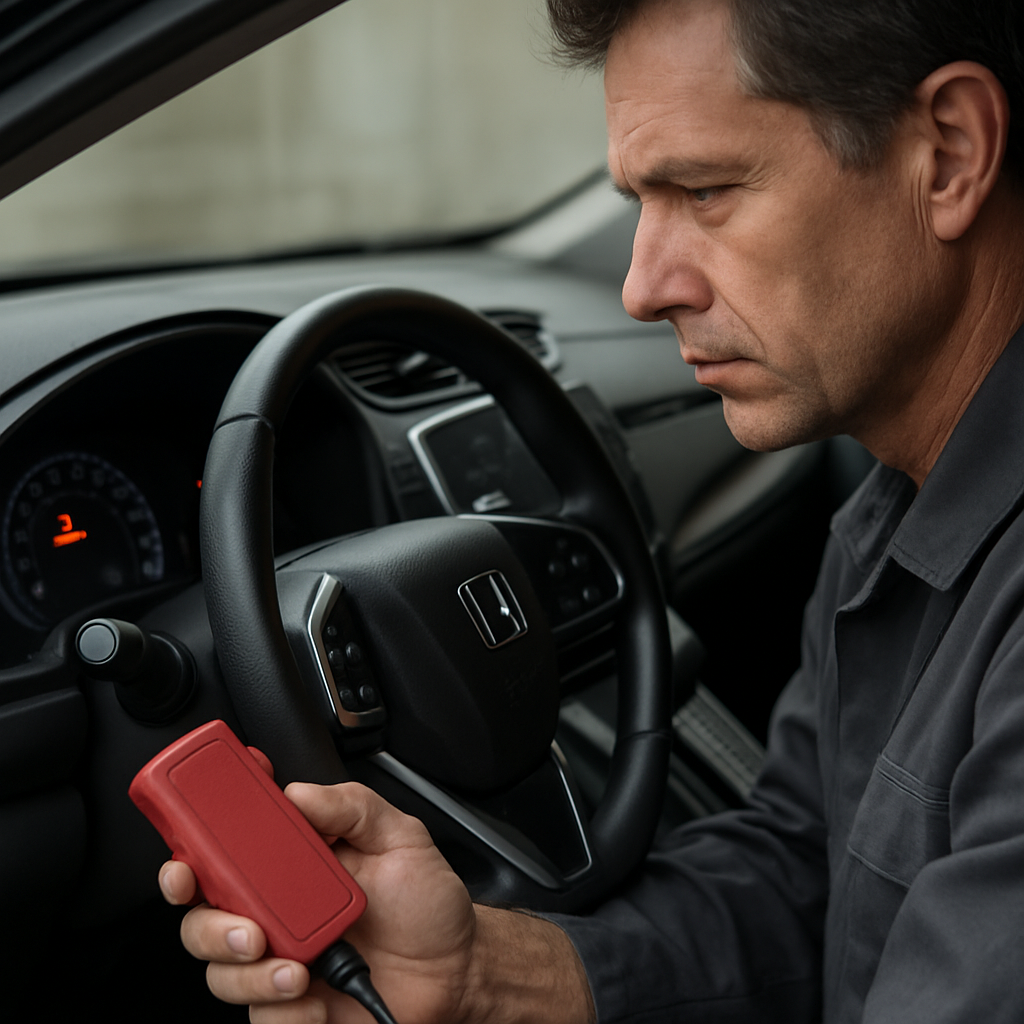
Do not try to reset a Honda CR-V SRS/airbag warning light until the stored fault has been read and assessed. There is no single verified reset method that can safely be applied to every CR-V. Clearing a warning light without correcting the cause does not prove that the airbag and seat-belt restraint system is working properly.
Can you reset a Honda CR-V airbag light safely?
The SRS (Supplemental Restraint System) warning should be treated as a fault warning, rather than a light that simply needs switching off. A proper repair normally has three separate stages:
- retrieving the stored SRS fault information;
- diagnosing and correcting the underlying issue; and
- clearing the warning and checking the system again using the correct procedure for that vehicle.
An extinguished warning light alone is not confirmation that the restraint system has been repaired. Ask a technician with equipment capable of accessing Honda SRS diagnostics to read the fault information and explain what further checks support the diagnosis. A fault code is a starting point for diagnosis; it does not automatically prove that a particular component has failed.
Do not assume that a basic engine-code reader can access or erase SRS faults. Likewise, do not use battery disconnection, connector shorting, airbag-module removal or system-disabling as a generic reset method.
A CR-V owners’ forum discussion mentions paperclip and MES-connector reset instructions for a 2010 model. However, that discussion does not establish an approved procedure, its safety or its applicability to another CR-V. It should not replace the service information for the exact vehicle.
The warning light by itself cannot identify the fault or show how the restraint system may be affected. Do not assume the system will operate normally until it has been professionally assessed. If the SRS warning is illuminated, seek advice from a suitably qualified technician before relying on the vehicle’s restraint system.
Does the procedure differ by CR-V model year?
Yes, vehicle-specific information matters. Searches commonly cover the 2003, 2006, 2007, 2008, 2009, 2013 and 2016 Honda CR-V, but no verified reset sequence is available here for any of those individual years. A procedure should not be transferred from one generation or model year to another.
In particular, a discussion concerning a 2010 CR-V is not evidence that the same connector location, timing sequence or clearing method applies to a 2003, 2006, 2007, 2008, 2009, 2013 or 2016 CR-V. Identify the exact model year and obtain the matching Honda service information before any SRS repair or clearing attempt.
Is the SRS warning the same as a passenger-airbag indicator?
Not necessarily. This article concerns the SRS fault warning. A passenger-airbag status indicator is a separate, model-specific display, and its meaning should be checked in the owner’s manual for the relevant CR-V year. Do not use an SRS reset method to address a passenger-airbag status light or message.
For related background on the distinction between an SRS warning and passenger-airbag status displays, see our Honda Accord passenger-airbag light guide. That article is not a substitute for CR-V-specific manual or service information.
The low-tyre-pressure warning is also unrelated to the SRS system and requires separate diagnosis and resetting procedures.
Could a recall be involved?
An illuminated SRS warning does not, by itself, mean that a recall applies. Recall eligibility cannot be confirmed from the warning light, model name or model year alone. If you are concerned about an airbag recall, check the vehicle’s VIN with Honda or the appropriate official recall authority. Do not rely on an online anecdote or a dashboard warning to determine recall status.
What to do next
- Record the CR-V’s exact model year and the warning symbol or message displayed.
- Have the SRS fault information retrieved with suitable Honda-capable diagnostic equipment.
- Ask for the cause to be diagnosed before authorising code clearing or parts replacement.
- Use service information that matches the exact vehicle for any repair, warning-light clearing and post-repair verification.
- Check any possible recall by VIN through an official source.