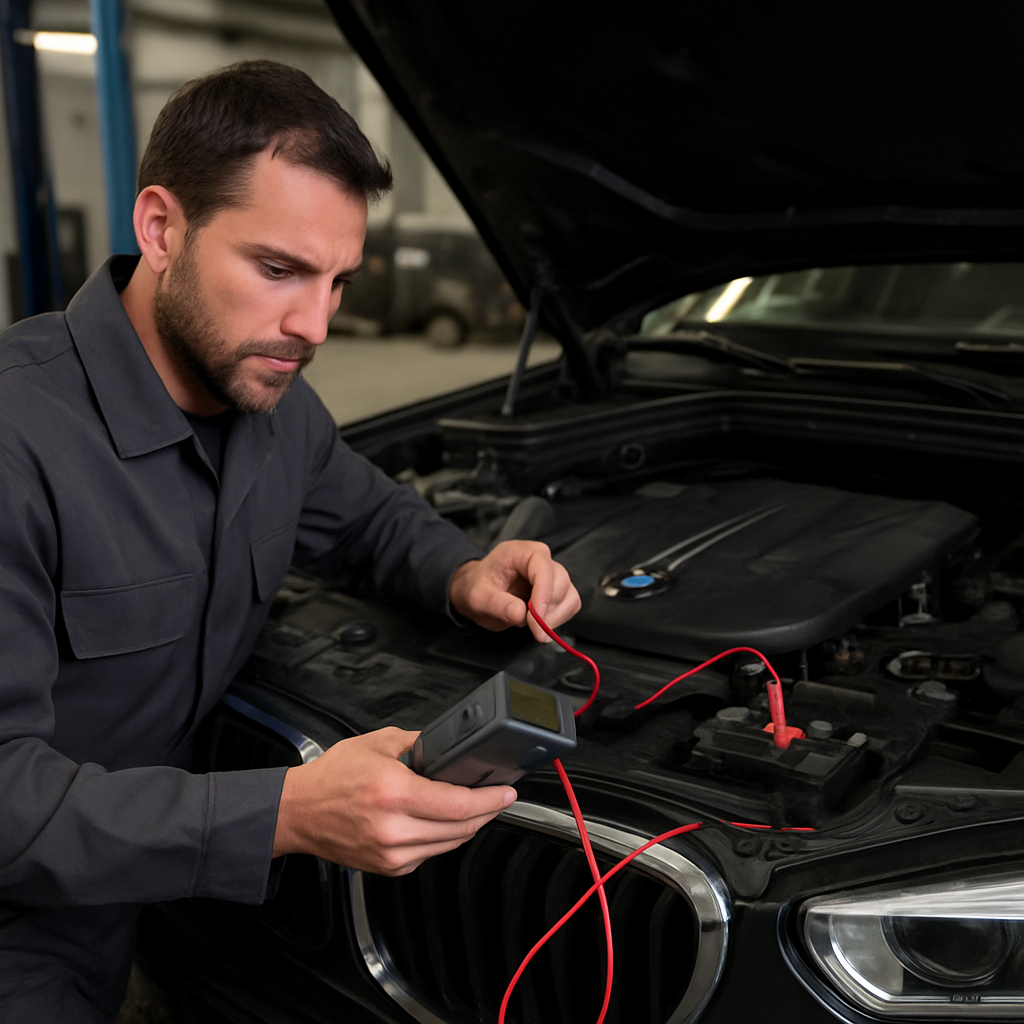
This article concerns the X5’s 12-volt battery, rather than the high-voltage traction battery fitted to some plug-in hybrid versions. A BMW X5 battery that repeatedly goes flat may no longer hold a charge, may not be recharging properly, or may be losing power to an electrical load while the vehicle is parked. Frequent short trips can also leave the battery undercharged. These are possibilities to test, not a diagnosis: more than one issue can be present, and the symptom alone does not identify the failed part.
If the battery dies overnight or while the X5 is parked, arrange tests of both the battery and the charging system. If those checks are satisfactory, the next step is to investigate whether the vehicle is entering its normal sleep state and whether a circuit is drawing excessive power while parked.
Why does a BMW X5 battery keep going flat?
There are three useful distinctions. A weak battery may have lost the ability to store enough charge, even if it can sometimes be recharged. A charging problem means the battery is not being replenished adequately while the vehicle runs. A parasitic draw is an electrical load that continues using power after the vehicle should have shut down or entered sleep mode. A battery can be weakened by repeated discharges while another fault is causing those discharges.
- Age or poor battery condition: A battery may no longer retain charge reliably. A battery-condition or load test can help establish its condition; age alone is not proof that replacement is needed.
- Charging-system fault: A failing alternator is one possible reason why the battery is not being adequately charged. A technician should test the charging system rather than assume the battery itself is at fault. Read more about how an alternator can drain a battery.
- Frequent short trips: Repeated short journeys may not give the battery enough time to recharge fully, particularly if the vehicle is also used infrequently or has a developing battery or charging issue.
- A parked electrical draw: A module that does not enter sleep mode can continue drawing power. A faulty Intelligent Battery Sensor (IBS), which monitors battery information used by the vehicle’s control systems, is one possible lead. A BMW battery-drain guide notes that incorrect IBS data or modules failing to sleep can contribute to discharge. This does not establish that the IBS is faulty in a particular X5.
Other specific possibilities sometimes raised in online discussions include comfort-access activity, a fan continuing to run after shutdown, or a shift- or brake-switch issue. Treat these as leads for a technician to investigate, not as confirmed X5 defects or a diagnosis of your vehicle. Forum and video claims do not establish the cause in an individual car.
A repair-service overview of BMW battery-drain diagnosis discusses the IBS, modules that may not enter sleep mode, ageing batteries, alternator faults and short-trip use. The right conclusion still depends on test results from the specific vehicle.
What to check if the battery dies overnight or while parked
A battery that repeatedly goes flat after being parked warrants investigation of both battery condition and any abnormal parked draw. The timing is useful information, but it does not identify a particular circuit or component. The same applies to a 2015 or 2016 BMW X5: the available information supports a general diagnostic approach, not a year-specific fault, repair or service bulletin.
- Record the pattern. Note how long the X5 was parked before it would not start, how often it is driven, whether journeys are mostly short, and whether the battery has been discharged or replaced before. Note any electrical equipment or recent work that may be relevant.
- Test the battery. Ask for a battery-condition or load test, not simply a recharge. A battery that has been deeply or repeatedly discharged may be damaged, so charging alone may not restore reliable performance.
- Check charging-system performance. If the battery is serviceable, testing the charging system can help establish whether it is being recharged properly. A charging fault and a parked draw are different problems, although they can coexist.
- Investigate parked draw if needed. If the battery and charging system test satisfactorily but the battery still discharges while parked, a technician can check whether the vehicle enters its normal sleep state, measure current draw using suitable procedures, and identify the responsible circuit with BMW-capable diagnostic equipment.
Do not treat a generic current figure as a BMW pass-or-fail specification. Sleep behaviour and the correct diagnostic procedure can depend on the vehicle, so circuit testing should follow vehicle-specific service information. A fuse-pulling test mentioned in search results is not a verified procedure for every X5; do not remove fuses at random or assume that doing so will identify the fault safely or conclusively. For broader background, see more ways to diagnose a draining car battery.
How to fix a BMW battery drain
A parasitic drain can be repaired once the responsible circuit or component has been identified. There is no universal reset or part replacement that fixes every battery-drain problem. The sensible order is to confirm battery condition and charge, test charging performance, allow the vehicle to reach its normal sleep state, assess the draw, isolate the responsible circuit using the correct vehicle-specific method, and then repair or replace the confirmed faulty component.
IBS faults or modules that fail to sleep may need BMW-capable diagnosis because the problem involves vehicle electronics and sleep behaviour. A qualified workshop is appropriate if basic battery and charging checks do not explain the repeated discharge. Jump-starting or charging may restore enough power temporarily, but it does not show why the battery went flat. Follow the jump-start procedure in the correct owner’s manual or ask a qualified technician; do not guess at connection points or procedures.
Disconnecting the negative battery terminal is not a routine fix. It may interrupt electrical supply, reset settings or require systems to be reinitialised, particularly on newer vehicles. Likewise, clearing a message does not repair an unresolved drain.
How long does a BMW X5 battery last?
Battery life varies with the fitted battery, its condition, use and charging history. A practical guide suggests paying particular attention to condition as a battery approaches roughly four to six years old, but that is not an X5-specific guaranteed lifespan or a manufacturer replacement interval. Test results matter more than age alone; do not replace a battery solely because it has reached a particular age.
The same guide notes that many X5s use AGM batteries, but not every X5 should be assumed to have one. Check the battery actually fitted and the vehicle’s required specification before charging or replacing it, and use a charger compatible with its chemistry. If replacement is needed, it should match the vehicle’s required type and capacity. A BMW battery-drain guide advises that a replacement battery in a modern BMW should be registered with the vehicle computer so its charging strategy can account for the battery’s type and capacity. Registration is part of the replacement process; it does not diagnose or fix a continuing parasitic draw.
Can you reset an increased battery-discharge warning?
The available information does not establish a reset sequence for a BMW battery-discharge warning, so there is no safe basis for giving a model-specific procedure here. First identify the exact message and consult the correct owner’s manual or a BMW-capable technician. A warning reset, battery registration after replacement, and repair of the cause of a discharge are different things. Clearing a warning should not be treated as a fix for a battery that keeps going flat.
Are low-battery symptoms enough to diagnose the problem?
No BMW-specific list of low-battery symptoms is established by the sources available for this article. Electrical or starting behaviour alone cannot confirm whether the battery is weak, undercharged or being drained while parked. A battery test and, where indicated, charging-system and parked-draw diagnosis are needed to distinguish those possibilities. If the X5 has been left unable to start, see what to check when a car clicks but will not start.
Does the same advice apply to a 2007 BMW 530i?
A 2007 BMW 530i is a different model from the X5, and the information available here does not establish 530i-specific causes. The general distinction still applies: test the battery, check charging-system performance, and investigate a parked electrical draw if the first checks do not explain the discharge. Do not assume that an X5-specific diagnosis or repair applies to the 530i.