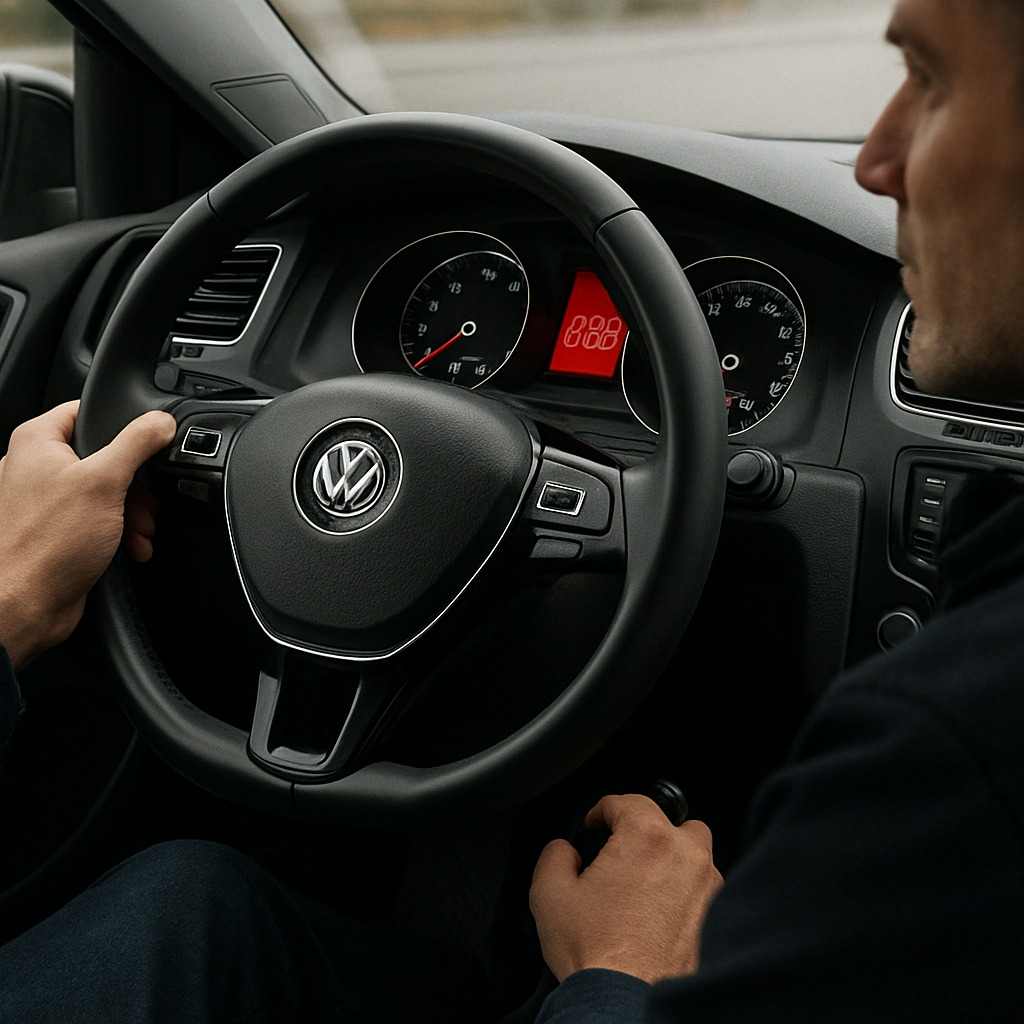
The appropriate way to get a VW Golf out of limp mode is to have the underlying fault diagnosed and repaired. There is no universal reset or bypass for every Golf, and switching the ignition off or clearing a warning does not show that the fault has been fixed. If the car’s behaviour makes it unsafe to continue, stop at a safe location and arrange professional help.
What limp mode means on a VW Golf
Limp mode is a protective operating state intended to reduce the risk of further damage when a vehicle detects a fault. It is a prompt to investigate the underlying problem, not a diagnosis of a particular failed part or a repair in itself. Carwow’s guide to limp mode advises having the fault checked and explains that the mode can be cleared once the cause has been fixed.
The exact symptoms and warning indications can vary with the vehicle and the fault. Do not use one symptom alone to identify the cause or assume that another Golf’s fault will be the same as yours.
How to get a VW Golf out of limp mode
- Prioritise a safe stopping place. If the Golf’s behaviour makes it unsafe to continue, stop somewhere safe and seek roadside assistance or recovery rather than trying to reach your destination.
- Arrange a prompt assessment. Tell the workshop what the car did, when it happened, and what warning messages or lights appeared. Include the model year and, if known, the engine and transmission variant.
- Have the underlying fault identified and repaired. Avoid guessing at parts or treating a reset as a repair. The correct next step depends on the fault and the circumstances.
- Ask what was found. A suspected cause is not the same as a confirmed diagnosis. Ask the technician to explain the finding and whether the repair resolved the problem before relying on the car as normal.
Do not try to disable limp mode or rely on a generic reset sequence instead of addressing the cause. Limp mode is designed to limit the effects of a fault, and bypassing it does not repair the problem.
What causes a VW Golf to enter limp mode?
Limp mode does not identify one universal cause. Different faults can trigger it, and the mode itself does not show which component is responsible. A warning light, a change in how the car behaves, or a stored fault code can help describe the problem, but none should be treated as a confirmed diagnosis on its own.
Do not replace parts based only on a general list of possibilities or an anecdote about another Golf. Diagnosis can depend on the vehicle’s year, engine, transmission, symptoms, and fault information. Have the particular car assessed rather than assuming that a specific system or sensor is responsible.
Does the advice differ for a 2022 VW Golf?
Do not assume that a reset procedure or diagnosis for an older Golf or a different Golf variant applies to a 2022 model. The sensible next step remains to have the underlying fault diagnosed and repaired using information from the particular vehicle.
If the problem appears to involve the transmission
Limp mode does not by itself prove that the transmission is at fault. If the Golf also has trouble selecting or engaging gears, report that symptom to the workshop. A diagnostic code can be useful information, but it does not by itself prove that a particular part has failed.