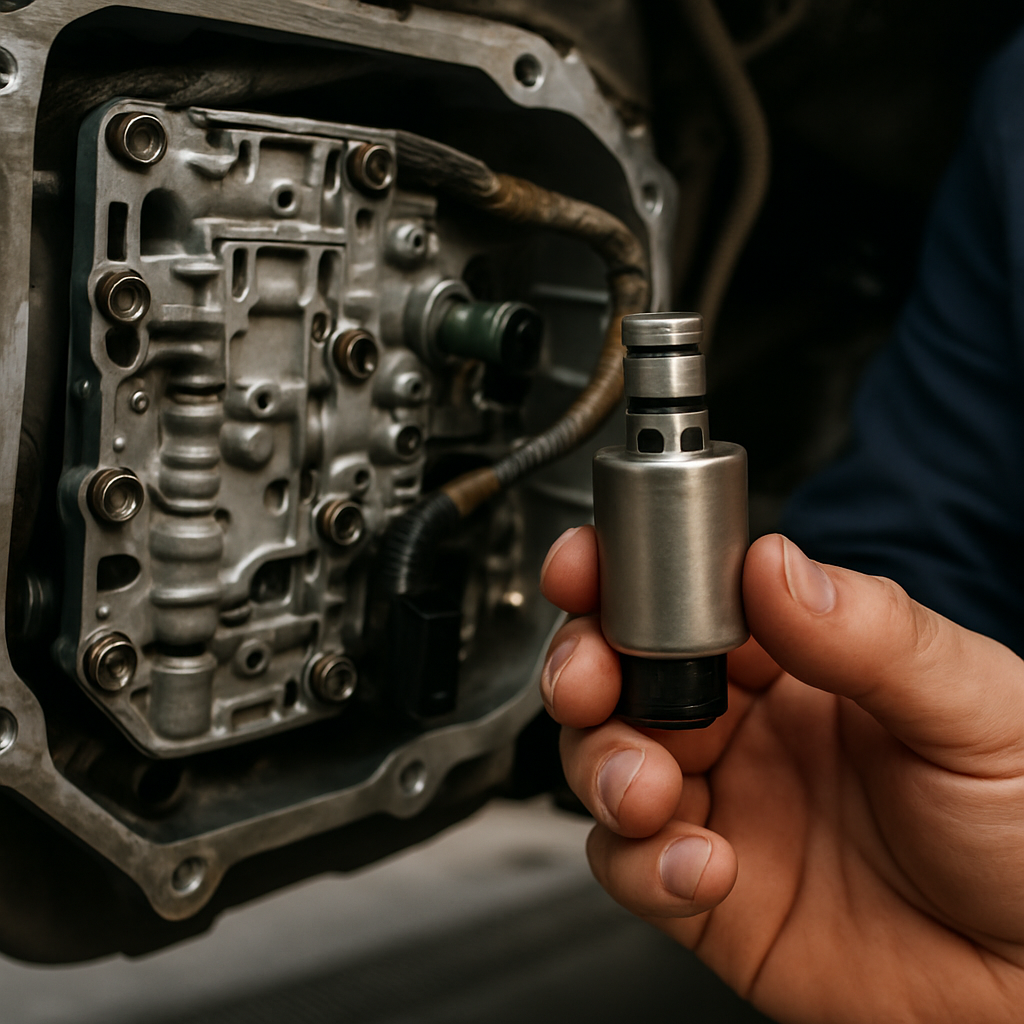
A pressure control solenoid D performance or “stuck off” fault, commonly associated with code P2714, can be caused by a faulty solenoid, low or contaminated transmission fluid, a clogged filter, wiring or other electrical problems, or a fault in the transmission pump or valve body. The code points to a pressure-control performance problem; it does not, by itself, prove that the solenoid is physically stuck or identify the failed part.
Pressure control solenoids help regulate hydraulic pressure in an automatic transmission, which the transmission control system uses to manage shifts. Because several electrical and hydraulic faults can affect pressure control, diagnosis should follow the procedure for your exact vehicle and transmission rather than starting with a solenoid replacement.
What P2714 Means—and What Could Cause Solenoid D to Be Stuck Off
P2714 is associated with pressure control solenoid D performance or a “stuck off” condition. In practical terms, the control system has detected pressure-control operation that does not match what it expects. That description is not proof that the solenoid itself is mechanically jammed, nor does it establish why the pressure response is wrong. The Kelley Blue Book explanation of P2714 lists several possible causes, including fluid, wiring, the solenoid, the filter, the pump and the valve body.
Possible causes include:
- A faulty or damaged pressure control solenoid D: The solenoid may be worn, damaged or not operating as intended.
- Low or contaminated transmission fluid: Incorrect fluid level or dirty, burnt or debris-contaminated fluid can interfere with transmission hydraulic operation. Check level and condition only using the vehicle manufacturer’s specified procedure.
- A clogged transmission filter: Restricted fluid flow can contribute to pressure-control problems.
- Wiring or electrical faults: Damaged wiring, poor connections, or an open or shorted solenoid circuit may affect operation. A performance or “stuck off” description is not, on its own, confirmation of an open circuit or short.
- A transmission pump or valve-body problem: A fault elsewhere in the hydraulic system can produce a pressure-control concern even if the solenoid is not the root cause.
A Toyota-focused overview also discusses the solenoid, fluid and wiring as possible contributors to P2714; it is useful for general context, not as a diagnosis for a specific Toyota model. Read the general Toyota P2714 explanation. A separate P2714 code overview from CarParts.com uses the performance/stuck-off description as well.
Slipping, unusual shifts or warning lights may be reported by individual owners, but such reports do not establish a universal P2714 symptom or confirm a particular cause. The vehicle’s own behavior and diagnostic results need to be assessed together.
Where Is Pressure Control Solenoid D Located?
Pressure control solenoid D is an electromechanical component inside the automatic transmission. The exact position, access route and amount of disassembly required depend on the vehicle and transmission. The information available here does not establish a universal location, such as a particular side of the transmission or a specific position within the valve body.
Before ordering a part or opening the transmission, check service information for the exact model year and transmission. The letter “D” alone is not enough to determine the component’s location or confirm which part fits.
What to Check Before Replacing Anything
Use a diagnosis that matches the vehicle rather than treating P2714 as a parts-replacement instruction. A sensible sequence is to:
- Confirm the stored code and follow the diagnostic procedure for the exact year, model and transmission.
- Check transmission fluid level and condition only as directed by the manufacturer. A fluid check or service is not a guaranteed cure for this code.
- Have the relevant wiring and electrical connections checked, including the solenoid circuit where the vehicle’s procedure calls for it.
- Ask for the solenoid, filter, valve body and pressure-related causes to be assessed as appropriate to the test results.
Do not assume that P2714 confirms an electrical open or short. If another code, such as P2716, is present, it needs its own authoritative definition and vehicle-specific diagnostic procedure; the P2714 information here does not establish what P2716 means or how to test it. For another example of a transmission pressure-control code with more than one possible repair path, see our guide to diagnosing and repairing the P0776 transmission code.
Can You Get a Stuck Solenoid Unstuck?
There is no universal reset, additive or quick procedure supported here for freeing pressure control solenoid D. A fault described as “stuck off” could involve the solenoid, its electrical supply or control, fluid condition, or another part of the transmission’s hydraulic system. The code alone cannot distinguish between those possibilities.
Confirm the code, follow the vehicle-specific diagnostic steps and check fluid using the manufacturer’s procedure. Have the wiring, solenoid, filter, valve body and pressure-related causes assessed as indicated by the diagnosis. Avoid trying to force or strike the solenoid, applying solvents, or relying on an additive or fluid change as a guaranteed fix. If access requires transmission or valve-body work—or the vehicle is slipping or shifting abnormally—seek professional transmission diagnosis.
Does P2714 Mean the Solenoid Needs Replacing?
Not necessarily. Replacement may be appropriate if testing confirms that the solenoid is faulty, but low or contaminated fluid, a clogged filter, wiring or electrical faults, a defective pump, or a valve-body problem are also possible. The repair decision should follow confirmation of the code, inspection of relevant fluid and electrical conditions, and testing of the components implicated by the vehicle-specific procedure.
No reliable replacement price, labor time or generic procedure can be given without the vehicle and transmission details. Repair access and cost depend on the confirmed fault and the specific application. Likewise, there is no single P2714 solenoid D part number that can safely be applied to all vehicles. Verify the repair procedure and part fitment against the exact year, model and transmission using suitable service or parts information.
P2714 on a Toyota Tundra: What Can Be Confirmed
The available Toyota-focused information provides general P2714 context and discusses possible solenoid, fluid, filter and wiring causes. It does not establish which Tundra model years or transmission variants it applies to, whether every Tundra uses the same solenoid arrangement, or a Tundra-specific location, part number or repair procedure.
For a Tundra, confirm the code definition, transmission identification, diagnostic procedure and part fitment for the exact year and configuration. If TRAC OFF and check-engine indicators are also showing, our guide to what Toyota TRAC OFF and check-engine lights can mean explains those dashboard warnings; it does not establish that P2714 caused them.
P2714 on a Toyota Camry: Check the Exact Transmission
The Toyota-focused P2714 information supports general discussion of possible causes, not a Camry-specific diagnosis. It does not identify the relevant Camry model years or transmission variants, the solenoid’s exact location, or a correct replacement part. Do not assume that all Camrys share one solenoid layout or repair.
Check the code definition and diagnostic steps for your exact Camry year and transmission before choosing a part or repair. If the vehicle is slipping, shifting abnormally or otherwise behaving unsafely, arrange prompt professional assessment rather than assuming it is safe to continue driving.