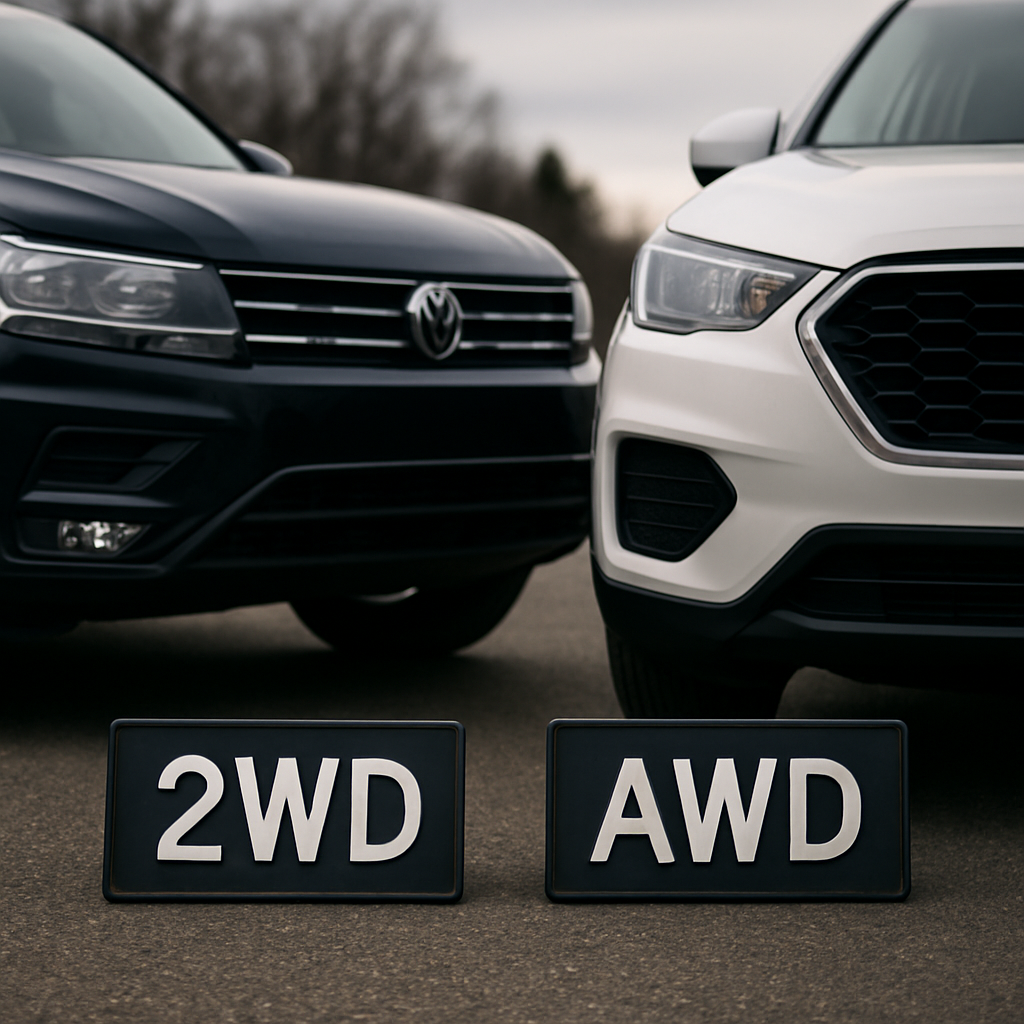
The short answer: 2WD sends engine power to one axle only, while AWD can send power to both the front and rear axles. For most drivers who mainly use paved roads, a 2WD car or SUV is the lower-cost, simpler choice. AWD is most worthwhile when snow, consistently loose surfaces, rough roads, or other low-traction conditions are a genuine and recurring part of the vehicle’s job. The right answer depends on the specific vehicle, its tyres, and how and where you drive.
2WD vs. AWD: The Basic Difference
In a conventional four-wheeled passenger vehicle, two-wheel drive (2WD) means that one axle is driven: either the front wheels or the rear wheels. All-wheel drive (AWD) is a system that can distribute engine power to both axles, giving the vehicle the ability to use all four wheels for propulsion.
These labels describe the driven wheels, not the number of wheels fitted to the vehicle. They also do not tell the whole story about how a particular system operates. As Practical Motoring’s overview of 2WD and AWD SUVs notes, many AWD systems drive principally through one axle in normal conditions and bring in the other axle when their controls detect a need for extra traction.
| Term | What it means | Typical role |
|---|---|---|
| 2WD | Power goes to one axle only. | The umbrella term for FWD and RWD. |
| FWD | Front-wheel drive: the front axle is driven. | Common in cars and car-based crossovers. |
| RWD | Rear-wheel drive: the rear axle is driven. | Common in pickups, sports cars, and some luxury vehicles. |
| AWD | A system that can power both front and rear axles. | Usually intended for on-road, all-weather traction, but designs vary widely. |
| 4WD or 4×4 | A system that can power both axles, commonly with driver-selectable modes. | Traditionally associated with trucks and more rugged off-road vehicles. |
FWD and RWD are both types of 2WD
It is easy to treat 2WD, FWD, and RWD as three separate choices, but FWD and RWD are actually the two main forms of 2WD. A front-wheel-drive vehicle uses the front wheels for both propulsion and steering. A rear-wheel-drive vehicle sends power to the rear wheels while the front wheels steer.
That distinction matters. Weight distribution, vehicle layout, and driving behaviour differ between FWD and RWD vehicles, so there is no single winter, handling, or traction experience that applies to every 2WD vehicle.
AWD does not always mean a fixed 50/50 split
AWD is not one uniform technology. A full-time system sends some drive to both axles as part of normal operation. An on-demand system may operate mainly as front- or rear-wheel drive and transfer torque to the other axle when acceleration or reduced grip calls for it. Some systems are tuned for efficiency, while others are rear-biased or designed to support performance driving.
Consequently, an AWD badge does not prove that all four wheels are always driven equally, that the system has a lock mode, or that it can send a particular fixed proportion of torque to each axle. The operating strategy, selectable modes, and limits are specific to the model and should be checked in its owner’s manual and technical specifications.
AWD versus 4WD: related, but not interchangeable
Both AWD and 4WD can power the front and rear axles. The conventional distinction is that AWD is generally automatic and intended for changing on-road traction, whereas traditional 4WD is commonly found on truck-based vehicles and often gives the driver selectable modes. Many traditional 4WD vehicles run in rear-wheel drive until 4WD is selected; some also offer lower-range gearing for demanding terrain.
Those are broad conventions rather than rules that apply to every badge. As Driving.ca’s explanation of AWD and 4WD emphasises, drivetrain designs vary, including whether and when power is transferred between axles. Follow the manufacturer’s instructions for the exact vehicle, particularly before selecting any 4WD mode.
Which Is Better – and Do You Really Need an AWD SUV?
Neither AWD nor 2WD is universally better. For a driver who spends almost all of their time on tarmac and only occasionally uses a maintained dirt road, 2WD is usually the sensible economic choice. For a driver who regularly encounters snow, unploughed or loose roads, extended rough-road travel, or terrain where maintaining forward traction is a real concern, AWD can be a useful upgrade.
An SUV body shape alone does not create a need for AWD. A 2WD crossover can be entirely suitable for school runs, commuting, motorway work, and occasional well-maintained unsealed roads. Conversely, an AWD crossover is not automatically equipped for serious off-road use. Ground clearance, tyres, approach and departure angles, underbody protection, drive modes, and the manufacturer’s stated limits all matter.
When 2WD makes the most sense
Comparable 2WD SUV versions are commonly less expensive to buy and slightly cheaper to run than their AWD equivalents. They have fewer drivetrain components, and they avoid some of the weight and mechanical losses involved in driving a second axle. The size of the difference in price, fuel consumption, cabin packaging, and maintenance requirements depends on the model and trim, so compare the exact versions under consideration rather than relying on a generic rule.
2WD is commonly a strong fit if you:
- Drive mainly on paved urban, suburban, or motorway routes.
- Use unsealed roads only occasionally and when they are maintained.
- Prioritise purchase price and running costs.
- Do not routinely drive in snow, deep loose material, or rougher terrain.
- Are choosing a vehicle for ordinary road use rather than for off-road capability.
When AWD is likely to be worthwhile
AWD can improve the vehicle’s ability to get moving and continue making progress where the primary driven axle has limited grip. That can be valuable on recurring snow-covered roads, loose surfaces, more extensive dirt or rough-road routes, and some off-road conditions. Practical Motoring similarly concludes that AWD becomes beneficial for lower-traction driving and more demanding terrain beyond ordinary dirt roads.
AWD is more likely to justify its extra cost and complexity if you:
- Regularly drive on snow-covered, icy, loose, or rough surfaces.
- Live where low-traction conditions are routine rather than an occasional forecast.
- Frequently travel on long, unsealed, or poorly maintained roads.
- Need the traction benefits of an AWD vehicle for the routes you genuinely use.
- Have checked that the specific vehicle’s clearance, tyres, and intended-use limits suit the terrain.
Wet weather alone does not automatically make AWD necessary. Nor does living in a snowy area automatically make 2WD unsuitable. Tyres, road treatment, route choice, driver skill, and the frequency and severity of conditions all remain part of the decision.
Why Would Anyone Choose RWD?
RWD is a 2WD layout in which the rear wheels receive engine power and the front wheels steer. Buyers may choose it because it is common in the kinds of vehicles they want: pickup trucks, sports cars, and some luxury cars. It can also appeal to drivers who prefer the driving characteristics associated with a rear-drive layout.
That preference is not universal. AWD can also provide performance advantages in some conditions by helping a vehicle put available power to the road, while many enthusiasts prefer the response and balance of RWD. The better layout depends on the vehicle’s design and the driver’s priorities, not on a blanket rule that one is superior.
Winter use deserves separate consideration. In general, rear-drive vehicles can be less straightforward to manage on snow or ice than front-drive vehicles, particularly when the driven rear axle has limited grip. That does not make every RWD vehicle unsafe or unusable in winter. Tyre choice, vehicle setup, conditions, and measured driving remain important, but a shopper choosing 2WD should recognise that FWD and RWD have different real-world behaviour.
What Are the Disadvantages of 2WD?
The main disadvantage of 2WD is traction when the driven axle loses grip. Because only one axle propels the vehicle, it has less ability than AWD to use the available grip at the other axle. The limitation becomes most relevant on snow, loose gravel, mud- or sand-like surfaces, rough roads, and terrain beyond ordinary maintained dirt tracks.
It is not a verdict that 2WD is inherently inferior. On a dry paved road, or on an occasional well-maintained unsealed road, a 2WD vehicle may be the lighter, less expensive, and more efficient option. The disadvantage matters only when your usual conditions expose the limits of driving one axle.
The effect is also layout-dependent:
- FWD: the engine’s weight is commonly over the driven wheels, which can be helpful for ordinary traction in some low-grip conditions.
- RWD: the front and rear wheels have separate steering and propulsion roles, a layout widely used by pickups, sports cars, and some luxury vehicles, but it may require greater care when rear-axle traction is poor.
Neither point predicts the capability of every vehicle. Tyres, load, surface condition, ground clearance, traction-control calibration, and driver inputs can all change the result.
AWD Improves Traction, Not Every Part of Winter Safety
AWD can help a vehicle get moving and accelerate with less wheelspin when grip is limited. It does not repeal the limits of braking or cornering. All vehicles must still slow and turn using the grip available from their tyres, and an AWD system cannot make an unsuitable tyre appropriate for snow or ice.
This is why tyres are central to the decision. As Cartelligent’s drivetrain comparison notes, a 2WD vehicle with dedicated winter tyres can outperform an AWD vehicle fitted with all-season tyres on slick roads. That does not mean AWD has no value; it means drivetrain and tyre choice solve different parts of the traction problem.
Avoid treating AWD, 4WD, traction control, or SUV ride height as a guarantee of control. Extra traction can encourage drivers to travel faster than conditions allow, even though stopping and cornering limits remain. In poor weather, use tyres suited to the season and conditions, reduce speed, leave more following distance, and follow local weather and road guidance.
Towing, Boat Ramps, and Drivetrain Choice
AWD or 4WD may provide useful traction in some low-grip launch situations, but drivetrain traction is not the same thing as towing approval. It does not establish how much a vehicle may tow, how much payload it may carry, whether a particular hitch is suitable, or whether the vehicle is appropriate for a specific trailer or ramp.
Before towing, check the manufacturer’s ratings and instructions for the exact model, model year, trim, drivetrain, and equipment fitted. Confirm the published towing rating and payload separately, as they are different limits. Do not use a generic AWD-versus-2WD comparison as a substitute for the vehicle’s handbook, ratings label, or applicable towing requirements.
Before You Choose: Check the Exact Vehicle, Not Just the Badge
Two vehicles carrying the same AWD or 2WD label can differ substantially. Before buying, leasing, or relying on a drivetrain for a particular route, verify the specification of the exact vehicle and trim.
- Confirm whether it is FWD, RWD, AWD, 4WD, or a system with more than one selectable operating mode.
- Check whether AWD is standard or optional and whether it is full-time or on-demand.
- Read the manufacturer’s instructions for any selectable drive modes and their use limits.
- Compare the exact trim’s price and official fuel-economy figures rather than assuming every AWD version has the same penalty.
- Check tyre specification and condition, ground clearance, and the manufacturer’s intended-use limits.
- If towing is relevant, verify the specific vehicle’s towing rating and payload rating separately.
- Do not assume an AWD badge means a torque-locking mode, serious off-road protection, or the same capability as another AWD model.
For many buyers, the decision is straightforward: choose 2WD when paved-road driving and ownership costs are the priority; choose AWD when lower-traction conditions are frequent enough to make its extra capability useful. Then make the final call using the exact vehicle’s specifications, tyres, and owner’s manual rather than the drivetrain badge alone.
Pingback: 2017 Hyundai Elantra Timing Chain Replacement Cost: Tensioner Estimates, Parts Prices, and What to Verify - Premier Motoring Blog