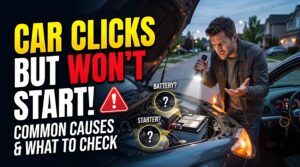
If your car clicks when you turn the key but the engine does not start, the cause is commonly a lack of sufficient power reaching the starter or a starter-system problem. The noise can narrow the possibilities, but it cannot identify the failed part on its own. A battery may still power the dashboard and radio while lacking the power needed to operate the starter, and a starter fault can also produce a click.
Why a car clicks but won’t start
Listen carefully to the type of click you hear. Rapid, repeated clicking is commonly associated with a battery that cannot supply enough power to turn the starter motor. One distinct click can be a possible sign of a starter or starter-circuit problem. Neither pattern is a conclusive diagnosis, so avoid replacing parts solely on the basis of the sound.
As Firestone explains in its guide to starting clicks, battery and starter problems are both among the possible causes. A starter-related fault remains possible with a single click, but the starter should be tested before it is condemned.
Working lights, a radio or an illuminated instrument panel do not rule out a weak battery. These accessories use far less power than the starter motor. A battery can therefore appear to have electrical power yet still be unable to crank the engine, as Crowell Brothers notes in its starting-system advice.
Repeatedly turning the key is unlikely to establish the cause. Tapping a starter is also not a dependable repair or diagnostic method. Firestone notes that it can sometimes make a starter operate temporarily, but not always; it does not confirm the fault or resolve the underlying problem.
What to check first when you hear clicking
- Note whether the noise is a rapid series of clicks or one clear click.
- Watch the dashboard lights during the starting attempt. Significant dimming or lights going out is useful information, but it does not by itself prove which component has failed.
- Check the battery and any accessible connections only in accordance with the vehicle owner’s manual. Do not carry out electrical work if you are unsure how to do it safely.
- If the cause is not clear, arrange proper battery and starting-system testing rather than replacing the battery, starter or another component based only on the sound.
EAS Tire & Auto’s first-check guide also identifies battery connections, engine grounds and starter-related fuses as possible inspection areas. They are possible points in the starting circuit, not confirmed causes of every clicking no-start.
If the car will not crank and there is no click
A silent, no-crank condition is different from a clicking no-start. In a no-crank condition, the engine does not turn when you attempt to start it and there is no starter click. If the engine turns over normally but does not fire up, that is a separate fault path; see our guide to the different problem of a car that cranks but won’t start.
Dashboard lights coming on still do not prove that the battery can deliver enough current for starting. An apparently good battery should not be treated as ruled out until the battery and its starting connections have been properly tested. Conversely, no dashboard lights may indicate a more complete loss of electrical power, but that symptom alone cannot identify the cause.
A recently fitted battery does not automatically explain or rule out a no-click problem. The symptom may involve the battery, its connections, the starter circuit or a starting interlock, among other possibilities. If basic owner-manual checks do not resolve the issue, ask a technician to test the battery, connections, starter circuit and starting interlock rather than assuming that the replacement battery or a particular component is at fault.
For a more focused explanation of this lights-on but silent symptom, see our guide to what to check when the lights come on but the car makes no click.
A Park-to-Neutral check for automatic cars
For an automatic vehicle, hold the brake pedal and try starting in Neutral rather than Park. EAS Tire & Auto lists this as a basic check. If the vehicle starts in Neutral, the transmission range or neutral-safety switch may need attention. That result is a useful clue rather than proof of a specific fault, so follow the owner’s manual and arrange inspection if the problem continues.
Engine grounds and starter-related fuses are other possible areas to inspect. However, silence alone cannot confirm that a fuse, ground connection or switch is at fault. Leave electrical diagnosis and repair to a qualified technician if you are not comfortable identifying these items safely.
Can a jump-start help if the starter is bad?
The available information does not establish whether a jump-start will help in a particular case where a starter fault is suspected, nor does it provide vehicle-specific jump-start instructions. Do not assume that a jump-start will fix or diagnose a starter problem. Consult the owner’s manual or seek qualified roadside or workshop assistance.
If the battery repeatedly becomes discharged, a technician may need to assess the charging system as part of the wider diagnosis. A clicking or no-click symptom on its own does not confirm an alternator fault.
Is the clicking a transmission tick?
The available guidance concerns clicks heard during an attempted start; it does not describe how to identify or compare a transmission tick. Do not assume that a click heard when turning the key indicates a transmission fault. If the sound occurs while driving, when selecting gears or after the engine has started, make a note of when it happens and have the vehicle assessed separately by a qualified technician.