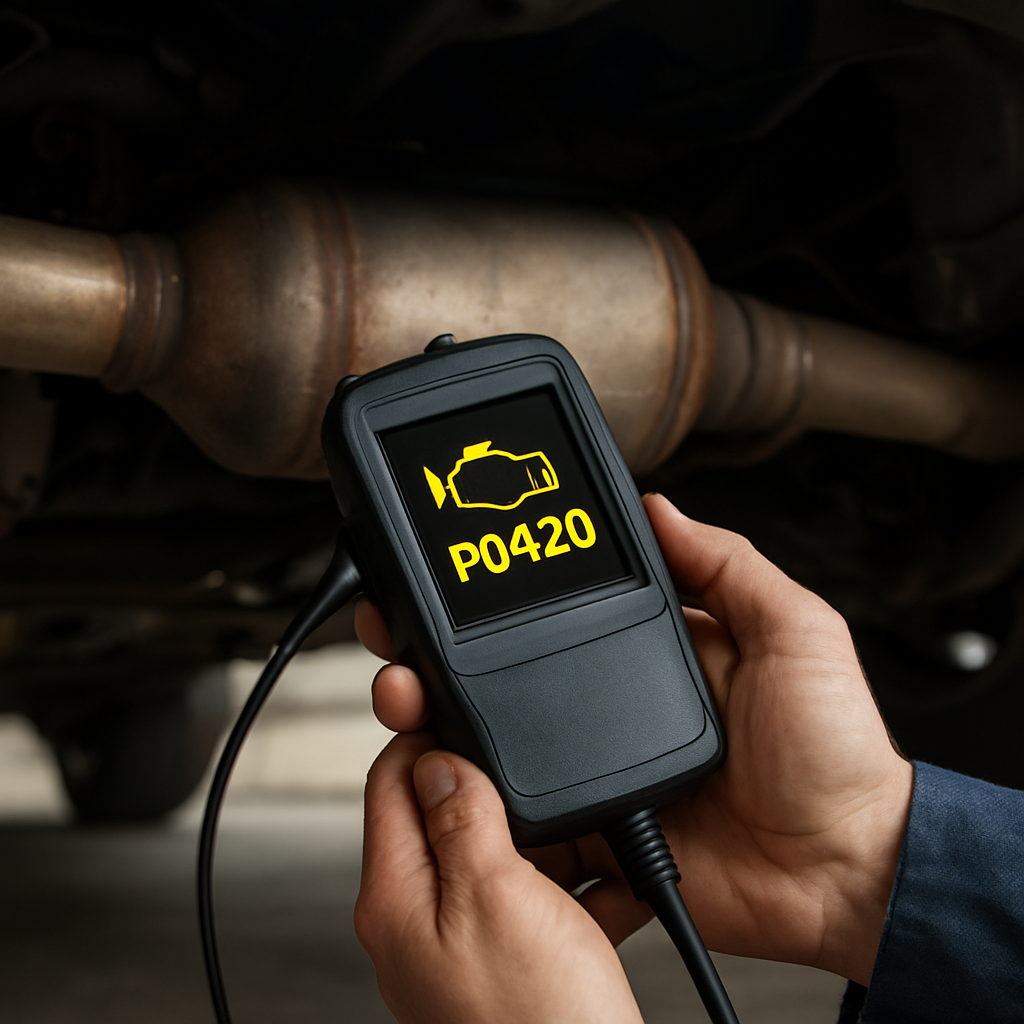
The wording “catalyst system efficiency below threshold” is not enough, by itself, to identify a failed part or determine whether a vehicle is safe to drive. The exact diagnostic code and vehicle details matter. The research available for this article contains no authoritative diagnostic or manufacturer source to verify the code’s technical meaning, causes, repair procedure, or severity. Therefore, those points cannot responsibly be stated as established facts here.
What should you check first?
Record the exact code shown by the scan tool, including every letter and number, and note the vehicle’s make, model, year, and engine. The wording in a dashboard message or on a basic code reader may not provide enough detail to identify the applicable diagnostic information. Check the vehicle’s manual and seek a diagnosis based on its specific engine and service information rather than choosing a repair from the message alone.
A code or warning does not, by itself, confirm that a particular component has failed. Do not replace a catalytic converter, oxygen sensor, or another part solely on the basis of this wording without a supported diagnosis.
What do Bank 1 and Bank 2 mean for the location?
The search wording often includes “Bank 1” or “Bank 2”, but this article does not have a verified technical source or vehicle-specific information to explain how those labels apply to your car or identify a physical component location. There is no responsible universal Bank 1 location to provide for an unspecified vehicle. The answer must be checked against the exact make, model, year, and engine.
The same limitation applies to a Toyota P0420 location question: a Toyota model and year alone may not be enough to identify the relevant layout, and no Toyota service information was supplied for verification. A Toyota Celica answer also requires the Celica’s year and engine; the available evidence does not support a model-specific diagnosis.
How is it fixed, and how much could it cost?
No verified diagnostic sequence, confirmed cause list, or current pricing information is available here. That means it would be misleading to prescribe a repair or give a cost range. The appropriate next step is to have the exact code interpreted using information for the specific vehicle, with the fault confirmed before parts or labour are authorised. Any estimate should identify the diagnosed fault and what the quoted work includes.
For more on the topic, see our guide to diagnosing a P0420 Bank 1 code. It is related reading, not a substitute for vehicle-specific diagnosis.
Is it bad to drive with this warning?
The evidence available for this article does not establish whether a vehicle displaying this wording is safe to drive or how urgently it needs attention. Do not treat the message alone as clearance to drive or as proof of an immediate hazard. Consult the vehicle manual and arrange an assessment based on the exact code and any other warning messages or symptoms. If you are unsure whether to continue driving, seek advice from a qualified technician rather than relying on the code wording alone.
You can also read whether you can keep driving with a P0420 code; the linked article should not replace guidance for your particular vehicle.