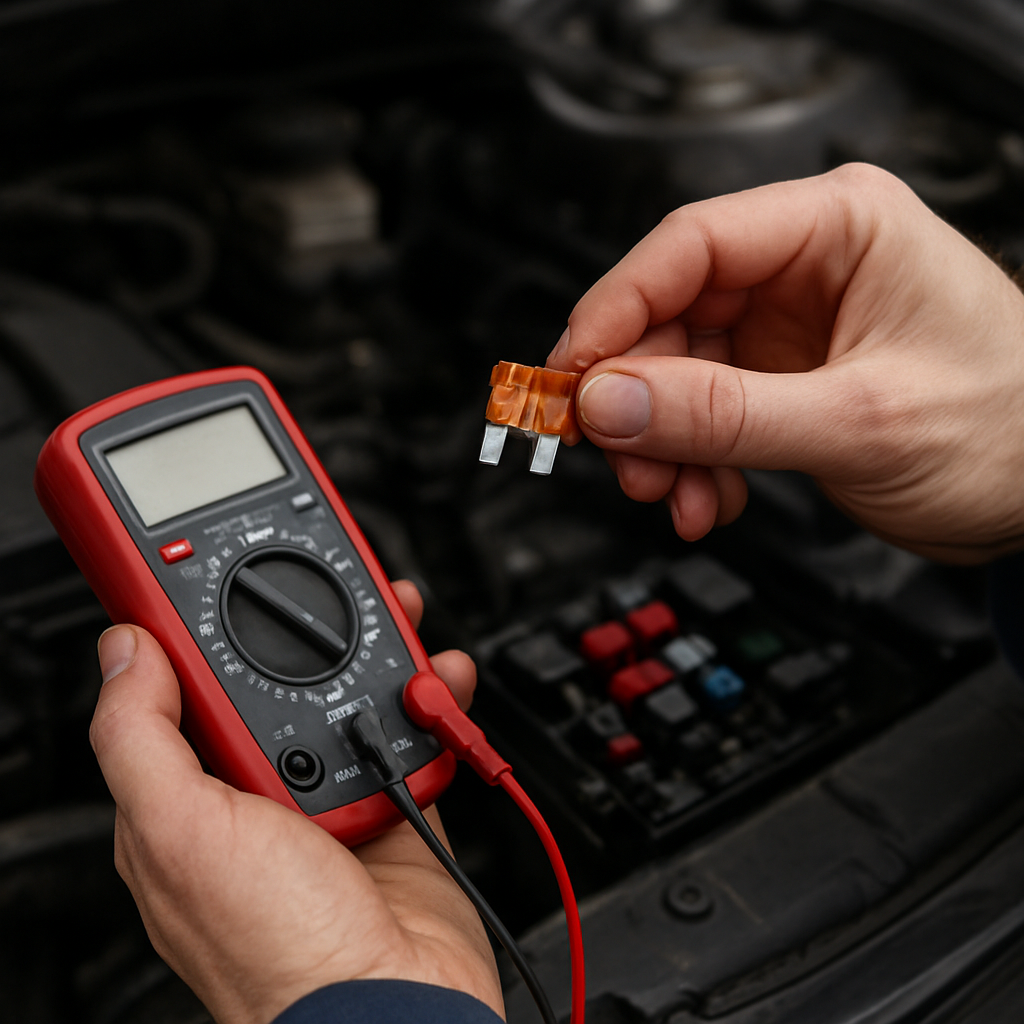
A car fuse that keeps blowing usually points to excess current or another fault in the circuit it protects—not proof that the fuse itself is defective. A fuse is designed to open the circuit when its metal element melts, so replacing it may restore power temporarily without fixing the underlying problem.
Why does the same fuse keep blowing in a vehicle?
The available automotive information identifies several possible fault locations. They are general leads for cars, trucks and motorcycles, not a diagnosis for a particular vehicle or model.
- Damaged wire insulation: If insulation wears through, an exposed conductor can touch grounded vehicle bodywork and create a short. A vehicle fuse explanation of recurring failures describes this as one possible cause.
- A damaged fuse socket: Spring tabs inside a socket can become bent or damaged. If a tab contacts the grounded outer shell, the circuit may short and the replacement fuse can fail again.
- A failing motor or pump: A component with an internal fault may draw more current than intended. A motor or pump on the affected circuit is therefore one possible inspection lead, not a confirmed cause.
- A loose or corroded connector: This has also been reported as a possible lead in a social-media discussion about vehicle fuse failures. That report is not a confirmed diagnosis or strong evidence that a connector is the cause in any particular case.
The same broad possibilities may be relevant whether the vehicle is a car, truck or motorcycle, but the information available does not establish category-, make-, model- or year-specific causes. A repeatedly failing fuse needs circuit-level diagnosis to identify the actual fault.
If the affected circuit serves an accessory outlet, a damaged socket may be relevant. See our guide to troubleshooting a car’s cigarette-lighter socket and fuse for that specific component; it does not diagnose every recurring fuse failure.
What to do when a replacement car fuse blows again
- Identify the circuit. Use the fuse information for your own vehicle, such as its fuse-panel label or owner’s manual. Fuse locations and ratings vary, so do not rely on a generic chart.
- Note what was happening. Record which equipment was operating and the conditions when the fuse failed. This can help a technician narrow down which circuit or component to inspect.
- Use only the specified rating. The supplied vehicle fuse guidance says to replace a fuse with the same amperage rating. Check the vehicle’s own information for the correct specification; do not fit a higher-rated fuse to stop it from blowing.
- Arrange diagnosis if it fails again. A correctly rated replacement that opens again indicates that the underlying issue remains. Ask a qualified technician to assess the circuit, with damaged wiring or insulation, the fuse socket, and a component such as a motor or pump among the possible inspection leads.
Do not bypass the fuse, bridge its terminals or keep replacing it as a way to keep the circuit operating. The available information does not provide a complete test procedure or vehicle-specific repair instructions, so diagnosis beyond identifying the affected circuit is best left to a qualified technician.
Is a repeatedly blowing fuse dangerous?
A fuse is a protective device: its metal element melts to interrupt the circuit before wiring or components are damaged, according to the automotive explanation of how a fuse opens. That protective purpose does not prove that a blown fuse eliminates fire risk or guarantees the vehicle is safe. Repeated failure means the circuit problem is unresolved; do not treat a replacement fuse as a repair or assume the vehicle is safe to drive solely because the fuse has opened.
The information available does not establish a fire probability or provide a safe-to-drive determination. If the correctly rated replacement fails again, stop replacing it and arrange professional diagnosis.
What this guidance does not establish
This article covers general automotive possibilities only. The available research does not establish how to diagnose a repeatedly blowing household fuse, a home or vehicle air-conditioning circuit, or whether a fuse can be blown while still looking intact. Do not transfer these vehicle-specific observations into a household electrical repair procedure. It also does not provide a complete diagnostic test, a vehicle-specific fuse chart, model-specific findings or repair-cost estimates.