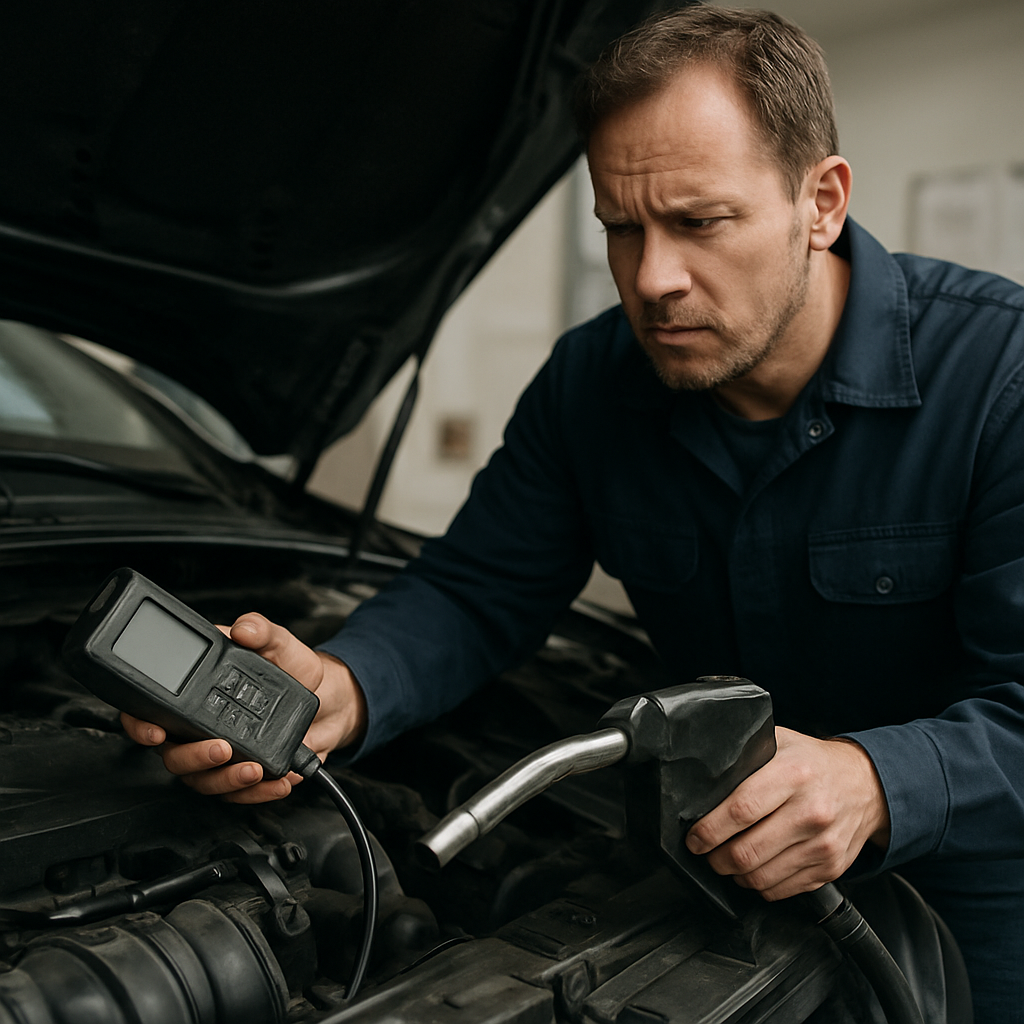
Yes. Bad or contaminated fuel can disrupt combustion and contribute to a misfire that triggers P0300. But the code does not confirm that fuel is the problem: it means the engine control system detected random or multiple-cylinder misfires, and several faults can cause that condition. If rough running began soon after refueling, that timing is a useful clue to mention during diagnosis, not proof that the fuel was contaminated.
Can Bad Gas Cause a P0300 Code?
Combustion depends on the correct air-fuel mixture igniting as expected. Poor-quality or contaminated fuel can interfere with that process, so one or more cylinders may misfire and the vehicle may set P0300. Both CARiD’s P0300 explanation and 1A Auto’s diagnostic guide include poor or contaminated fuel among possible causes.
A recent fill-up matters most when the symptoms started shortly afterward. Note when the misfire began, where you refueled, and whether the engine’s behavior changed. However, a fault appearing after refueling could still be coincidental; ignition, air, fuel-delivery, electrical, or mechanical problems can produce the same code. P0300 alone cannot identify fuel as the cause.
Do not assume that topping off the tank or adding a fuel product will fix the problem. If the misfire continues, have the vehicle diagnosed rather than relying on a presumed remedy.
What P0300 Means—and What It Does Not Tell You on a Specific Vehicle
P0300 means the engine control system has detected a random or multiple-cylinder misfire. A misfire occurs when combustion in a cylinder does not happen as expected. The code describes the detected condition; it does not name the failed part or confirm a root cause. Identifix’s P0300 guide explains that causes can involve ignition, fuel delivery, airflow, electrical control, sensor input, or the engine’s mechanical condition.
A scan may also show cylinder-specific codes such as P0301, P0302, or P0303, which can help identify where the control system detected a misfire. Those codes still need diagnosis: they do not, by themselves, prove which component has failed. For a broader overview, see our broader guide to diagnosing a P0300 misfire.
The general meaning is the same when the question concerns a Chevrolet, Chevy Silverado, Ford, or Nissan: bad fuel is one possible cause, but the code does not establish a make-specific failure pattern or diagnosis. The exact diagnostic steps and specifications depend on the vehicle’s year, engine, and service information. Ford owners can read more about Ford-specific P0300 causes and driving risks.
On a 2014 Chevy Cruze, P0300 means a random or multiple-cylinder misfire has been detected. That general code definition does not establish a Cruze-specific cause or repair. P0304, by comparison, is a cylinder-specific misfire code; see the related Chevy Cruze P0304 cylinder-misfire guide for that different code.
Other Common Causes of P0300 and Why Multiple Cylinders Can Misfire
There is no single failed part that P0300 proves is responsible, and the available evidence does not establish one universally most common cause. Possible causes fall into several categories:
- Ignition: Worn or faulty spark plugs, failing ignition coils, or related circuit problems can prevent proper combustion.
- Fuel delivery: Fuel injectors may have a fault, or the engine may not be receiving adequate fuel.
- Fuel pump: Yes, a weak or failing fuel pump can restrict fuel delivery and contribute to misfires. P0300 alone does not confirm that the pump has failed. If you have a Nissan Maxima, this guide covers fuel-pump symptoms and testing on a Nissan Maxima; its details should not be assumed to apply to every Nissan.
- Air leaks: A vacuum leak or other unmetered air entering the engine can disturb the air-fuel mixture.
- Electrical, sensor, or control faults: Problems with wiring, electrical control, or sensor inputs can affect how the engine operates. A sensor-related issue is one possibility to test, not a conclusion from P0300; read more about how an O2 sensor may relate to P0300.
- Mechanical engine faults: Problems affecting engine condition or cylinder operation can also cause misfires.
More than one cylinder can misfire when a shared issue affects the engine—for example, a fuel-delivery, air, ignition-control, or electrical problem. Some mechanical faults can also affect multiple cylinders. That is a reason to investigate shared systems, not evidence that any one of them has failed. A restricted catalytic converter can also contribute to misfires if it creates sufficient exhaust backpressure, but that possibility does not make the converter the likely cause in any particular case.
How to Diagnose and Fix P0300 Without Guessing
Fixing P0300 means finding and correcting the cause of the misfire. Clearing the code alone does not repair the fault, and replacing parts based only on P0300 can lead to unnecessary repairs.
- Record all codes and available freeze-frame information. Do not focus on P0300 in isolation; note any related codes as well.
- Review the diagnostic data. Misfire counters, fuel trims, and related codes can help show when and how the fault occurs. Identifix recommends reviewing these details before settling on a cause.
- Test the relevant systems. Depending on the evidence, diagnosis may include inspecting spark plugs and ignition components, assessing fuel delivery and injectors, checking for air leaks, or investigating electrical, sensor, control, and mechanical faults.
- Use vehicle-specific service information. Test methods and specifications vary by vehicle, year, and engine. A generic pressure figure or procedure should not be assumed to apply to every car.
- Verify the repair. After the diagnosed fault is corrected, check that the misfire has stopped and that the codes or relevant monitoring data do not show it continuing.
If the problem began after refueling, share that timing with the technician so fuel quality can be considered alongside other causes. It is still important to test rather than replace a pump, injector, coil, or sensor on suspicion alone.
Can You Drive with P0300?
The code alone cannot establish that a vehicle is safe to drive. Arrange prompt diagnosis, particularly if the engine is running roughly or the vehicle’s behavior has changed. An ongoing misfire can damage the catalytic converter.
If the check-engine light is flashing, treat it as urgent. A flashing light can indicate a misfire that risks catalytic-converter damage, so stop driving when it is safe to do so and arrange appropriate assistance. If the engine is severely rough, losing power, or behaving abnormally, do not continue the trip; seek professional help instead. A steady light does not tell you the cause or severity by itself, and there is no universal safe distance or time limit that can be inferred from P0300.