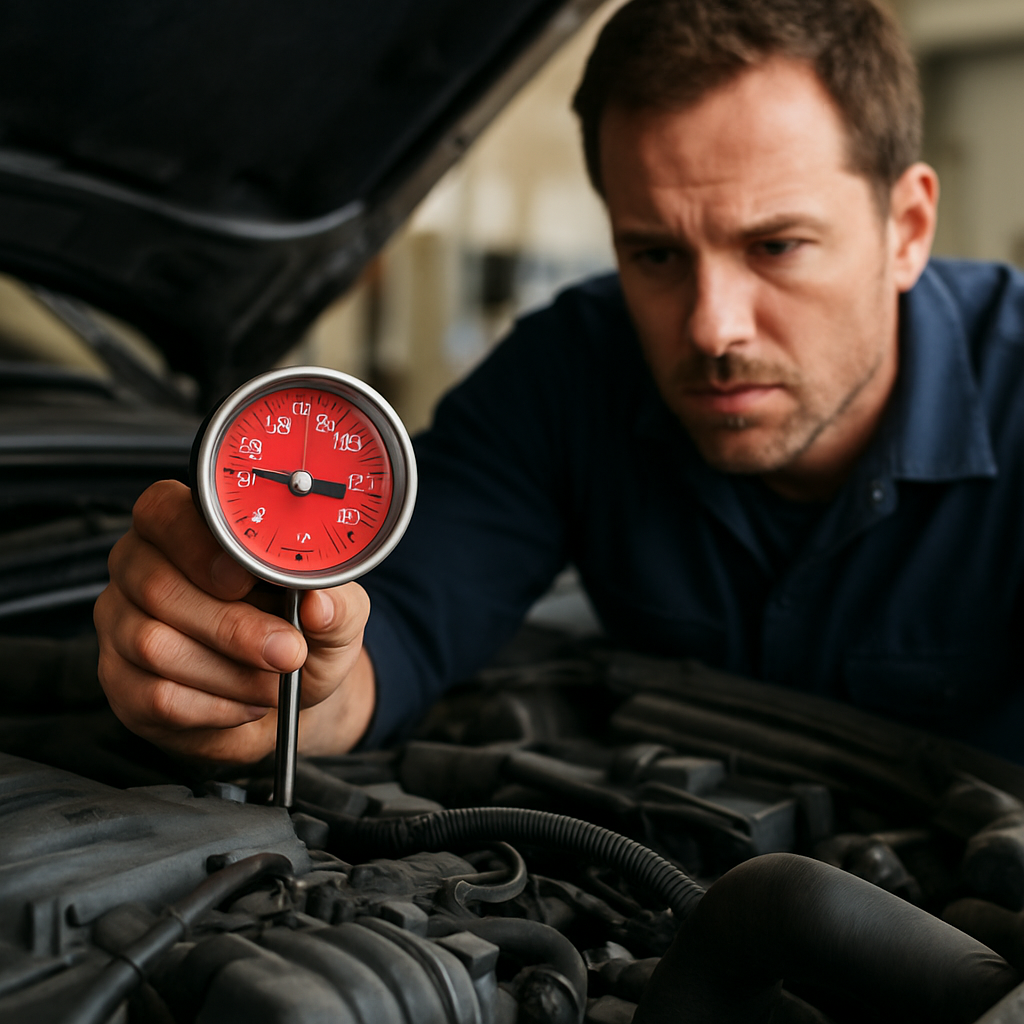
If your engine coolant is reading 230°F (about 110°C), treat it as a concerning high temperature. It is above the commonly cited operating ranges for many cars, but the available evidence does not establish one temperature at which every engine overheats. The correct limit depends on the vehicle, so check its owner’s manual and take any temperature warning seriously. This answer assumes the reading is in Fahrenheit; verify the units if your dashboard or scan tool may be displaying Celsius.
Is 230°F Too Hot for an Engine?
For many vehicles, 230°F is higher than the typical operating range cited by general automotive sources. It warrants attention, particularly if the temperature is continuing to rise or a warning appears. However, a single number cannot confirm that every engine is overheating: engines and cooling systems differ, and a vehicle’s actual warning threshold is manufacturer-specific.
General sources commonly cite ranges of approximately 190–220°F (88–105°C) or 195–220°F (90–105°C) as normal operating temperatures. These are broad reference ranges, not a substitute for the specification or warning behaviour of your particular vehicle. Carvilles Automart’s temperature guide gives a general range, while Industrias Dolz’s overview also stresses that operating conditions can affect temperature.
| Reading | How to interpret it |
|---|---|
| About 190–220°F (88–105°C) | A commonly cited general operating range; your vehicle’s own specification takes precedence. |
| 230°F (about 110°C) | Above those commonly cited ranges and worth treating as a concerning high reading, but not a universal overheat threshold. |
| 90°C (about 194°F) | Near the lower end of the cited typical ranges for a warmed-up engine. |
| 90°F (about 32°C) | A different reading from 90°C and below the cited warmed-up coolant ranges. |
There is no single universal answer to “At what temperature does an engine overheat?” The typical operating range, the point at which a vehicle displays a warning, and the temperature at which a particular engine may be at risk are not necessarily identical. Consult the manual for your exact vehicle rather than relying on a generic cutoff.
Why the Temperature Gauge May Not Tell the Whole Story
Some temperature gauges are programmed to smooth out normal fluctuations, so the needle may not move in direct proportion to every change in coolant temperature. Gauge position and warning behaviour can also vary between vehicles. A steady-looking needle should not override a temperature warning or other signs that the engine is overheating. BAR-TEK’s explanation of engine temperature notes both that engines differ and that gauges may be smoothed or programmed.
A sealed, pressurised cooling system affects the coolant’s boiling behaviour. That means 230°F does not automatically prove that the coolant is boiling; nor should one boiling-point figure be assumed to apply to every vehicle and coolant system. The HP Academy coolant-temperature discussion explains how system pressure affects boiling temperature.
What Should You Do If the Reading Reaches 230°F?
- If the temperature is rising, a temperature warning appears, or the vehicle is showing signs of overheating, pull over somewhere safe. Do not assume it is safe to continue driving just because the display reads 230°F rather than a higher number.
- Follow the vehicle’s warning instructions and arrange appropriate service or recovery if the temperature remains high or the warning persists.
- Do not open the radiator cap or another pressurised cooling-system cap while the engine is hot. Wait until the system has cooled before carrying out any inspection involving a cap; hot coolant and pressure can create a burn risk.
- Do not replace a fan, thermostat, water pump, radiator or coolant on the basis of the temperature reading alone. A high reading identifies a concern, not its cause; diagnosis depends on the vehicle and further checks.
Some drivers notice a rising temperature in traffic or while idling. That situation is worth investigating, but it does not by itself confirm a failed radiator fan or another particular fault. If the problem occurs specifically while stationary, see our guide to why a car may overheat at idle.
Continued overheating can lead to serious engine damage. That possibility does not mean a 230°F reading alone proves that damage has occurred or that a head gasket has failed. For more context, read about how overheating can contribute to head-gasket damage.
Does the Answer Differ for Toyota, Ford or Chevrolet?
The general ranges above are not Toyota-, Ford- or Chevrolet-specific specifications. The research available for this article does not establish a separate 230°F limit for any of those makes or account for differences by model year, engine or trim. Check the owner’s manual and the warnings for your exact vehicle. If its reading is high or a warning appears, use the cautious steps above rather than assuming that 230°F is normal for the make.
Are 200°F or 230°F Too Hot for a Diesel?
The sources available here do not establish a diesel-specific normal operating range or overheat threshold. The general ranges in this article offer context only; they cannot determine whether 200°F or 230°F is safe for every diesel engine. Diesel vehicles can differ by model and engine, so use the manufacturer’s guidance and take the vehicle’s own warnings seriously. A single reading is not enough to diagnose a cooling-system fault.
Do These Temperatures Apply to a Transmission or Catalytic Converter?
No. The figures in this article concern engine coolant temperature. Transmission-fluid temperature is a separate measurement, and these coolant ranges do not establish whether 230°F is acceptable for a transmission. Likewise, if “cat” means catalytic converter, that is a separate component and temperature question; this evidence does not establish a catalytic-converter limit or diagnose a fault.