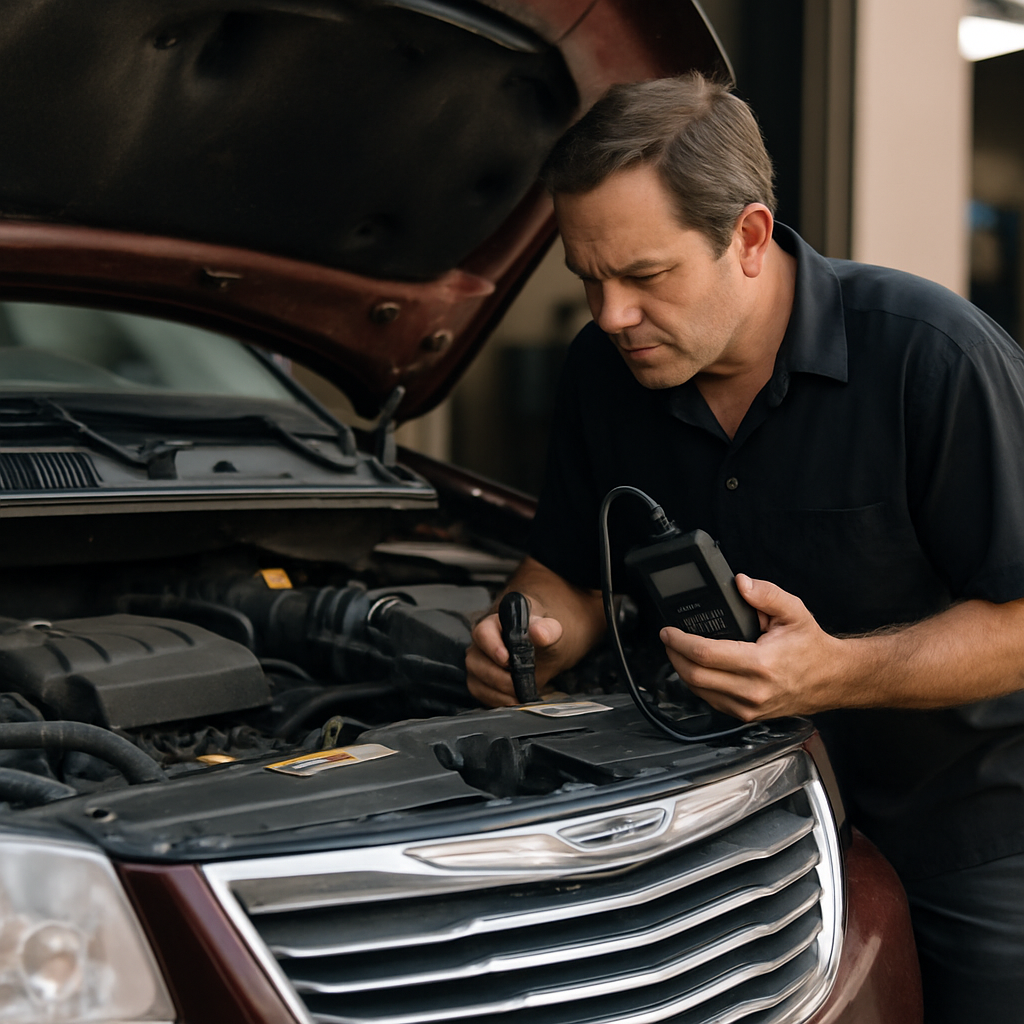
On a Chrysler Town & Country, P1128 is described as “Closed loop fueling not achieved”. One source addressing a 2009 Town & Country uses that definition, while other references use the fuller wording “Closed Loop Fuel Not Achieved Bank 1”. It means the powertrain control module (PCM) has not reached, or cannot rely on, the expected closed-loop fueling state. The code is a diagnostic clue—not proof that an oxygen sensor has failed, that the engine is definitely running rich or lean, or that one specific repair is needed.
What P1128 means on a Chrysler Town & Country
In closed-loop operation, the PCM uses feedback that includes oxygen-sensor readings to help manage fuel delivery. P1128 indicates that the expected fueling-control state has not been achieved. The 2009-specific description is available in this answer about P1128 on a Town & Country; a broader P1128 code reference includes “Bank 1” in the definition.
P1128 is manufacturer-specific, so its definition and diagnostic implications should not automatically be assumed to be identical across every make and model. Even within the Town & Country range, the available information does not establish a complete cause ranking or a universal procedure for every model year and engine.
Does P1128 mean the oxygen sensor is bad?
No—not on its own. A response concerning a 2010 Town & Country associates P1128 with oxygen-sensor values, and another code reference mentions wiring as a possible diagnostic area. Those are leads for diagnosis, not confirmation of a failed sensor or damaged wiring. The code alone also does not establish a definite rich or lean condition.
Have the exact code confirmed and interpreted for the van’s model year and engine, along with any other stored or pending codes, before authorizing parts replacement. A technician can determine what vehicle-appropriate diagnosis is needed. Do not replace an oxygen sensor simply because P1128 is present. For background on how oxygen-sensor faults are diagnosed, see our related guide; it does not establish the cause of P1128 on your van.
Can you drive with a P1128 code?
Not every vehicle with P1128 is immediately unsafe to drive, but the code alone cannot confirm that a particular Town & Country is safe. Kelley Blue Book says P1128 is not immediately dangerous in general and describes the vehicle reverting to a default fuel-injection value when the sensors are inactive. That is not a guarantee about your van’s condition, and the source does not set a Town & Country-specific threshold for safe driving.
Arrange prompt diagnosis rather than continuing to drive indefinitely without follow-up. KBB notes possible effects on fuel efficiency, emissions testing, drivability and, over time, engine condition; these are potential consequences, not inevitable outcomes for every van. If the engine is running poorly, the van has a serious drivability problem, or there is another immediate safety concern, stop driving and seek professional help. Avoid a long journey based only on the generic code description. See KBB’s P1128 guidance for its general driving advice.
P0128 is a different code from P1128
P0128 is not another name for P1128. KBB defines P0128 as a coolant-thermostat code indicating that coolant temperature is below the thermostat-regulating temperature. The similar-looking numbers describe different diagnostic concerns; a P0128 definition does not explain P1128. The available reference does not establish the causes, repair, or model-year-specific application of P0128 for every Town & Country, so confirm the code and vehicle details before drawing conclusions.
What about P1129?
P1129 is a separate code. The information available here does not establish its definition for a Dodge Ram 1500, so verify it using service information appropriate to that truck’s model year and engine rather than assuming it shares P1128’s meaning.
Pingback: Why Does a Car Squeal Stop When You Brake? Causes and What to Check - Premier Motoring Blog