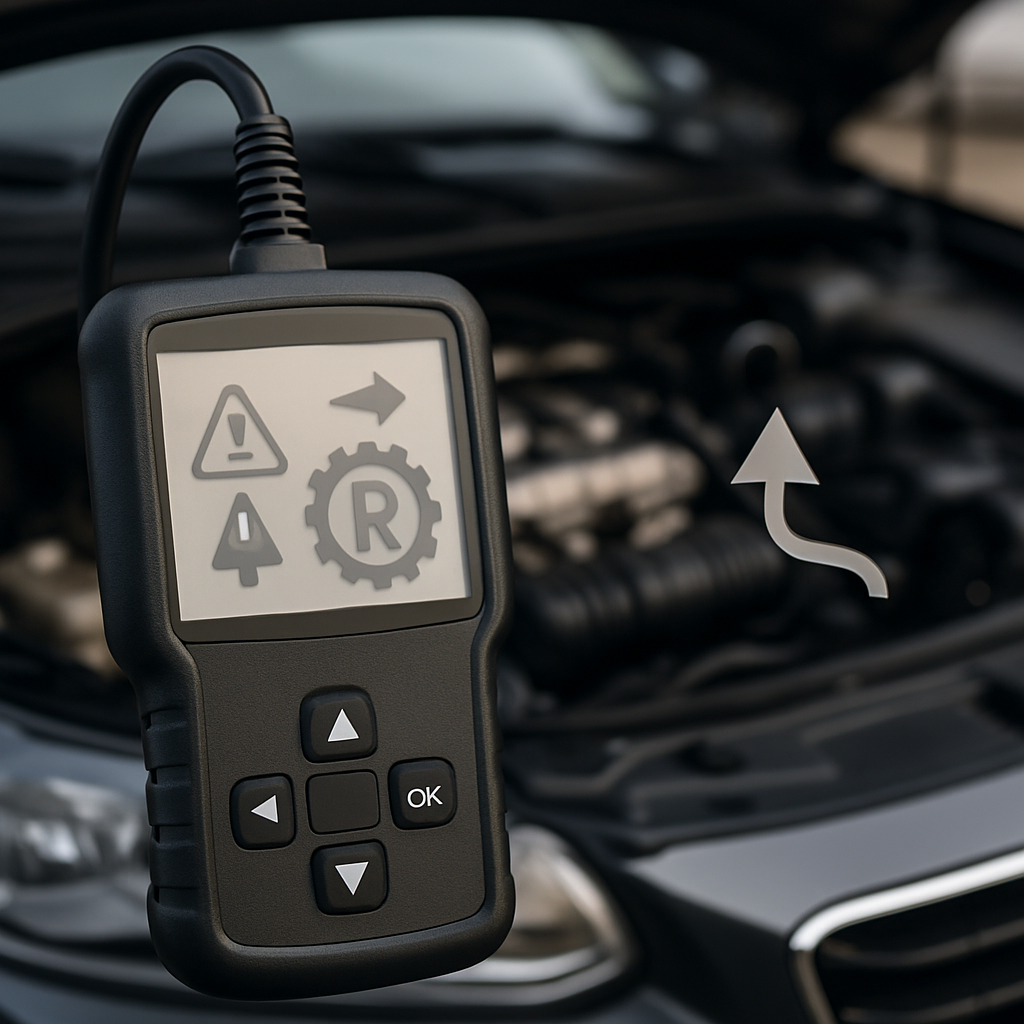
P0736 means the transmission controller has detected an incorrect or abnormal gear-ratio relationship while reverse is selected. In plain terms, the speed readings the controller uses do not match the relationship it expects for reverse. The code points to a detected mismatch; it does not identify a failed part or prove that the transmission needs replacing.
The precise monitoring logic and conditions that set P0736 vary by vehicle and transmission. A vehicle may still have reverse, or it may have difficulty engaging or holding it. Diagnosis needs to account for the symptoms, any other stored codes and the service information for the exact vehicle.
What does the P0736 reverse gear-ratio code mean?
Automatic transmissions use speed information and control strategies to manage gear operation. Depending on the vehicle, the PCM, TCM or another control arrangement monitors whether the transmission’s observed speed relationship is consistent with the selected gear. P0736 is the general OBD-II description for a reverse incorrect-ratio condition. The P0736 code overview from CarParts describes the code as an issue detected from transmission speed readings, while a P0736 technical overview from FS1 also describes a mismatch between the expected and observed relationship in reverse.
This does not mean the speed sensor itself has failed. A sensor or its circuit could be among the items a technician checks, but the code reports the controller’s interpretation of speed information and transmission operation. Nor does it prove that reverse has completely failed: the code may be present with broader shifting concerns, and the vehicle’s actual behaviour can vary.
There is no universal ratio threshold or setting procedure that applies to every vehicle. The manufacturer’s diagnostic information for the specific model year and transmission is needed to confirm the conditions under which the code sets and how to test it.
Symptoms and possible causes of P0736
Some vehicles may show a warning light or other transmission-related message. Possible driving symptoms include reverse that will not engage or hold, slipping or an abnormal response in reverse, and other shift problems. A vehicle may have only one of these symptoms, several of them, or no obvious symptom beyond the stored code. A harsh, jerking or delayed engagement is a symptom to report, not proof of a particular fault; see our guide to why a car may jerk or slam into reverse for related context.
P0736 has a broad diagnostic scope. Depending on the vehicle and what further testing shows, possible areas for investigation include:
- Electrical problems, such as relevant wiring, connectors or signals.
- Transmission-fluid concerns, if inspection confirms an incorrect level, poor condition or a leak.
- Solenoid or transmission-control operation.
- Hydraulic operation or internal mechanical wear. One possible internal issue discussed in a limited Chrysler minivan Q&A is worn clutch packs, but that example does not establish the cause on other vehicles.
These are possibilities, not a ranked list of confirmed causes. A speed-ratio mismatch does not by itself prove that fluid is low or dirty, that a solenoid is faulty, or that internal transmission damage has occurred. A code alone cannot distinguish among those explanations. For broader background on symptoms and diagnostic distinctions, see our guide to common automatic-transmission symptoms and diagnosis.
What to do about a P0736 code
There is no one-part fix for P0736. The right repair depends on what is causing the abnormal ratio reading or transmission behaviour, so avoid replacing a sensor or solenoid, changing fluid, clearing the code or authorising a rebuild based only on the code.
- Record the symptoms and all stored codes. Note whether reverse engages, slips, shudders or behaves differently, and whether any other warning messages or codes are present. Do not clear codes before they have been recorded and assessed.
- Look for visible fluid leaks. If you see a leak, have it assessed. Do not assume a leak is the cause of P0736 without diagnosis.
- Check fluid level or condition only if the correct procedure is available. Procedures and requirements differ by vehicle; follow the owner’s manual or vehicle-specific service information rather than a generic method. Our guide explains how to check transmission fluid level on certain Chevy and Nissan vehicles, but its scope is limited to the vehicles it covers and it is not a universal P0736 fix.
- Arrange qualified diagnosis if the code persists or reverse behaves abnormally. A technician can use the vehicle’s diagnostic procedure to assess relevant wiring and connectors, speed readings, control and solenoid operation, hydraulic operation and internal transmission condition, as appropriate.
The available information does not establish a vehicle-independent test sequence, a universal repair or a reliable repair-cost estimate. Use the exact vehicle’s service information and diagnosis to decide what work, if any, is appropriate.
Is it safe to drive with P0736?
The code alone cannot determine whether a vehicle is roadworthy. If reverse is absent, slipping or unpredictable, avoid relying on it or repeatedly trying to make it engage, and arrange an assessment. If the vehicle also shifts abnormally, avoid driving in conditions where that behaviour could make movement difficult to control. A technician can advise whether it should be driven to a workshop or transported, based on the actual symptoms.
Does P0736 mean the same thing on every vehicle?
The general code meaning is reverse incorrect ratio, but the transmission, controller logic, setting conditions and diagnostic procedure can differ. A code description is useful context, not a substitute for information matched to the vehicle’s VIN, model year and transmission.
- Dodge Grand Caravan and Chrysler minivans: The general meaning can help explain the code, but the available information does not establish a Grand Caravan-specific cause or repair. A Chrysler Town & Country Q&A is only a limited example and should not be treated as proof that a Grand Caravan has the same fault.
- Cummins applications: One P0736 discussion specifically about the 68RFE describes the controller assessing an input-to-output speed relationship in reverse. That is a transmission-specific example; it does not establish that every Cummins vehicle uses a 68RFE or shares the same diagnosis.
- Chevrolet: The general definition may orient you, but the available evidence does not establish Chevrolet-specific setting conditions, likely failure or repair. Confirm the exact transmission and use its service information.
- Allison transmissions: Do not assume a particular Allison cause or repair from the generic code description. Diagnosis requires the exact transmission and its applicable service information.
- Range Rover: The general code meaning is not enough to identify a Range Rover-specific failure or repair. Model year, transmission and vehicle-specific diagnostic information matter.
What if P0736 appears with P0792 or another ratio code?
If P0736 appears with P0792, the fact that both codes are stored does not show that one caused the other. The available information does not establish what P0792 means for the relevant vehicle or a technical relationship between the two codes. Record both and have them assessed using the service information for the exact vehicle; do not infer a repair from their co-occurrence.
Likewise, P0736 guidance should not be used as a repair guide for P0730, P0733 or P0734. The available information here does not establish the diagnosis or repair for those separate codes. Each requires its own vehicle- and transmission-specific diagnostic procedure.