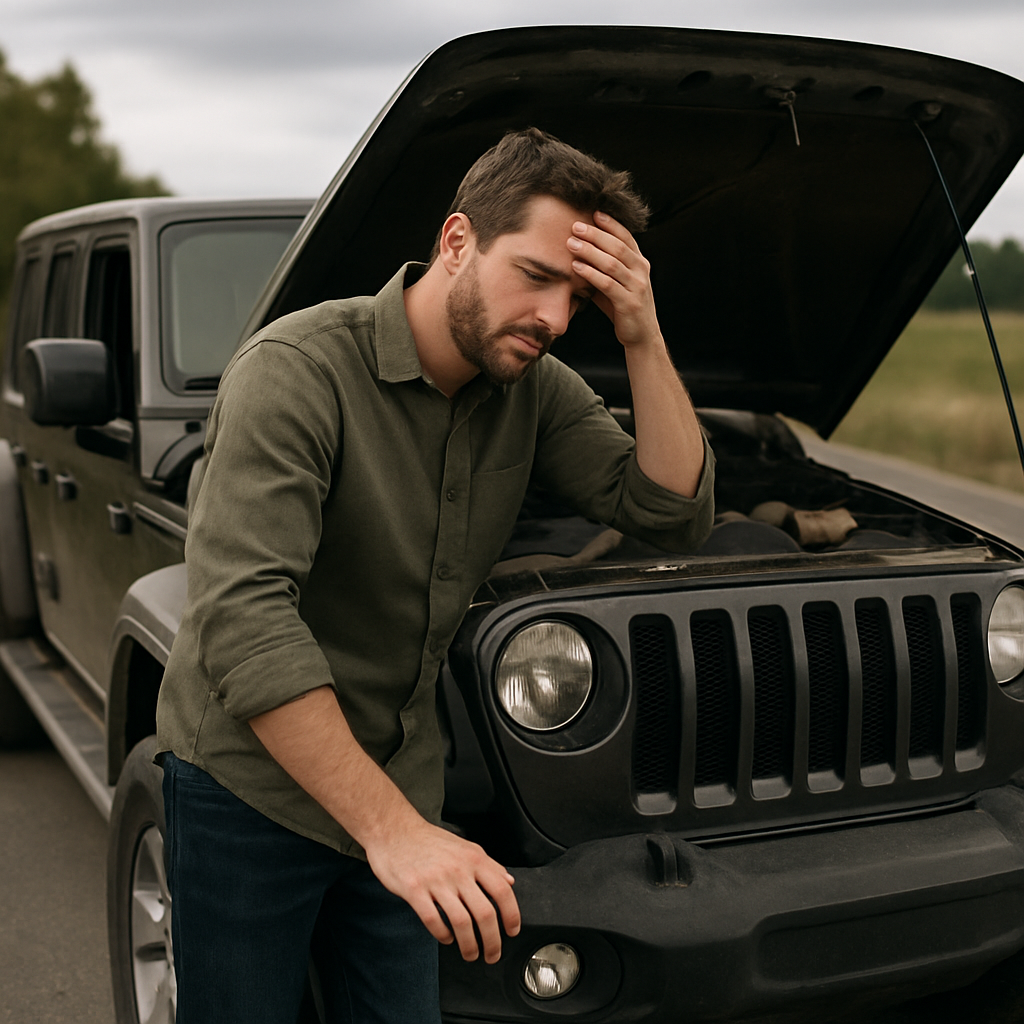
A Jeep that feels weak, sluggish, or unresponsive can have several possible causes; the feeling alone does not identify a failed part. The right diagnostic direction depends on the Jeep’s model, year, and powertrain, any warning lights or messages, and what happens when you press the accelerator. Start by noticing whether the engine bogs or hesitates, or whether it revs without the vehicle gaining speed as expected—those patterns point towards different areas to investigate.
Why your Jeep may feel sluggish or weak under acceleration
If the engine struggles to rev, hesitates, or feels as though it is not getting enough power, possible diagnostic areas include fuel delivery, restricted fuel flow, and problems with the air intake. A source discussing the Jeep Cherokee also identifies oxygen-sensor and throttle-position-sensor faults as possibilities. These are leads for diagnosis, not proof that any one component has failed.
That source is specifically about the Cherokee. It does not establish that the same faults, failure patterns, or repairs apply to every Jeep model, engine, or year. A technician will need to assess the vehicle and its stored diagnostic trouble codes before recommending parts. Avoid replacing a fuel, intake, or sensor component based on sluggishness alone. The Jeep Cherokee power-loss discussion is useful as model-specific background, not a diagnosis for all Jeeps.
If the engine revs higher but your Jeep does not pick up speed in step with it, the issue may lie in how power is transferred through the transmission or drivetrain rather than in the engine’s ability to rev. A transmission or drivetrain problem is only one possibility; the symptom does not confirm it. The discussion of Jeep skipping sensations describes transmission and drivetrain issues as potential explanations for related driving symptoms, but inspection is needed to establish what is happening in your vehicle.
Note when the weakness occurs: for example, during acceleration, on a hill, while turning, or only after the Jeep has been driven for a while. If it began “after” something, record exactly what happened beforehand, such as a refuelling stop, recent repair, or change in driving conditions. Without knowing what “after” refers to, there is no sound basis for naming a particular cause.
Knocking or clunking alongside power loss is another symptom to report, but it does not identify the fault. If you hear those noises, see Jeep Cherokee knocking or clunking when accelerating for related checks. Likewise, if a scan identifies a misfire code, the code needs interpretation in context: read more about a P0300 random or multiple-cylinder misfire code or what a P0303 cylinder 3 misfire code means. A code is evidence to help diagnosis, not by itself proof that a particular part needs replacing.
If your Jeep suddenly loses power while driving
A sudden loss of propulsion is different from gradual sluggishness. Prioritise control: if you can, move out of traffic to a safe place and arrange roadside assistance or professional inspection if the engine stalls, power loss happens repeatedly, or the Jeep cannot accelerate reliably. Do not assume it is safe to continue driving because power returns or a warning disappears.
Once you are safely stopped, note what happened as precisely as you can: Did the engine shut off, did the accelerator stop responding, did a warning light or message appear, or did power return after a delay? Record whether the event happened during acceleration, on a hill, while turning, or at a steady speed. These details can help a technician distinguish between different diagnostic possibilities.
Owners searching about a 2015 Jeep Wrangler losing power or a Wrangler JK experiencing weak acceleration should not assume a known model-specific fault from the symptom alone. The available information does not establish a particular 2015 or JK defect, diagnosis, repair, or model-year trend. A vehicle-specific assessment, including its stored codes and service history, is needed.
Some third-party material describes reported power-loss or shutdown concerns involving Wrangler 4xe hybrid systems, including possible software or battery-system concerns. Those reports do not establish how prevalent an issue is, confirm the cause in an individual vehicle, or apply to a non-hybrid Wrangler. For a 4xe or another hybrid, follow the vehicle’s warnings and owner information, and contact an authorised service provider. Do not attempt work on high-voltage components. If you are concerned about a recall, check the vehicle by VIN using an official recall service and ask an authorised provider to confirm applicability. The supplied reports about Wrangler 4xe loss-of-power complaints and reported 2024 Wrangler 4xe problems are not a VIN-specific recall determination.
What to do if your Jeep has no power at all
“No power” can describe different situations, and they need different checks:
- No dashboard or electrical power: This is different from an engine that runs poorly. Repeated electrical cut-outs or a complete loss of electrical power warrant professional help.
- Dashboard lights work, but the engine will not start: Notice whether the vehicle clicks, cranks slowly, or does not crank. If it is safe to do so, you can look for battery connections that appear loose or dirty; do not handle exposed wiring or work around moving parts.
- The engine starts but the Jeep will not accelerate properly: Treat this as a drivability or propulsion symptom and follow the guidance above, rather than assuming it is a starting-system fault.
For a no-start, possible areas include battery connections or a weak battery, the starter motor, ignition switch, wiring, or fuses. These are possibilities, not diagnoses. Basic observations such as whether the Jeep clicks or cranks slowly can help a technician narrow the problem, but do not replace testing. For more on the distinction between dashboard power and a no-start, see these guides to checking battery connections when a Jeep will not start and possible Wrangler starting-system issues.
When to book a service diagnosis
Arrange professional diagnosis if the loss of power persists, worsens, returns without an obvious explanation, or is accompanied by warning lights or messages. Repeated stalling, a sudden loss of propulsion, or unreliable acceleration calls for stopping when safe and arranging assistance, rather than waiting for a routine appointment.
When contacting a garage, share:
- the Jeep’s year, model, and engine, and whether it is a 4xe or another hybrid;
- when the problem began and what happened immediately beforehand, including recent repairs or refuelling;
- the driving conditions in which it occurs, such as acceleration, hills, turning, or steady-speed driving;
- whether the engine bogs, hesitates, revs without a matching increase in speed, stalls, or stops responding;
- any warning lights, messages, or diagnostic codes, and whether the symptoms are intermittent.
Ask the technician to diagnose the symptom and review stored fault codes before authorising component replacement. A code can help direct further checks but does not always identify the root cause on its own. If a scan reports a camshaft-position fault, for example, use the code and vehicle-specific diagnosis to guide next steps rather than assuming the sensor is responsible; see camshaft position sensor symptoms and diagnosis.
Suggestions such as an alternator, catalytic converter, camshaft or crankshaft sensor, or auxiliary battery should not be treated as confirmed causes based on the power-loss symptom alone. The supplied information does not verify an alternator diagnosis, a specific 2015/JK fault, or whether a recall applies to an individual Jeep. Codes, inspection, and vehicle-specific testing are needed to determine what is actually wrong.
Pingback: Hyundai Accent P0326 Code: Meaning, Causes and Whether You Can Drive - Premier Motoring Blog