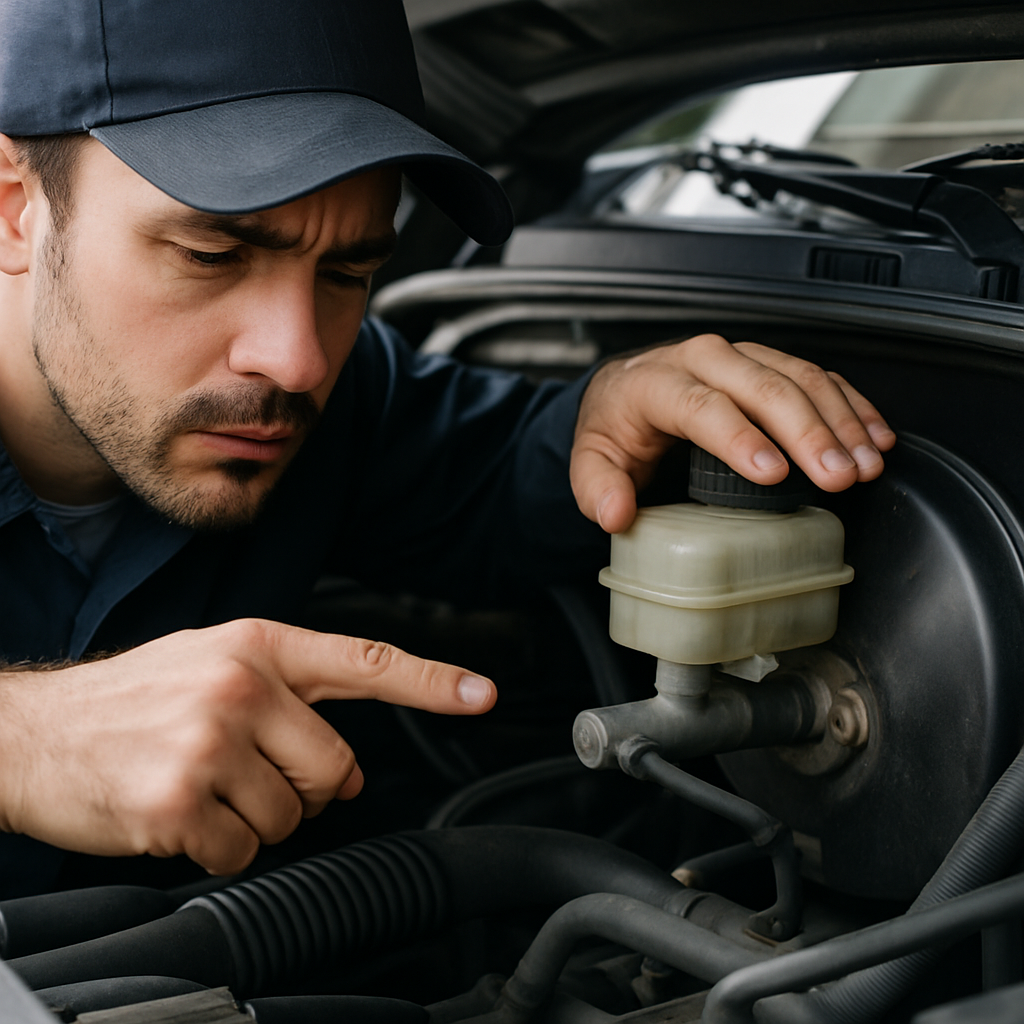
A brake pedal that suddenly feels unusually hard and takes much more effort to press can point to lost brake assistance from the booster or its vacuum supply. A pedal that slowly sinks while you hold steady pressure can point to a hydraulic problem, including a possible master-cylinder fault. Neither symptom confirms which part has failed: leaks, air in the brake lines and other faults can produce similar symptoms.
The distinction matters because braking problems can make a vehicle unsafe to use. Treat these checks as observations, not a diagnosis. If the pedal sinks, braking has changed significantly or stopping is difficult, do not continue driving; arrange professional inspection and towing if needed.
Brake booster vs. master cylinder: how the symptoms differ
The brake booster helps provide the force needed to press the brake pedal. The master cylinder converts pedal force into hydraulic pressure that operates the brakes. In short, the booster assists your push; the master cylinder creates the pressure.
| What you notice | What it may suggest | Important qualification |
|---|---|---|
| Unusually hard pedal; much greater effort needed | Reduced brake assist, potentially involving the booster, vacuum supply or check valve | Pedal feel alone cannot identify the failed component. |
| Pedal gradually sinks while held steady | A hydraulic-pressure problem, possibly an internal master-cylinder leak or failing seals | Other hydraulic faults, including leaks or air, can also cause trouble. |
| Soft or spongy pedal | A possible hydraulic problem | It is not proof of master-cylinder failure; air or a leak can cause a similar feel. |
| Pedal travels unusually far or toward the floor | A potentially serious loss of hydraulic pressure or another brake fault | It is not the typical clue used to identify a booster fault, and it needs prompt investigation. |
A hard pedal and a sinking pedal are different clues, not definitive diagnoses. More than one fault can also be present. A technical comparison of booster and master-cylinder symptoms describes the same basic distinction: lost assist commonly makes the pedal harder to press, while a sinking pedal points toward a possible hydraulic problem.
How to check for a bad brake booster
A hard pedal that requires substantially more effort than usual is a common sign of reduced brake assist. It does not, by itself, prove that the booster has failed. The problem could involve the booster, its vacuum supply or a check valve, and diagnosis may require further inspection.
One cautious, stationary observation is to assess whether brake assist is present as the engine starts. Keep the vehicle parked securely and follow the owner’s manual; note whether the pedal’s feel changes in a way that suggests assist is being provided. An unexpected or absent change is a reason to seek diagnosis, not a stand-alone verdict that the booster is bad. The brake-booster diagnostic overview also identifies checking for assist and boost at engine start as diagnostic steps.
Some vacuum-related problems may also be accompanied by a hissing sound or an engine-running issue. Neither clue proves the booster is defective, and their absence does not rule out a problem. Do not remove components or rely on a generic test as a complete, tool-free diagnosis. These observations cannot establish that the vehicle is safe to drive or replace a professional brake inspection.
How to check for a bad master cylinder
With the vehicle safely stationary, apply steady pressure to the brake pedal and observe whether it continues to sink. A pedal that gradually drops under steady pressure can indicate an internal hydraulic leak or failing master-cylinder seals. It is a warning sign, not confirmation: other brake-system faults can also affect pedal feel. A master-cylinder testing guide describes a pedal-hold check, but a technician must interpret the result in context.
Other clues worth reporting include:
- Low or falling brake-fluid level: This can indicate fluid loss. The source needs to be found; topping up the reservoir does not fix a leak.
- Visible brake-fluid wetness: Look for signs around the master cylinder and its connection to the booster, as well as elsewhere in the brake system. Any suspected leak warrants inspection.
- A soft or spongy pedal: This may accompany a master-cylinder problem, but air or another hydraulic fault can feel similar.
- A pedal that sinks: This can be consistent with an internal fault even when no external leak is obvious.
An internal master-cylinder fault may not leave visible fluid outside the component. However, the absence of visible leakage does not prove that the master cylinder is the cause. The master-cylinder symptom overview also lists a soft or spongy pedal, sinking pedal, low-fluid warning and fluid leaks as possible signs—not as a substitute for diagnosis.
Do not decide to replace the master cylinder on pedal feel alone. A technician should confirm the fault and check for other causes before replacement. If braking is compromised or stopping is difficult, arrange professional help rather than driving to a repair shop; RepairPal advises towing when trouble stopping occurs.
Can a bad brake booster make the pedal go to the floor?
A pedal going to the floor is not the typical symptom used to identify a failed booster. A booster or assist problem more commonly presents as a hard pedal that takes greater effort. A sinking or floor-bound pedal is a more serious clue of a possible hydraulic problem, which could involve the master cylinder, a fluid leak, air in the system or another fault. The symptom alone cannot identify the failed part.
Do not treat a sinking pedal or difficulty stopping as safe to drive. Stop using the vehicle and arrange prompt professional diagnosis; if stopping is difficult, have it towed. For a related, vehicle-specific discussion, see what can cause a brake pedal to go to the floor. That article concerns a 2008 Chevy Impala and does not establish a diagnosis for other vehicles.
Can a bad master cylinder damage the brake booster?
The available information does not establish that a master-cylinder failure will damage the booster, so it would be wrong to assume either that damage has happened or that it cannot happen. Fluid wetness around the master-cylinder/booster connection can be a sign of an external leak and should be inspected. Wetness there does not, on its own, prove the booster is damaged. If you find fluid around the junction or notice a change in braking, have a qualified technician assess both components.
Do the checks differ on Chevy, Honda or Ford vehicles?
The symptom distinction in this article is general guidance, not a verified procedure for every Chevrolet, Honda or Ford. Booster design, brake-assist systems and service procedures can vary by vehicle, including by model and year. Check the owner’s manual or service information for the exact vehicle, and use a qualified technician for diagnosis rather than assuming one generic test applies to every make.
What to do next
- If the pedal is unusually hard, braking effort has increased, the pedal sinks, fluid is low or you see a leak, arrange a prompt brake inspection.
- If the pedal sinks toward the floor or the vehicle is difficult to stop, do not drive it; arrange professional help and towing if needed.
- Share the specific symptoms with the technician, including when they occur, whether the pedal is hard or soft, whether it sinks under steady pressure, and whether you have noticed fluid wetness, hissing or an engine-running change.
- Do not treat an owner-level check or a fluid top-up as proof that the brakes are repaired or safe to use.