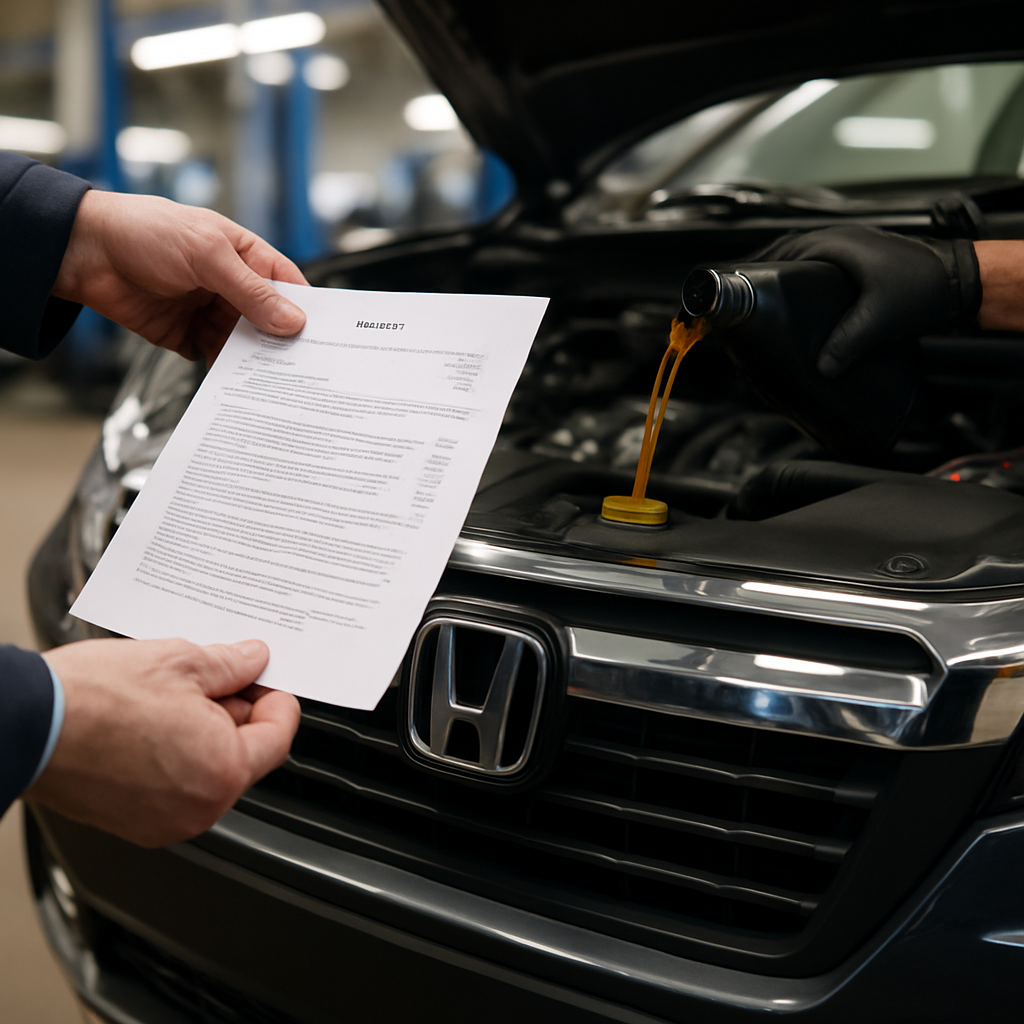
A Honda Ridgeline oil change should not automatically include costly transmission, transfer-case, or other drivetrain work. Ask for an itemised estimate, identify which work is the oil service and which is an additional recommendation, then compare the recommendation with the maintenance schedule for your truck. A reported 2022 Ridgeline case shows why this matters: at 18,000 miles, an owner was quoted $627 for transmission and transfer-case service alongside an oil change, despite the report stating that Honda did not require that work until 75,000 miles.
Why Honda Ridgeline Oil Change Extra Costs Can Climb So Quickly
The oil change itself is only one line on a dealership invoice. The final figure can rise when a service adviser adds inspections, tyre rotation, fluid services, filters, brake work, or recommended maintenance packages. Some of those items may be appropriate for a particular vehicle, but they are not automatically part of an oil change.
The useful distinction is between required maintenance, work indicated by the vehicle’s maintenance system or schedule, and recommended work, which may be based on mileage, time, use, inspection findings, or the dealer’s own service menu. Before authorising work, ask the adviser to separate those categories in writing.
The $627 Ridgeline Quote: What Was Included?
In the reported example, a 2022 Honda Ridgeline owner visiting a dealer at 18,000 miles for an oil change was quoted $627 for transmission and transfer-case service. Torque News’ account of the owner report says the services were not required until 75,000 miles.
That is an owner anecdote, not proof that every dealer quote is inappropriate or that the same recommendation will appear on every 2021, 2022, or later Ridgeline. It does, however, illustrate the question owners should ask: what specific condition, maintenance code, or manufacturer interval supports each additional charge?
What to ask before approving a service package
- Which line items are included in the oil change price?
- Which services are due according to the truck’s maintenance reminder or maintenance schedule?
- Which items are recommendations rather than scheduled maintenance?
- Is the quoted price for parts, labour, taxes, and shop supplies?
- Can each fluid service be priced separately rather than as a package?
An itemised quote makes it easier to decline work that is not due, postpone a non-urgent recommendation, or obtain a comparable estimate from an independent garage.
Why Does Honda Charge So Much for an Oil Change?
A higher dealer invoice does not necessarily mean the oil and filter alone are unusually expensive. The charge may include synthetic oil, a genuine filter, labour, inspections, a tyre rotation, disposal fees, taxes, or added services. The important point is that a customer should be able to see exactly what is being purchased.
Price also varies by area and retailer. A low advertised oil-change offer may have limits, while a higher estimate may include work beyond the advertised service. Comparing the total without comparing the listed work can be misleading.
How Often Should the Oil Be Changed in a Honda Ridgeline?
Use the maintenance reminder and the maintenance information that applies to your specific Ridgeline, rather than relying on a universal mileage rule from a forum or a dealer sticker. Mileage, time, driving conditions, and prior service history can all affect what is due.
Do not assume that an early oil change means every accompanying fluid service is also due. Likewise, do not assume that a generic interval applies equally to every model year, including 2017 and 2018 Ridgelines or newer 2021 and 2022 trucks. Check the service record, the truck’s reminder, and the applicable Honda documentation before agreeing to extra work.
Is It Really Safe to Go 10,000 Miles Between Oil Changes?
There is no single mileage answer that safely fits every Ridgeline and every use case. The sensible approach is to follow the vehicle’s maintenance guidance and respond to its maintenance reminder, rather than treating 10,000 miles as either an automatic target or an automatic danger point.
Short trips, heavy loads, towing, extended idling, severe temperatures, and dusty conditions can make an owner’s operating pattern different from routine driving. If there is uncertainty about an interval, ask the servicing garage to explain the recommendation against the vehicle’s own schedule, not simply against a blanket mileage figure.
Oil Changes, Drivetrain Fluids, and Timing-Belt Work Are Different Jobs
One reason service quotes can be confusing is that major scheduled work may be discussed during a routine visit. An oil change, transmission service, transfer-case service, and timing-belt replacement are separate operations with different purposes and intervals.
For longer-term planning, another Torque News report states that Honda recommends Ridgeline timing-belt replacement at 105,000 miles or seven years, whichever comes first. That is a substantially different maintenance event from an oil change, and it should not be conflated with a routine visit or used to justify unrelated early work.
How to Keep Control of Your Ridgeline Service Bill
- Request the estimate before work begins. Ask for every charge to be listed individually.
- Approve only the work you understand. It is reasonable to ask for time to review a recommendation.
- Keep invoices and mileage records. A clear history helps establish what has already been completed.
- Compare like-for-like quotes. Make sure another garage is quoting the same fluids, parts, and labour before judging the price.
- Ask about the reason for an early recommendation. A condition found during inspection is different from a generic package suggestion.
The practical takeaway on Honda Ridgeline oil change extra costs is simple: an expensive quote may contain legitimate maintenance, but it should never be treated as part of the oil change by default. An itemised estimate and the truck’s own maintenance guidance are the best safeguards against paying early for work that is not yet due.
Pingback: Ball Joint Press for Control Arm Bushings: Tool Choice and Safe Use - Premier Motoring Blog