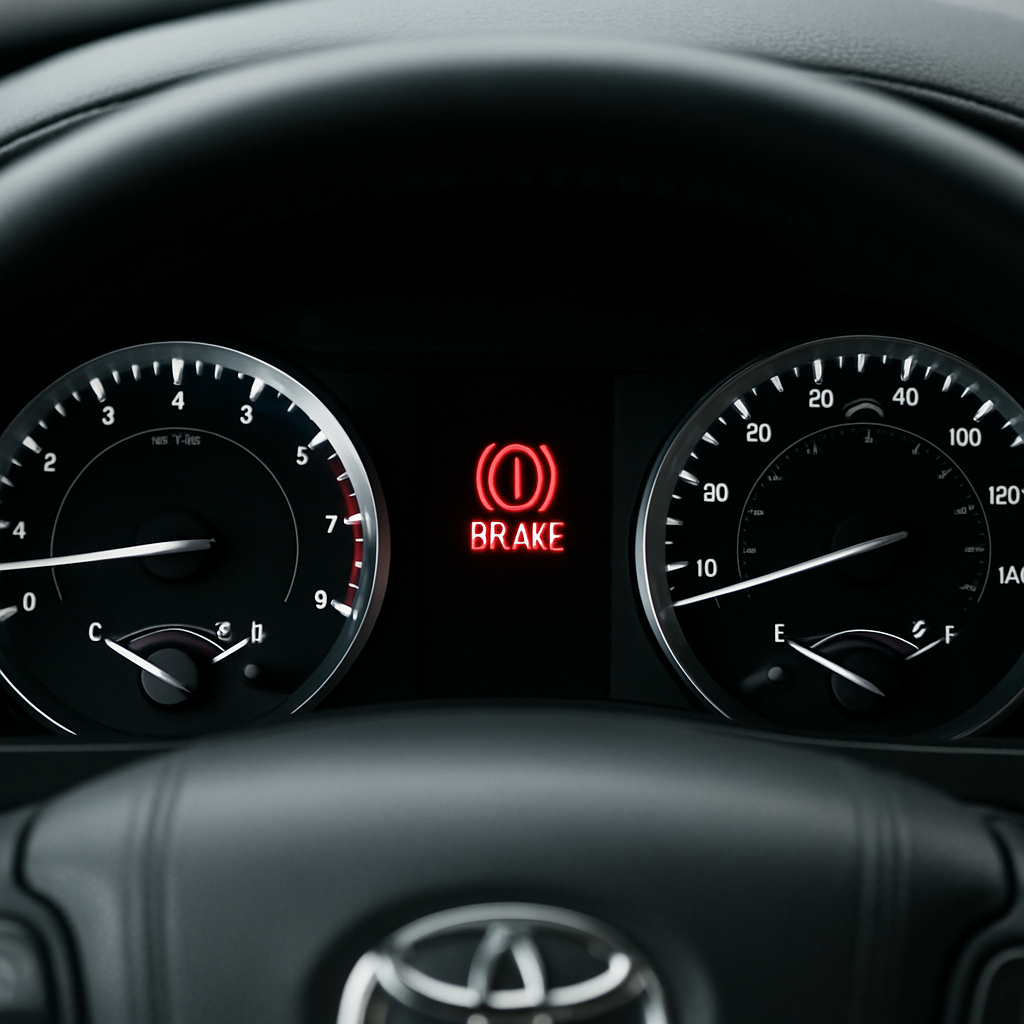
A brake-related warning on a Toyota Highlander Hybrid does not identify one confirmed fault by itself. The exact warning symbol or dashboard wording matters. A parking-brake indicator may mean that the parking brake is engaged or has not fully released, while a separate brake-system warning or message may mean something different. Check the owner’s manual for the vehicle’s model year and arrange an inspection if the warning remains on or returns.
What a brake warning can mean on a Highlander Hybrid
A general Highlander parking-brake indicator should illuminate when the parking brake is engaged and extinguish when it is released. The available Highlander inspection source describes a handle, cable and switch as part of the system, but this should not be treated as confirmation of the parking-brake design or operating procedure for every Highlander Hybrid model year.
The supplied evidence is a general Highlander parking-brake inspection source rather than Toyota service information or a model-year-specific owner’s manual. It does not define every possible Highlander Hybrid brake warning, establish separate meanings for 2017 and 2018 models, or show that those years use different warning logic. The following are general possibilities for a parking-brake light that stays on, not a diagnosis of an individual vehicle.
According to the Highlander parking-brake-light inspection guide, possible reasons include:
- The parking brake is still engaged or not fully released. Confirm that it is fully released using the vehicle’s own controls and the procedure in the relevant owner’s manual.
- The parking brake is not disengaging. The warning can remain illuminated if the parking-brake mechanism continues to apply the brake after it has been released.
- A faulty parking-brake switch. A switch that detects whether the brake is applied can fail and leave the indicator illuminated.
- Low brake-fluid level. The source describes the parking-brake lamp as a multifunctional indicator that may also illuminate when the brake-fluid reservoir level is low. The lamp alone does not establish why the fluid level is low.
- A faulty brake-fluid level sensor. A failed or inaccurate sensor can trigger a warning without reliably reflecting the reservoir level.
- Uneven brake-fluid pressure. This is different from low fluid or a faulty level sensor. The source says uneven pressure can affect braking performance and may make the vehicle pull to one side under braking.
These possibilities cannot be distinguished from the warning light alone. In particular, a brake warning does not confirm brake failure, but it should not be ignored.
Do not confuse it with other vehicle warnings
A dashboard brake warning is not the same as an exterior stop-lamp fault, where the rear brake lights do not illuminate when the pedal is pressed. It is also separate from a tyre-pressure monitoring warning, a secondary-collision-braking message, or a message described as “Braking Power Low”. The available evidence does not define those other warnings for the Highlander Hybrid, so information about one system should not be used to diagnose another.
What to do if the warning stays on
- Identify the exact warning. Record the symbol or message, the model year, any accompanying warning lights, and when the warning appears. Then consult the owner’s manual for that specific vehicle.
- Check the parking-brake state. Use the vehicle’s controls and manual to verify that the parking brake is fully released. Do not rely on a general description of a handle, cable or switch as a model-specific procedure.
- Watch for changes in braking behaviour. Note any change in pedal feel, braking response, unusual resistance, or whether the vehicle pulls to one side while braking.
- Stop and seek urgent assistance if braking is abnormal. If pedal feel or braking performance changes, or the vehicle pulls during braking, stop in a safe location when possible and obtain professional assistance rather than continuing to drive.
- Book an inspection if the warning persists or recurs. A technician may inspect the parking-brake mechanism and switch, brake-fluid reservoir, fluid-level sensor and other brake-system components. Retrieving brake-system diagnostic codes may also be necessary, as the warning lamp does not provide a confirmed diagnosis by itself.
Normal braking feel does not prove that it is safe to continue driving with a persistent warning. The available evidence does not provide a model-specific drive-or-do-not-drive threshold for a Highlander Hybrid, so use the owner’s manual and professional advice based on the precise warning and the vehicle’s symptoms.
For a related Toyota warning-light situation, see our guide to Toyota Sienna ABS and brake warning lights. That article concerns the Sienna and does not provide a Highlander Hybrid-specific diagnosis.
Potential inspection-cost context
The cited inspection guide lists an estimate of $94.99 for a parking-brake-light inspection on a 2017 Toyota Highlander V6 3.5L Hybrid, with a shop/dealer-price range of $105.01 to $112.52. These figures are source-specific inspection estimates, not repair prices or a quote for a confirmed fault, and costs may vary by location. The listing does not establish that the estimate applies to every warning on a 2017 Highlander Hybrid or to a 2018 model.