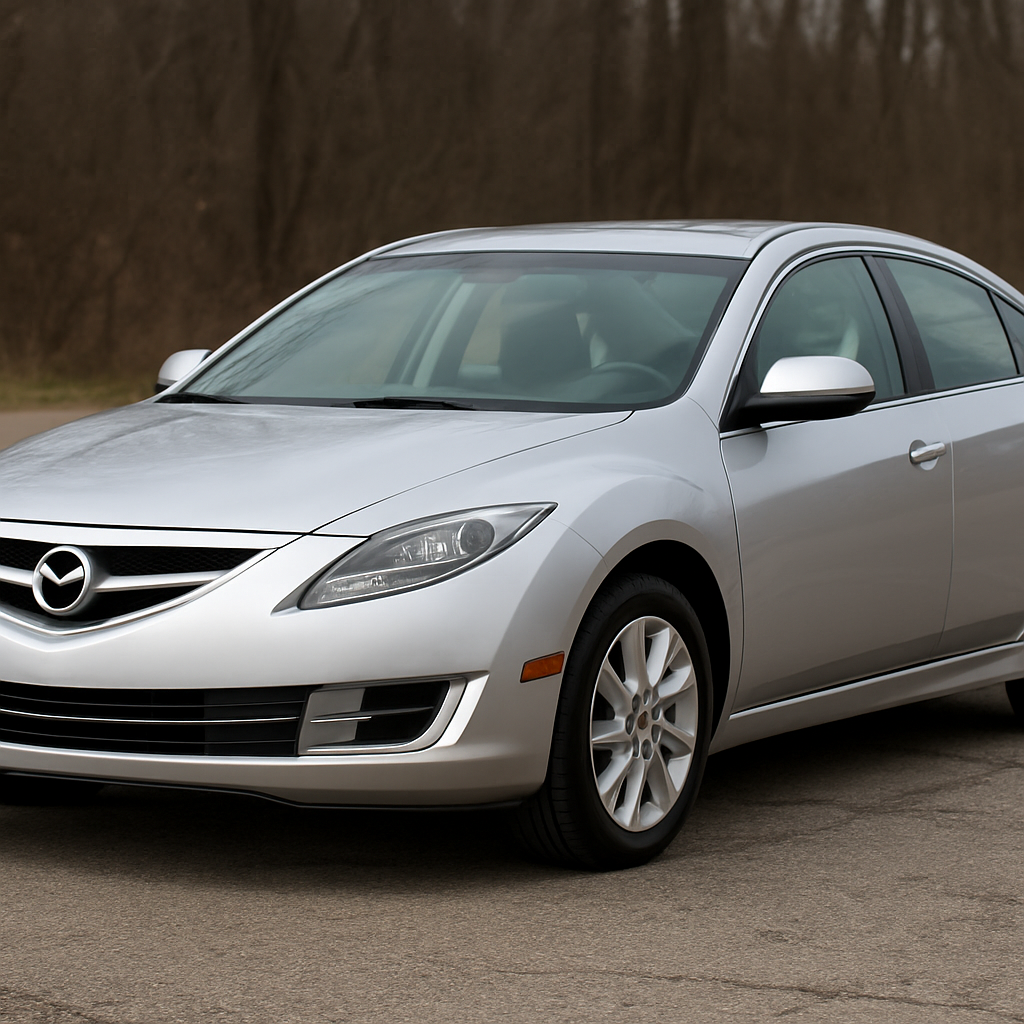
The available evidence documents safety-recall campaigns associated with the 2009 Mazda 6, but it does not establish a reliable ranking or frequency of ordinary mechanical failures across all cars of this model year. One recall listing reports 10 campaign records involving airbags, door latches, front suspension, the fuel tank and roof-rack bolts. These records do not mean every 2009 Mazda 6 is affected, or that any listed fault is present on a particular car.
The supplied research does not include comprehensive reliability data, ordinary-fault prevalence statistics, repair costs, maintenance intervals or Mazda-specific service procedures. The recall details below are drawn from one listing and should be treated as reported campaign information, not confirmation of a particular vehicle’s eligibility or repair status.
What problems are documented for the 2009 Mazda 6?
The recall-and-problems listing for the 2009 Mazda6 identifies the following NHTSA campaign numbers. The stated hazards are potential defects covered by campaign records; they do not prove that every vehicle experienced the problem.
| Campaign number(s) | Reported issue and potential hazard |
|---|---|
| 18V018000, 19V782000, 17V457000, 17V429000 | Passenger-front airbag inflator campaigns. The listing describes a possible inflator rupture that could send metal fragments towards occupants, causing serious injury or death. |
| 16V594000 | Airbag control-unit fault. The listing states that a failure could illuminate the airbag warning light and prevent airbag deployment in a crash. |
| 13V425000 | Door-latch mounting screws may loosen. If the latch does not engage, a door could open while the vehicle is moving. |
| 18V631000 | Corrosion may weaken the passenger-side front lower-control-arm mounting point, potentially affecting steering alignment and increasing crash risk. |
| 11V134000 | The listing reports that stresses associated with repeated fuel-tank venting may eventually contribute to a crack, creating the possibility of a fuel leak and increased fire risk. |
| 09E011000 | Roof-rack bolts may break, allowing the rack or its load to loosen while driving and creating a potential road hazard. |
| 09V043000 | The listing describes a door-hinge/accessory campaign and states a hazard involving an unlatched door, which could lead to an unrestrained occupant being ejected. |
The listing says it found 10 recall records and displays campaign-level vehicle counts for some entries. Those figures should not be added together to estimate the number of affected 2009 Mazda 6s: campaign populations can differ or overlap, and a campaign count is not a VIN-specific eligibility check.
Recall records are distinct from normal wear, routine maintenance and faults diagnosed on an individual car. A listed defect may apply only to eligible vehicles, and the record alone does not show whether a particular car was affected or whether the campaign work was completed.
How to check recalls on a specific car
Check the vehicle identification number (VIN) through the appropriate official recall channel for its market, then confirm with the relevant manufacturer or authority whether any applicable campaign work has been completed. Do not assume a car is covered, or that work has been carried out, from its model year or a general listing alone. The campaign numbers above are NHTSA identifiers, so VIN verification is required to establish applicability.
If you are considering a used example, or have concerns about one you own, arrange a qualified inspection. Given the subjects in the recall records, ask for suitable attention to airbag warning lights, door latching and corrosion around the front suspension mounting area. A recall listing is not an inspection or a diagnosis and cannot establish whether a particular vehicle is roadworthy.
How much should you rely on forum reports?
Owner discussions can highlight symptoms worth investigating, but an anecdote cannot show how common a fault is across a model year or diagnose another person’s car. The supplied CarTalk discussion contains a reply advising the owner to have a good mechanic identify what is wrong with that particular car. It does not substantiate a model-wide list of recurring failures. The supplied evidence also does not provide a verified catalogue of recurring 2009 Mazda 6 problems from Reddit.
For the same reason, search-result snippets and discussion titles are not enough to establish that starting, battery, fuse, transmission, engine, brake or steering faults are common on all 2009 Mazda 6s. Treat a reported symptom as a reason to assess the individual vehicle, not as proof of a particular failed part.
Can the evidence compare the 2007 and 2009 Mazda 6?
No supported year-to-year comparison is available from the supplied material. It covers reported recall records for the 2009 model, but provides no comparable 2007 fault or recall information and no evidence of issue frequency for either year. It therefore cannot establish which year is more reliable or has more common problems. Check recall status by VIN and assess each car’s condition individually.