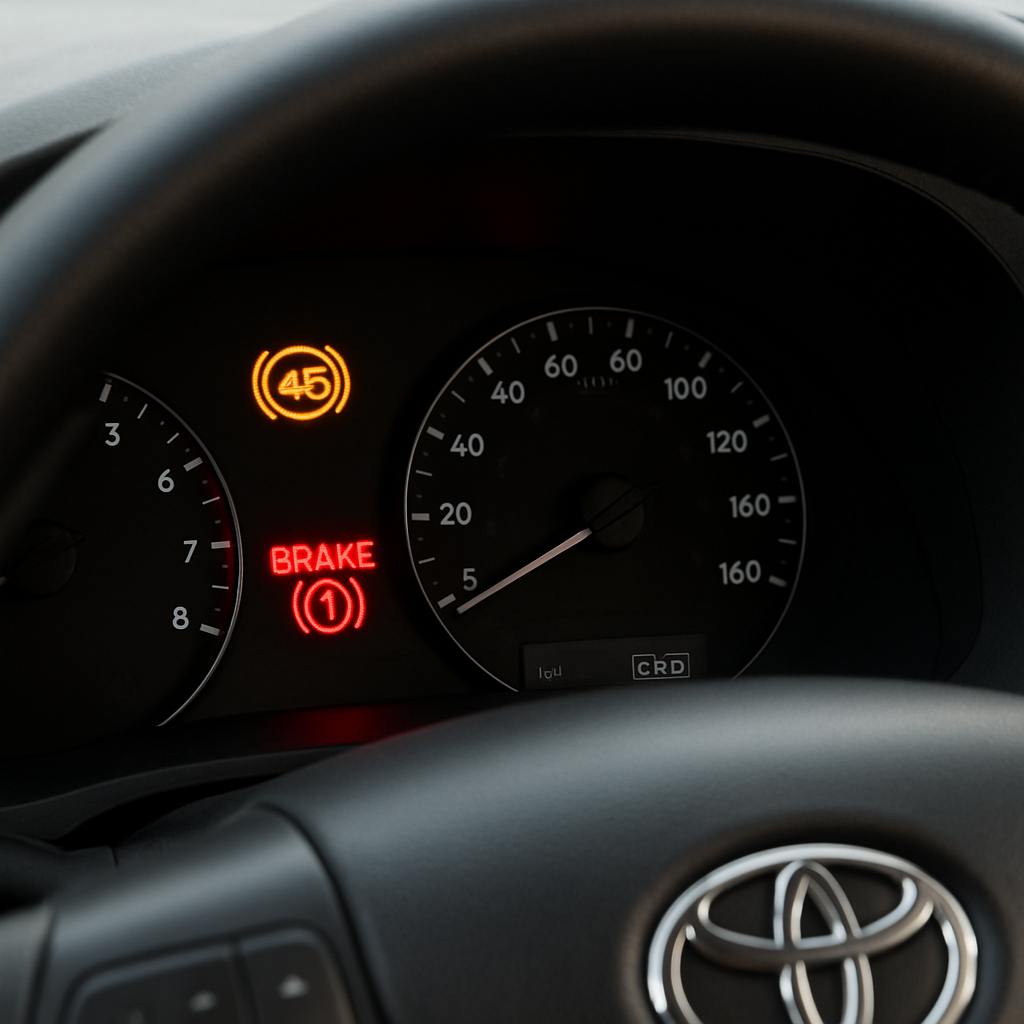
If the ABS warning light and brake warning light illuminate together in a Toyota Sienna, treat the combination as a braking-system warning that needs prompt attention. The lamps alone do not identify the failed part, and their exact meaning can vary by Sienna model year. Do not assume that a wheel-speed sensor, ABS actuator, brake-fluid issue or any other single component is responsible without a proper inspection.
The important point is that the warning lights are not a diagnosis. They indicate that the vehicle requires model-specific checks before a repair decision, or a decision to continue driving, can be made.
What the two lights can and cannot tell you
The ABS light relates to the anti-lock braking system. The brake warning light is a separate warning and may be associated with the parking brake or a condition requiring attention within the braking system, depending on the Sienna’s year and specification. When both are on, the dashboard does not provide enough information to confirm the cause or the condition of the braking system.
In particular, do not diagnose the vehicle from the lights alone. The warning combination does not prove that a sensor, wiring connection, control unit, hydraulic component or pump has failed. It also does not, by itself, prove that the vehicle has lost normal braking. The owner’s manual for the exact model year and a qualified inspection are needed to establish what the warnings mean in that vehicle.
How urgently should you respond?
Because this involves brake-related warnings, respond cautiously. If there is any change in brake-pedal feel, braking performance, steering behaviour while braking, a warning message, a visible fluid leak, smoke, a burning smell or another serious symptom, stop in a safe place when possible and seek professional assistance. Do not continue driving simply because the vehicle still moves or because the brake pedal appears to operate normally.
If there is no obvious change in braking, the warning lights still merit prompt diagnosis. Check the instructions in the owner’s manual for your Sienna’s model year before driving further. If you cannot confirm the appropriate action, contact a Toyota retailer, a suitably qualified repairer or roadside-assistance provider to discuss inspection or recovery.
Useful checks for the owner
- Confirm the warning lamps: note whether the ABS light, brake warning light and any other dashboard messages are illuminated continuously or appeared after a particular event.
- Check the parking brake: make sure it has been fully released. If the brake warning light remains on, do not assume this is the only issue.
- Look for accompanying symptoms: record any unusual pedal feel, reduced braking confidence, noises, vibration, pulling, leaks or intermittent warnings. These observations can help the technician but do not establish a diagnosis.
- Use the correct manual: consult the Toyota owner’s manual for the vehicle’s exact model year, as warning-lamp wording and instructions may differ between generations.
- Arrange an ABS-capable diagnostic inspection: a repairer should use equipment and service information appropriate to the Sienna’s braking and ABS systems. Do not assume that a basic engine-code reader will retrieve all relevant brake-system information.
What not to do
Do not clear warning lights, replace parts or rely on internet fault guesses before the underlying issue has been identified. Replacing an ABS sensor, module, pump or other component based solely on dashboard warnings can be unnecessary and may leave the actual problem unresolved.
Likewise, avoid treating reports about another Sienna as proof that your vehicle has the same fault. Sienna model years, braking-system designs, equipment levels and previous repair history can differ.
What a workshop needs to establish
A proper diagnosis should identify the relevant Sienna model year, confirm all active warning lamps and messages, inspect the braking system as appropriate, and retrieve any stored braking or ABS-related fault information with suitable equipment. The technician can then determine whether a repair is required and advise on the vehicle’s condition based on the actual findings.
Until that assessment is complete, the safest conclusion is not that a particular component has failed, but that the combined ABS and brake warnings require timely, vehicle-specific attention.
Sources and Further Reading
- Kontrolki ostrzegawcze hamulców i ABS — further reading identified in search results
- 2000 Toyota Sienna ABS/Brake issue : r/MechanicAdvice — further reading identified in search results