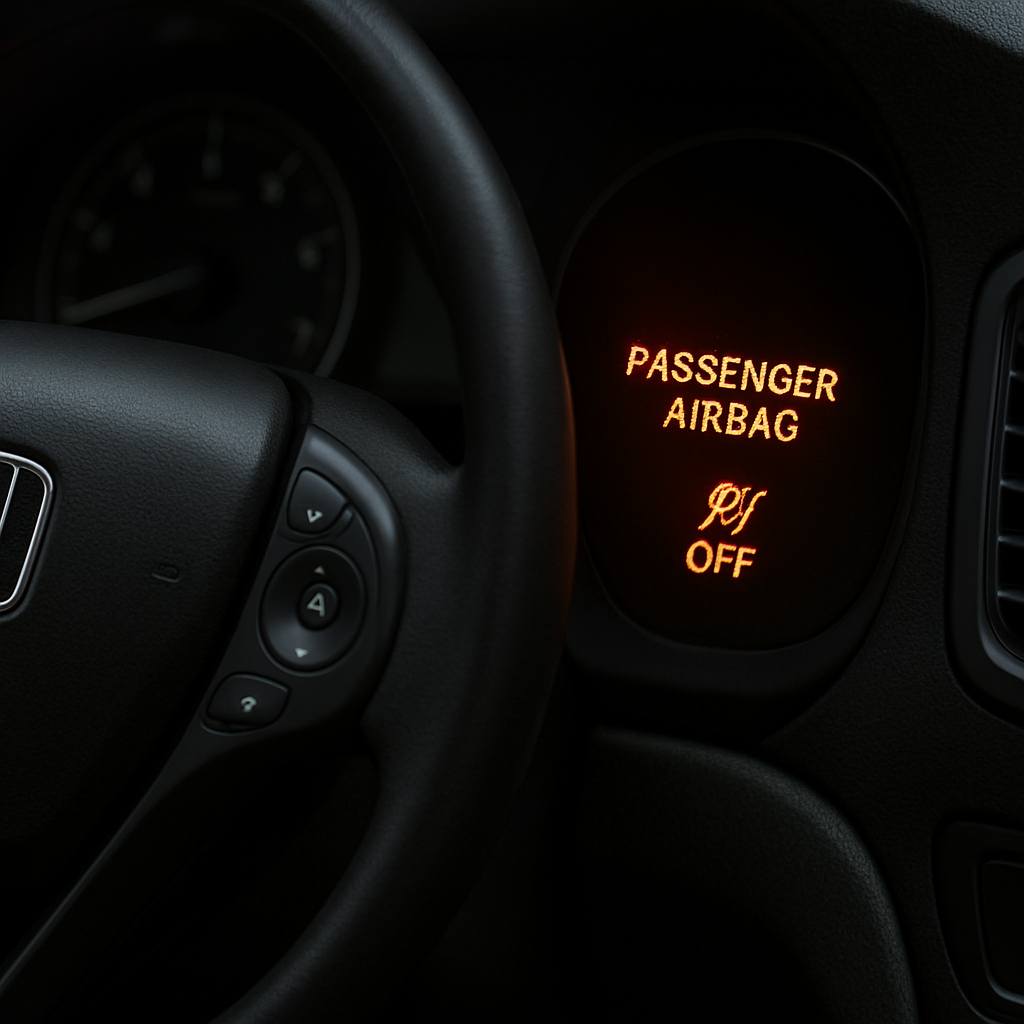
The Honda Accord passenger-airbag OFF indicator means the front passenger airbag is switched off by the vehicle’s passenger-seat classification system. It is a status indicator, not necessarily the same thing as the instrument-panel SRS/airbag warning light. Whether OFF is expected depends on the seat’s occupancy and how the system classifies it; check the owner’s manual for your exact Accord before deciding the indicator is normal or faulty.
What the passenger airbag OFF light means—and when it should be on
The passenger-airbag OFF light tells you that the front passenger airbag is not enabled. A passenger-seat Occupant Classification System (OCS) uses weight sensing as part of its classification. A year-specific explanation for a 2005 Accord associates an OFF indication with the OCS not detecting seat weight properly, but that does not establish the operating rules for every Accord year. You can read that year-limited OCS explanation, then verify the meaning and expected indicator behavior in your own vehicle’s manual.
Should the passenger airbag light be on or off? There is no universal answer. An OFF indication may be expected when the seat is empty or when the system classifies the seat in a way that disables the airbag. If someone is sitting in the seat and the indication seems unexpected, do not assume the airbag will deploy. Check the manual and arrange diagnosis by a qualified Honda/SRS technician if the status remains unclear or the unexpected indication persists.
As simple, low-risk checks, make sure the passenger is seated as the manual describes, remove loose items from the seat, and look for an obvious object obstructing the seat or buckle. Do not probe, disconnect, or move airbag wiring. A Honda service-center guide also notes that an obstruction at a buckle can contribute to a warning; this is a possibility, not a diagnosis of your Accord.
Does the passenger-airbag light meaning differ by Accord year?
The available information does not establish the exact indicator wording, sensor thresholds, or operating rules for the 2008, 2009, 2013, or 2014 Honda Accord. It supports only the limited explanation that passenger-airbag status is associated with seat occupancy classification and weight sensing; it does not show that these four model years use identical systems or behave identically.
- 2008 Accord: Use the 2008 owner’s manual for the indicator’s meaning and expected behavior.
- 2009 Accord: Check the 2009 manual; do not infer a fault or a specific cause from reports about other vehicles.
- 2013 Accord: Consult the 2013 manual rather than assuming its system matches another year.
- 2014 Accord: Refer to the 2014 manual for its instructions and indicator descriptions.
For each year, use the manual matching the vehicle’s model year, market, and trim. If the light’s behavior is unexpected, have the system assessed by a qualified Honda/SRS technician. The information available here does not establish a model-year defect or recall for these vehicles.
At what weight does the passenger airbag turn off?
No reliable numeric cutoff in pounds or kilograms is established by the available sources, and they do not confirm that one threshold applies across Accord years. The system’s use of weight sensing does not provide enough information to predict its decision for a particular person. Check the correct year-specific manual or ask Honda for applicable guidance. Do not test the system by placing weights on the seat, and do not treat a passenger’s weight alone as proof that the airbag is enabled.
Why is the passenger airbag light blinking?
The available evidence does not explain what a blinking passenger-airbag indicator means on a Honda Accord or confirm whether it is normal for any particular year. Do not assume blinking identifies a specific sensor, wiring fault, or airbag status. Check the owner’s manual for the exact model year and arrange diagnosis by a qualified Honda/SRS technician if the blinking continues or its meaning is unclear.
Passenger-airbag OFF indicator vs the SRS warning light
These indicators should not be treated as interchangeable. The passenger-airbag OFF light reports the status of the front passenger airbag. A separate SRS or airbag warning light relates to the vehicle’s broader supplemental restraint system. A persistent SRS warning can indicate a fault that may prevent one or more airbags from deploying; the light alone does not identify the failed part. A general airbag-warning-light overview also explains why a warning needs diagnosis rather than guesswork.
Possible causes mentioned in the available material include wiring or connector problems, a buckle-related issue or obstruction, sensors, and airbag components. These are possibilities, not confirmed causes for a particular Accord. A technician needs to retrieve and interpret the restraint-system diagnostic information and carry out appropriate testing. SRS diagnosis may require a scan tool that can communicate with the restraint system; a basic engine-code reader may not be sufficient. Our guide to how diagnostic trouble codes guide the next step explains why a code is evidence for diagnosis, not a repair instruction by itself.
If the SRS warning light is on: diagnosis and reset advice
Arrange prompt assessment by a qualified Honda or SRS technician if the SRS warning remains on. An active restraint-system fault can compromise protection, but the warning does not reveal which component is responsible. Follow the owner’s manual and seek professional advice about the vehicle’s condition; the available information cannot establish that it is safe to drive with an active SRS warning.
There is no universal reset procedure that can responsibly be recommended for every Accord. Clearing a warning without finding and repairing the underlying fault does not show that the airbags and related restraints are working. Do not bypass sensors, remove a warning-light bulb, pull fuses as a reset attempt, or disturb yellow SRS connectors. Limit owner checks to looking for an obvious obstruction around the seat or buckle, then leave system diagnosis and repair to a qualified professional.
A Honda service-center article discusses a buckle obstruction as one possible contributor to an SRS warning, but it does not prove that this is the cause in your car. Diagnosis should be based on the restraint-system codes and appropriate testing, not on a symptom or a reset alone.
Pingback: Can I Keep Driving With a P0420 Code? - Premier Motoring Blog