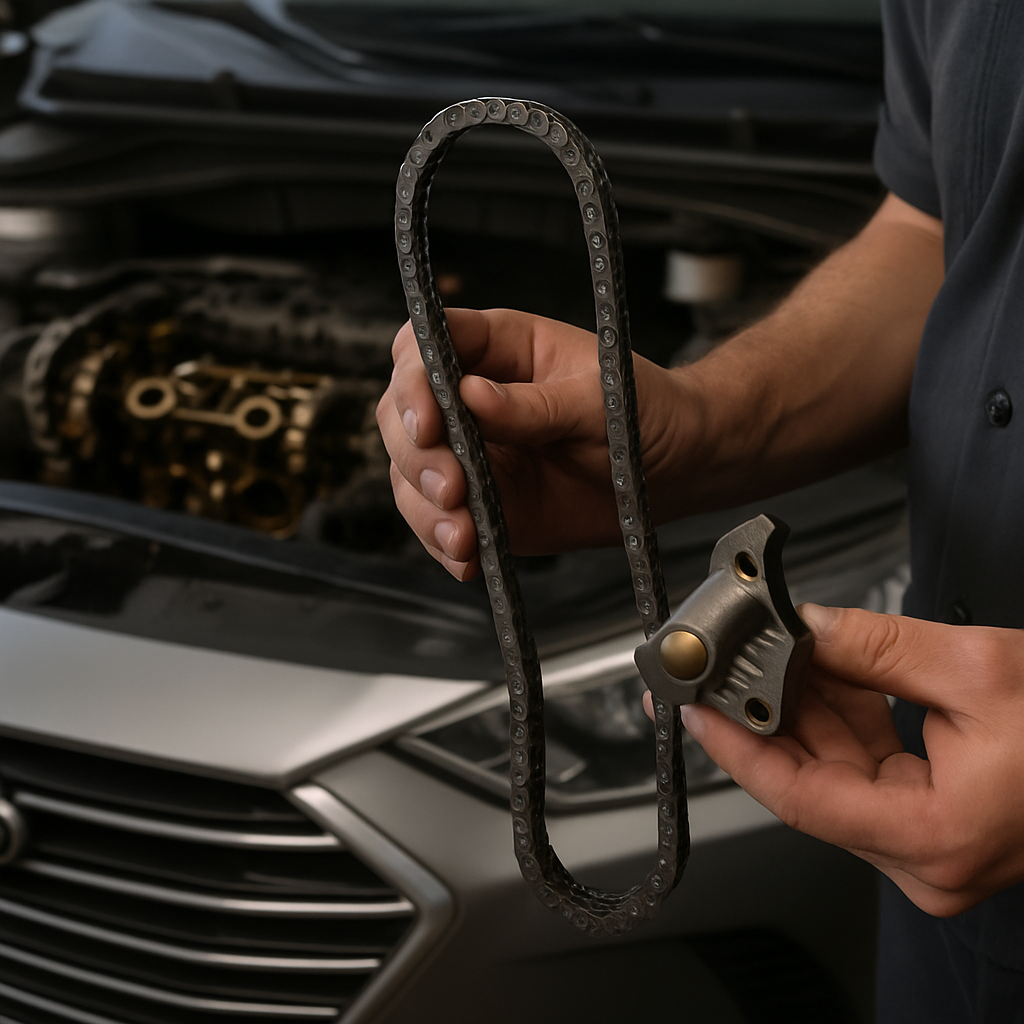
For a 2017 Hyundai Elantra, the clearest published figure in the supplied research is $1,183 to $1,577 for a timing chain tensioner replacement, not a verified all-in price for a complete timing-chain replacement. RepairPal’s 2017 Elantra timing chain tensioner replacement estimate is useful starting context, but the final bill can differ substantially if diagnosis shows that the chain, guides, CVVT-related hardware, camshafts, seals, or other engine components also need work.
In other words, do not use the tensioner estimate as a universal quote for every timing-chain job. Confirm the engine fitted to the car, the component the technician has actually diagnosed, and the complete scope of the proposed repair before approving it.
2017 Hyundai Elantra Timing Chain Replacement Cost: What the Available Estimates Actually Cover
A timing-system repair is not one fixed job. A workshop may be addressing a tensioner concern, replacing timing-system components as a package, correcting timing alignment, or investigating engine damage associated with a timing fault. Those are materially different repairs, even though an estimate may broadly describe them as timing-chain work.
| Cost information available | What it represents | What it does not establish |
|---|---|---|
| $1,183 to $1,577 | An estimated range for timing chain tensioner replacement on a 2017 Hyundai Elantra, according to RepairPal. | A confirmed universal installed price for replacing the complete timing chain and every related component. |
| $65.99 to $148.99 | Listed retail prices for 2017 Elantra timing-chain parts from Advance Auto Parts. | A repair quote, fitted price, or complete kit and labour cost. |
| More than $2,600 plus tax | A single Reddit user’s reported dealer quote for timing-chain and camshaft replacement on a 2017 Elantra with 94,000 miles. | An average, a standard dealer price, or proof that the quote is fair for another car. |
The RepairPal figure should therefore be described precisely: it is a timing chain tensioner replacement estimate. Its published range also makes clear that labour is a significant part of the work, but the supplied material does not provide a complete, usable breakdown of that labour figure.
Why a full timing-chain repair can cost more or less
The total changes with what has actually failed and what must be removed, renewed, or corrected during the repair. Depending on the diagnosis, an estimate may include some combination of the timing chain, tensioner, guides, CVVT-related components, camshaft-related components, gaskets and seals, fluids, diagnostic work, and repair of any damage associated with lost timing.
That is why it is not sound to add a retail chain price to a guessed labour charge and call the result a timing-chain replacement cost. It is also why one owner’s invoice or quote cannot reliably be applied to every 2017 Elantra.
Parts-only prices are not installed repair prices
Advance Auto Parts lists timing-chain parts for the 2017 Hyundai Elantra from $65.99 to $148.99. That range is useful only as retail parts context. It does not include the labour-intensive access work, diagnosis, related parts, gaskets, seals, fluids, taxes, or any additional engine repair that may be needed.
Before comparing a parts listing with a workshop estimate, check whether the quote covers only a single component or includes a broader timing-system repair. A lower retail price is not evidence that an installed repair should be inexpensive.
What an owner-reported dealer quote can, and cannot, tell you
A post on Reddit reported that a dealer quoted more than $2,600 plus tax for timing-chain and camshaft replacement on a 2017 Elantra at 94,000 miles. It is a useful example of how costs can rise when camshaft work is included, but it remains one owner’s report about one vehicle and one proposed scope of work.
It should not be treated as an average price, a benchmark for every dealer, or confirmation that the same repair is necessary on another Elantra. Local labour rates, the exact engine, the underlying fault, and the components included can all change the number.
What to Ask for in a Written Estimate
For a high-labour engine repair, ask for a written estimate that separates the work rather than relying on a single line such as “timing chain”. It should identify:
- diagnostic charges and the technician’s stated reason for recommending timing-system work;
- labour;
- the chain, tensioner, guides, and any other timing-system parts included;
- any CVVT-related or camshaft-related components;
- gaskets, seals, and fluids;
- taxes; and
- any separately priced repair for damage or related components.
Also ask the workshop to confirm the car’s exact engine and the failed component it has diagnosed. The supplied research does not establish that every 2017 Elantra uses an identical parts list or repair procedure, so that confirmation matters before comparing estimates.
If an estimate appears expensive, the most useful question is not simply “Why does a chain cost this much?” Ask what evidence supports the diagnosis, which parts are included, and whether the quote covers a tensioner-only repair, a wider timing-system repair, or additional engine work.
Timing-Chain Symptoms and Diagnosis: Do Not Treat a Code or Warning Light as Proof of a Bad Chain
The available discussions show that owners and technicians have dealt with 2017 Elantra 2.0 timing-chain concerns, including a reported timing-chain jump, timing codes after timing-system work, and jobs involving the chain, CVVT tensioner, and guides. They are useful illustrations of the questions a technician may need to investigate. They do not establish how frequent these faults are, prove a model-wide defect, or diagnose any individual car.
A Check Engine Light, a timing-related diagnostic code, a misfire, rough running, or poor performance is not by itself confirmation of a stretched or jumped chain. Several faults can produce overlapping symptoms, and the root cause may not be the timing chain.
Why diagnosis needs to be specific
Timing-system diagnosis may need to distinguish between the chain itself, the tensioner, guides, CVVT-related hardware, camshaft-related components, timing alignment after earlier work, and another engine-control or ignition issue. A technician should be able to explain the evidence for recommending costly chain work rather than relying on a warning light alone.
For example, the supplied iFixit result concerns a cylinder-three misfire and firing-order question, not a confirmed timing-chain failure. A misfire can be an important fault to investigate, but it must not be presented as proof that the chain is at fault.
Likewise, discussions about timing codes after repairs show why correct diagnosis and verification matter; they do not provide a validated procedure, specification, or diagnosis for another vehicle. This is not a suitable job to approach with improvised timing instructions, assumed timing marks, or unsupported torque values.
When not to continue driving
If the engine is running poorly, making abnormal mechanical noise, losing power, stalling, or a technician suspects jumped timing, avoid continued operation and arrange qualified assessment. That advice is precautionary: it does not mean that every warning light or diagnostic code requires the same response, nor does it identify the cause without diagnosis.
For a less severe concern, request diagnostic confirmation and the technician’s stated reason for recommending chain work before authorising an expensive repair. Keeping the written findings with the estimate can also make a second opinion more useful, because the second workshop can address the reported symptoms and diagnosis rather than merely quoting a generic timing-chain job.
Does a 2017 Elantra Timing Concern Mean There Is a Recall?
The supplied material does not include official Hyundai or NHTSA recall documentation for this question. It therefore cannot establish whether an engine recall exists, whether a particular campaign affects a 2017 Elantra, or whether a given vehicle is eligible for a remedy.
Recall status is VIN-specific. Owners who want to check should use Hyundai’s official recall resources and/or the NHTSA recall database with the vehicle identification number. Do not assume that a timing-system diagnosis is a recall, or that a recall mentioned for another vehicle, engine, production range, or market applies to every 2017 Elantra.
What Mileage and General Reliability Claims Cannot Tell You Here
The repair discussions in the supplied research mention individual vehicles at about 94,000 and 136,000 miles. Those are isolated anecdotes, not evidence of how long a 2017 Hyundai Elantra should last or when its timing components should require repair. Mileage alone does not confirm the need for timing-system work.
Similarly, the supplied sources are too narrow to identify the general “most common problem” with the 2017 Elantra. They concern timing-related discussions and parts pricing, not a comprehensive reliability dataset across engines, trims, systems, or markets. Keep the question focused on the diagnosed issue in the individual car.
Bottom Line
For the search term “2017 Hyundai Elantra timing chain replacement cost”, the most defensible starting figure is the $1,183 to $1,577 estimate for timing chain tensioner replacement, not a confirmed price for every complete timing-chain replacement. Retail timing-chain parts listed at $65.99 to $148.99 and a single owner-reported dealer quote above $2,600 plus tax provide context, but neither can be converted into a universal installed price.
Get an itemised estimate, verify the exact engine and diagnosed failed component, and ask what evidence supports timing-system repair. If the engine has abnormal mechanical noise, poor running, power loss, stalling, or suspected jumped timing, avoid continued driving and seek qualified assessment rather than assuming that a code or warning light identifies the failed part.