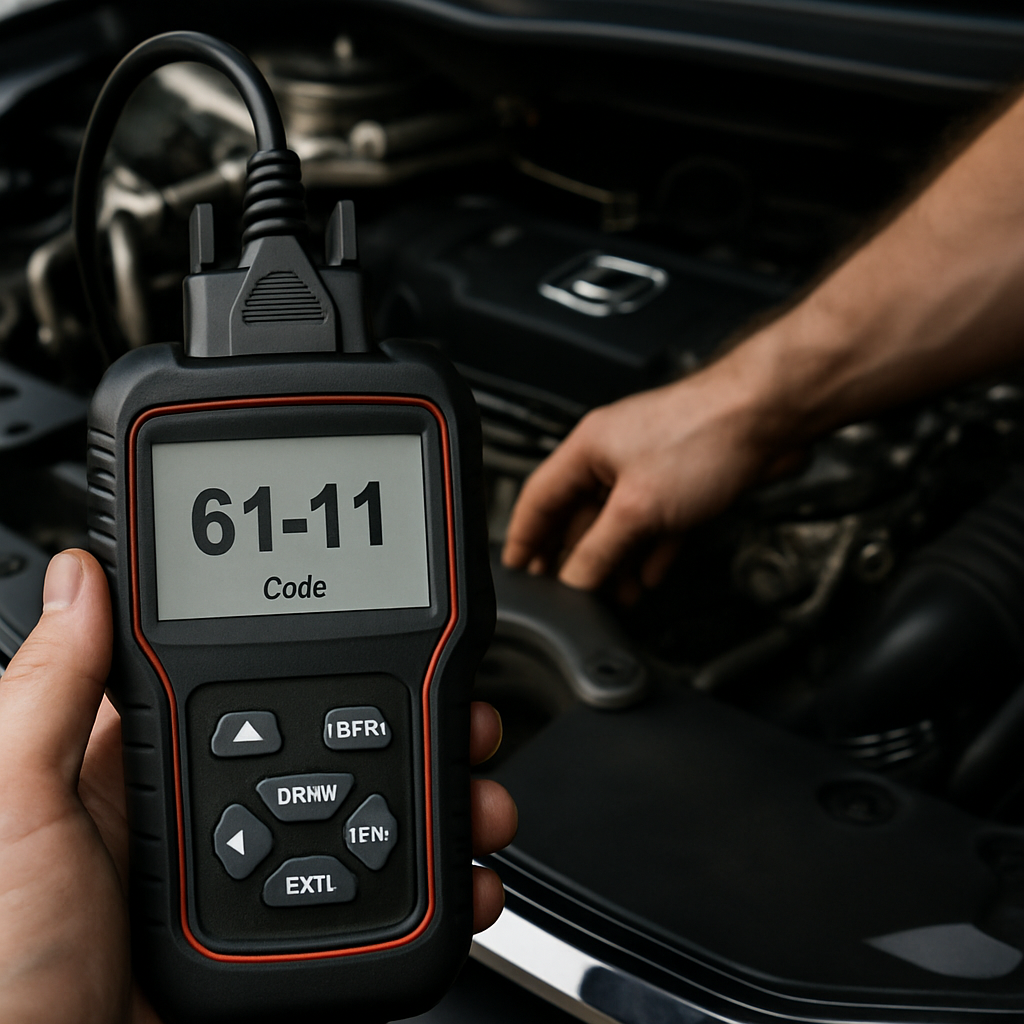
Honda DTC 61-11 indicates that the VSA modulator-control unit has detected low voltage in its power-source circuit, identified in the code description as the IG supply. It reports a low-voltage condition; by itself, it does not identify the failed part or prove that the VSA modulator is defective. The appropriate next step is to confirm the code and test the relevant power supply and connections using service information for your exact Honda.
What Does Honda Code 61-11 Mean?
The code refers to the VSA (Vehicle Stability Assist) modulator-control unit power-source circuit. In plain language, the control unit has detected that voltage at its IG power source was too low under the monitored conditions. A Honda DTC 61-11 explanation uses this same circuit-level description.
Code 61-11 is not a parts verdict. It does not, on its own, confirm a failed modulator, a seat-belt fault, a wheel-speed sensor problem or a particular solenoid fault. Owner discussions sometimes use broader shorthand such as ECU power failure, but diagnosis should follow the exact code definition and the service information for the vehicle.
Accord, Civic and Pilot owners may encounter searches or reports referring to this code, but the available evidence does not establish one procedure that applies to every model or year. If you have a 2013 Civic, an Accord or a Pilot, confirm that the scan tool has retrieved the complete code from the ABS/VSA system, then use the correct year- and configuration-specific diagnostic information. Wiring, test points and specifications can differ.
What Can Cause Low Voltage at the VSA Modulator?
There is no single root cause established by the code alone. A weak battery or a poor ground are reasonable initial areas to check, but they are possibilities rather than confirmed explanations. The supply circuit, its connections and the voltage reaching the control unit may also need to be tested. A Honda Accord owner discussion of code 61-11 illustrates the reported code wording, while a Honda Pilot discussion of VSA codes distinguishes a low-supply-voltage code from separate solenoid codes. These discussions provide context, not a substitute for vehicle-specific testing.
A low-voltage reading should not be confused with an internal modulator failure. Nor does it establish that a separate solenoid or wheel-speed sensor has failed. Do not assume the alternator, battery, ground, wiring or control unit is at fault until testing identifies the cause. There is no universal voltage threshold to apply across Honda models based on the information available here.
How to Diagnose and Address Code 61-11
The correct repair depends on where the voltage loss is occurring and whether the condition is present when tested. A cautious diagnostic sequence is:
- Confirm the exact code. Use a scan tool that can access Honda ABS/VSA systems, not just a basic engine-code reader. Record 61-11 exactly and retrieve any related ABS/VSA codes before clearing anything.
- Check the battery and basic connections. Have the battery condition assessed and inspect accessible battery terminals and ground connections for looseness or corrosion. These are preliminary checks, not guaranteed fixes.
- Test the vehicle-specific power circuit. If the code remains or returns, have the IG feed, relevant connections and voltage at the control unit checked using the correct wiring information and test procedure for the vehicle’s year and configuration.
- Repair only what the tests identify. A confirmed poor connection or supply-circuit problem calls for a different repair from a fault internal to the control unit. Do not replace the VSA modulator simply because 61-11 is stored.
- Verify the result. After the underlying issue is addressed, check whether the code returns under the applicable diagnostic conditions. Clearing the code or restarting the vehicle alone does not show that the fault has been repaired.
Connector pins, wire colours, fuse locations and test limits are vehicle-specific, so they should come from the correct Honda service information rather than a generic online procedure. Circuit measurements and work around the brake-control system are best handled by a qualified technician if you do not have the appropriate equipment and information.
Does Code 61-11 Mean the VSA Modulator Has Failed?
No. The code identifies a low-voltage condition in the modulator-control unit’s power-source circuit; it does not establish that the unit itself has failed. The supply and ground should be checked before an internal control-unit fault is considered. A separate solenoid code is a different finding and should be diagnosed on its own rather than treated as proof of the cause of 61-11.
Is “Initial IG Low Voltage” the Same as 61-11?
Not necessarily. The available video example describes a Honda Pilot DTC 61-01 as an initial-low-voltage condition. That is a different code from 61-11, so its procedure and reported readings should not be transferred to this code. The video discusses checking a fuse/feed and monitoring voltage during a test drive, but that is an anecdotal example for another code and vehicle, not an approved universal 61-11 test or a general pass/fail specification. You can see the 61-01 Honda Pilot example, but use the service procedure matching your own vehicle and full code.
Check every digit and formatting detail on the scan-tool report. The shorthand query 61-1 may refer to 61-1, 61-01 or a mistyped 61-11; these should not be assumed to mean the same thing. Similarly, 83-11 is a separate code, and the available evidence here does not define it. Confirm the exact code and consult matching Honda service information rather than guessing at a definition or repair.
Can You Drive With Code 61-11?
The code alone does not establish whether ABS or VSA functions are available, or whether the vehicle is safe to drive. Pay attention to any ABS, VSA or brake warning indications and to changes in braking behaviour. If braking feels abnormal, a brake warning is present, or you are unsure whether the car can be controlled safely, stop driving and arrange professional assistance. Otherwise, arrange prompt diagnosis rather than assuming the issue is resolved because the warning goes out or the code is cleared.
If ABS or traction-control warning lamps are also illuminated, our guide to what ABS and traction-control warning lights can mean offers general warning-light context. It is not a diagnosis of code 61-11; the fault still needs to be checked on the specific Honda.
Pingback: Chrysler Town & Country P1128 Code: Meaning and Whether You Can Drive - Premier Motoring Blog