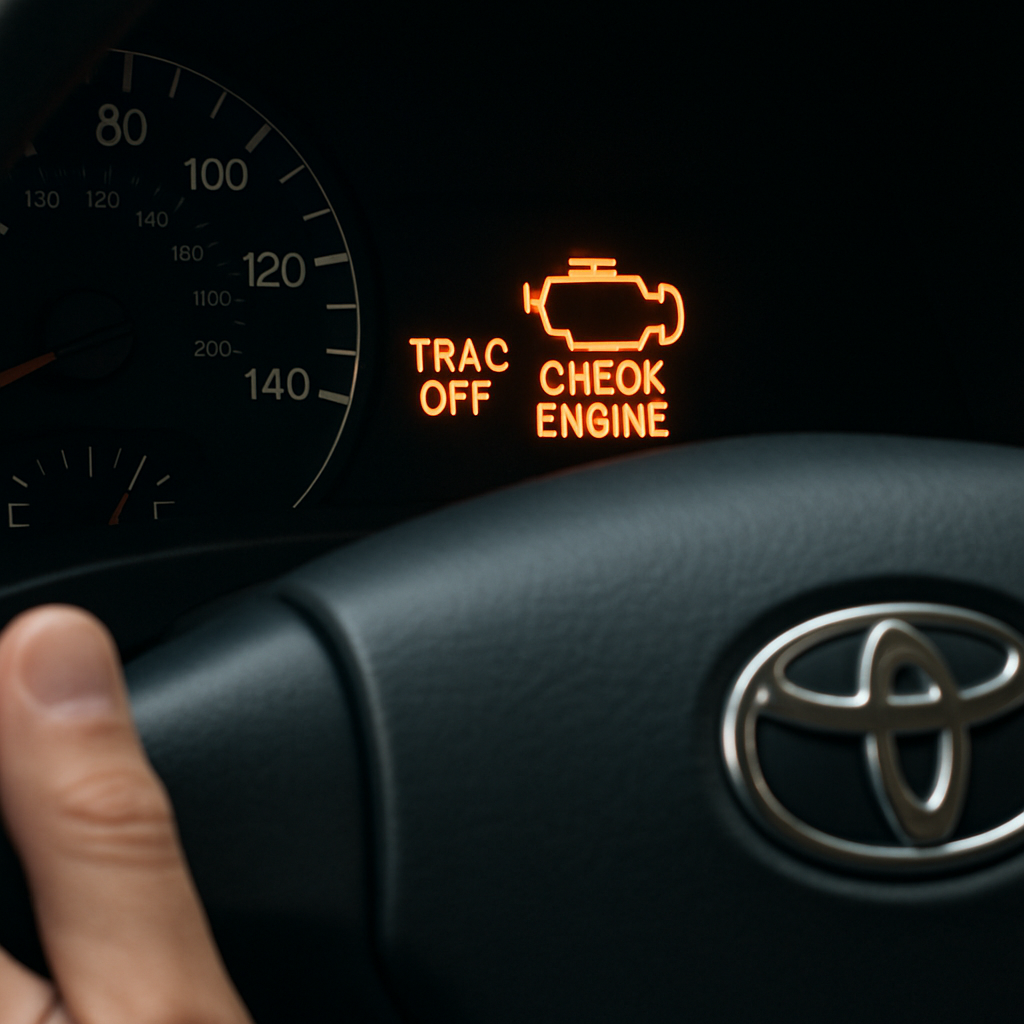
If your Toyota shows TRAC OFF and the Check Engine Light at the same time, the two warnings do not, by themselves, prove that the traction-control system has failed. On some Toyota vehicles, an engine or emissions-related condition that illuminates the Check Engine Light can also make traction control unavailable or switch it off as part of the vehicle’s warning logic. The correct starting point is to read the stored diagnostic trouble codes, not to assume that a particular sensor or component needs replacement.
Why Toyota TRAC OFF and Check Engine Lights Can Come On Together
TRAC is Toyota terminology for traction control. Its purpose is to help manage wheelspin, but it is not a substitute for careful driving, tyres suited to the conditions, or other vehicle safety systems. Toyota indicator names and the interaction among the engine, TRAC, ABS, and Vehicle Stability Control (VSC) systems vary by model, model year, drivetrain, and equipment. Check the owner’s manual for the specific vehicle.
A paired TRAC OFF and Check Engine Light display can occur because an engine-related fault has been detected and the vehicle has made traction-control assistance unavailable. A [Toyota warning-light overview](https://www.youtube.com/watch?v=Np9kBIXRuJg) describes this as a possible Toyota response to an engine problem. That relationship is important: the Check Engine Light and its stored codes are the diagnostic starting point, while the TRAC OFF lamp alone does not identify the failed system or component.
There is also a separate, simpler possibility. A TRAC OFF indicator can illuminate because the driver pressed the TRAC OFF button, whether deliberately or accidentally. As [Toyota Vacaville explains](https://tt-blogs.dealerfire.com/toyotavacaville/what-does-toyota-trac-off-light-mean), this button can disable TRAC and/or VSC, depending on the vehicle. That explanation is most relevant when there is no active Check Engine Light. Pressing the button may restore a driver-selected traction-control setting, but it is not a fix for an active engine warning.
What might be behind the warnings?
The dashboard lights cannot select the cause on their own. The supplied research supports these as non-diagnostic categories to investigate after a code scan:
- A fuel-cap or EVAP-related concern: a missing, loose, or visibly damaged fuel cap can be associated with an evaporative-emissions-system fault.
- Another engine or emissions-related problem: the Check Engine Light can represent many fault conditions, so the code and the vehicle’s symptoms matter.
- A traction, ABS, or wheel-speed-related issue: these systems can also affect traction-control operation, but the two lamps do not confirm a wheel-speed sensor or ABS fault.
Rain, snow, mud, and other slippery conditions can affect when traction control intervenes and may be situations in which a driver temporarily turns it off to free a stuck vehicle. They do not, without diagnostic evidence, explain an active Check Engine Light.
Is It Safe to Drive With TRAC OFF and the Check Engine Light On?
There is no blanket yes-or-no answer. A Check Engine Light can represent a wide range of conditions, and traction-control assistance may be unavailable while the warning remains. If the engine is running normally, the Check Engine Light is steady, and there are no serious symptoms, the immediate priority is to arrange a diagnostic scan and drive cautiously only as necessary to do so. Do not rely on traction control on wet, snowy, muddy, or otherwise slippery roads while TRAC is disabled or unavailable.
Stop driving and seek prompt professional assessment rather than continuing to use the vehicle if there is loss of power, poor running, a flashing Check Engine Light, overheating, smoke, unusual smells, severe vibration, or another serious drivability symptom. These are general escalation signs, not confirmation of a particular Toyota fault.
The [Toyota Check Engine Light guide](https://www.deserttoyota.com/toyota-check-engine-light) likewise distinguishes the TRAC OFF indication from the engine warning and notes that the traction-control button can restore functionality in some circumstances. An active Check Engine Light still requires its own diagnosis.
Safe first checks
- Note when the warnings appeared and record any symptoms, including rough running, reduced power, or whether the condition is intermittent.
- Check that the fuel cap is present, visibly undamaged as far as can be determined, and properly tightened.
- Check whether the TRAC OFF button was pressed. If the Check Engine Light remains on, do not treat the button as the solution.
- Use an OBD-II scanner to read and record stored diagnostic trouble codes. Many automotive-parts stores may offer code scanning, but this is not available at every location.
- Have the fault diagnosed before authorising repairs, particularly if warnings persist or the vehicle has drivability symptoms.
Do not clear codes, disconnect the battery, or replace parts based only on the two lamps. Clearing a warning can erase useful information and does not show that the underlying condition has been corrected.
Tacoma, Corolla, Camry and Highlander: Does the Same Explanation Apply?
The code-first approach applies across these Toyota models: paired lamps can require diagnosis of the Check Engine Light fault and do not independently identify a failed traction-control component. However, the supplied evidence does not provide model-year, engine, drivetrain, hybrid or non-hybrid, wiring-diagram, or owner-manual data for any of these vehicles. VSC, ABS, TRAC, and engine-warning combinations can display differently across Toyota models and years; the presence or absence of a VSC lamp does not confirm a specific fault.
| Model | What the paired lights mean in practice | Appropriate next step |
|---|---|---|
| Toyota Tacoma | The paired warnings do not prove a TRAC component has failed. Owner discussions raise wheel-speed-sensor or wiring damage as a possibility where debris or off-road use is involved, but this is not proof of a fault or evidence that it is a Tacoma-common failure. | Record the exact codes and symptoms, then use the correct model-year manual or a Toyota-capable technician for diagnosis. |
| Toyota Corolla | The same engine-fault/traction-control interaction may apply, but the lamps alone cannot identify a component or repair. | Read the codes and consult the correct model-year documentation or a qualified technician. |
| Toyota Camry | A Check Engine Light with TRAC OFF requires code-led diagnosis; it is not a model-specific diagnosis from the dashboard display. | Check the fuel cap and TRAC setting, record codes, and arrange diagnosis if the warning persists. |
| Toyota Highlander | For a Highlander, the combination can indicate that traction control is unavailable alongside an engine or emissions warning, but it does not establish why. | Obtain the exact diagnostic code and use the appropriate model-year owner’s manual or a qualified Toyota-capable technician. |
Do Not Guess at the Repair: Read the Diagnostic Codes First
A sensible diagnostic sequence is to record the conditions and symptoms, check the fuel cap and whether TRAC OFF was selected, scan for OBD-II codes, and diagnose the reported fault before approving repairs. For a fuller explanation of why a code is a starting point rather than a repair order, see our guide to what diagnostic trouble codes mean and what to do next.
A diagnostic code identifies a system or fault condition that needs investigation; it does not automatically instruct a technician to replace a named part. Proper diagnosis may require testing beyond the scan result, especially where an intermittent electrical fault, an emissions-system concern, or an ABS/traction-control issue is involved.
Online owner discussions associated with these warnings mention fuel-cap and EVAP concerns, catalytic-converter claims, wheel-speed sensors or wiring, shift engagement, oil-pump-related components, and rodent damage. Those anecdotes demonstrate why guessing is unreliable: they are not sufficient evidence to rank causes, diagnose an individual Toyota, or recommend a repair.
Use a qualified technician for persistent Check Engine Light faults, significant drivability symptoms, ABS or traction-control diagnosis, wiring repairs, and emissions or catalytic-converter work. The supplied research does not support Toyota-specific repair-cost ranges, labour times, code-to-component look-ups, sensor-test procedures, parts-fitment advice, or model-specific repair instructions for the Tacoma, Corolla, Camry, or Highlander.
Bottom line: when TRAC OFF and the Check Engine Light appear together on a Toyota, treat the Check Engine Light and stored codes as the priority. Confirm the simple owner-observable items first, drive cautiously if the vehicle is otherwise running normally, and obtain professional diagnosis promptly if there are serious symptoms or the warnings persist.